
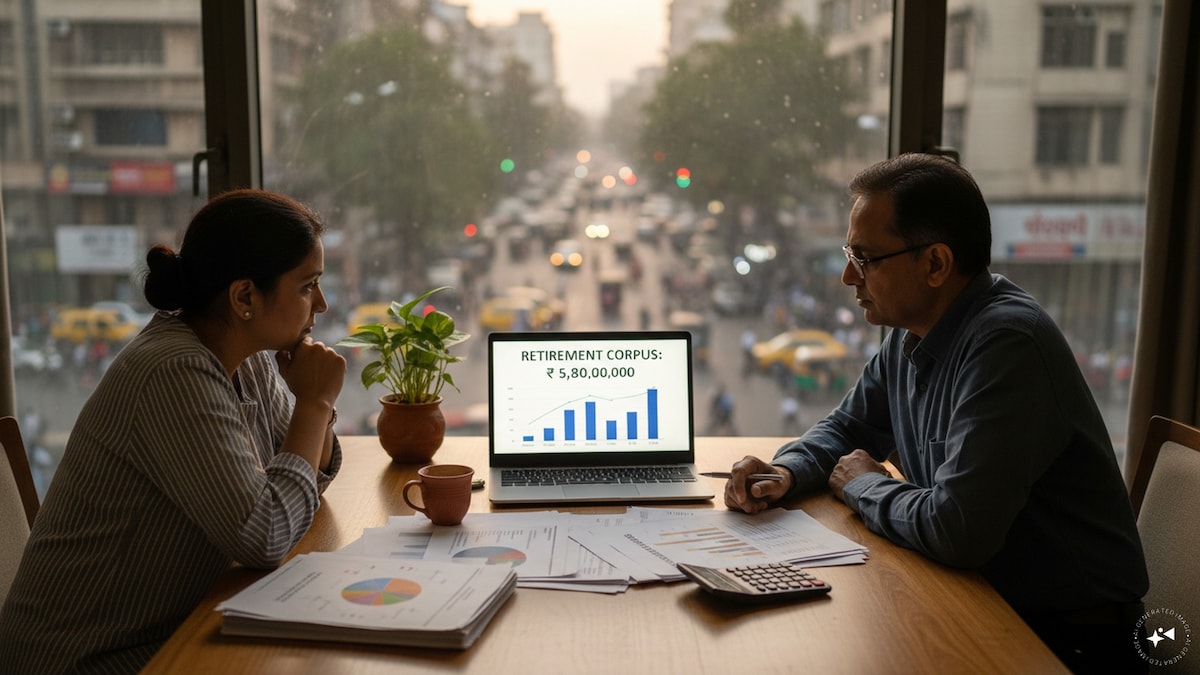
Retirement planning involves estimating future household and healthcare expenses to build a sufficient corpus. Ajay Kumar Yadav said, "Healthcare expenses should be calculated separately because their inflation may differ from that of regular household expenses." Experts suggest assessing current costs and choosing investments that support regular withdrawals during retirement years.
Retirement planning is not just about deciding how much money to accumulate before stopping work. It also involves estimating future household expenses, accounting for rising healthcare costs and choosing investments that can support regular withdrawals over a potentially long retirement period.
Financial experts say individuals should begin by assessing their current expenses and the lifestyle they expect to maintain after retirement. Loan EMIs or children's education costs may end by then, but healthcare, household expenses, travel and other lifestyle requirements could continue or increase.
How much money will you need after retirement?
The first step is to estimate how much today's expenses could grow by the time an individual retires.
For example, a 40-year-old spending ₹50,000 a month on household expenses today would need approximately ₹1.60 lakh a month at 60, assuming 6% annual inflation. If the person spends another ₹10,000 monthly on healthcare and assumes medical costs rise by 10% annually, that expense could increase to around ₹67,275.
This would take the combined monthly requirement to approximately ₹2.28 lakh, or ₹27.32 lakh in the first year of retirement.
Ajay Kumar Yadav, CFPCM, Group CEO and CIO at Wise Finserv, says healthcare expenses should be calculated separately because their inflation may differ from that of regular household expenses. He points to Aon's 2026 Global Medical Trend Rates Report, which projected an 11.5% increase in Indian employer-sponsored medical plan costs in 2026.
This is an insurance-related medical trend projection, rather than a forecast of individual household healthcare expenses over the next 20 years.
The next step is to estimate the corpus required to meet these expenses throughout retirement.
In Yadav's illustration, assuming 30 years of retirement, 6% annual household inflation, 10% healthcare inflation and an 8% annual investment return, the required corpus at age 60 works out to approximately ₹7.66 crore. At a 7% assumed return, the requirement increases to ₹8.78 crore, while at 9%, it falls to around ₹6.74 crore.
These figures are illustrative and assume constant annual investment returns. Actual requirements will depend on market performance, taxation, existing savings, pension income, EPF and NPS balances, and other sources of income.
Rubina Singla, Founder of Equitrust Solutions, says the commonly used 25–30 times annual expenses rule can provide an initial estimate, but may not be sufficient in cases involving longer retirement periods or higher medical expenses. She also suggests using a 3.5% annual withdrawal rate, with withdrawals adjusted for inflation, as a conservative starting illustration.
Ramesh Vishwanathan, CEO of FPSB India, suggests calculating the retirement savings gap by comparing the estimated corpus requirement with existing and expected retirement resources. For instance, if an individual needs ₹3 crore but expects to accumulate ₹2 crore through investments and retirement benefits, the shortfall would be ₹1 crore.
How should you invest at different stages of life?
The investment mix for retirement should reflect the time remaining until retirement, the investor's risk appetite and financial commitments.
In their 20s and 30s, individuals generally have a longer investment horizon and can consider a higher allocation to equity-oriented investments. EPF can provide a savings avenue for eligible employees, while NPS offers a retirement-focused investment structure.
During the 40s and early 50s, the focus should shift towards assessing accumulated savings, existing asset allocation and the amount still required to meet the retirement target. Equity investments can continue to play a role, alongside debt and fixed-income investments.
Singla suggests the following indicative allocation based on the number of years remaining until retirement:
Years until retirementEquityDebt and fixed incomeMore than 25 years70–85%15–30%15–25 years60–75%25–40%5–15 years40–60%40–60%Less than 5 years25–45%55–75%
These are indicative ranges and not a standard allocation for all investors.
Rishi Dhaddha, Country Head at InCred Premier, says that as retirement approaches, capital preservation, liquidity and income planning become increasingly important. However, eliminating equity entirely may not be appropriate, given that retirement could last 30–35 years and the portfolio may still need to address inflation.
Vishwanathan says individuals should assess their overall financial position, risk tolerance and liquidity requirements rather than follow a fixed allocation between investment products.
How can retirees generate regular income from their savings?
Accumulating a retirement corpus is only one part of the exercise. Individuals also need to decide how to use it to meet regular expenses without exhausting their savings too quickly.
Yadav suggests dividing retirement investments into three purpose-based buckets:
Regular income bucket: Instruments such as annuity plans, Senior Citizens' Savings Scheme (SCSS), RBI Floating Rate Savings Bonds and Post Office Monthly Income Scheme can be considered, subject to eligibility and suitability, to meet regular expenses.
Support bucket: Equity savings funds, balanced advantage funds, conservative hybrid funds and multi-asset allocation funds may provide an additional source of funds through systematic withdrawal plans (SWPs). These are market-linked investments and do not guarantee returns or withdrawals.
Growth bucket: Diversified equity mutual funds, including flexi-cap and multi-cap funds, can form part of the portfolio intended to support expenses in the later years of retirement.
The allocation will depend on the retiree's existing pension, monthly expenses, tax position and risk appetite. Someone with a regular pension may have different income requirements from someone entirely dependent on investments.
What mistakes should individuals avoid while planning retirement?
Experts point to a few common gaps that can affect retirement preparedness.
Delaying retirement savings: Yadav illustrates the impact of starting late through a hypothetical ₹10,000 monthly SIP earning a 10% annual return, compounded monthly. It could grow to approximately ₹2.26 crore over 30 years. To accumulate a similar amount over 20 years at the same assumed return, the monthly investment would need to be around ₹29,800. These are mathematical illustrations, not assured returns.
Underestimating future expenses: Planning with today's spending levels can result in an inadequate corpus. At 6% annual inflation, monthly expenses of ₹1 lakh today could rise to approximately ₹3.21 lakh in 20 years.
Relying heavily on one asset: Singla cautions against putting every available rupee into property or children's financial goals. A self-occupied house, for instance, does not automatically generate income to meet regular retirement expenses.
Ignoring the risk of withdrawals during market downturns: Yadav highlights sequence-of-returns risk, where a sharp market fall soon after retirement can affect a portfolio if the retiree has to sell equity investments to meet expenses.
Not accounting for longer life expectancy: Retirement calculations should consider the possibility of living into one's 90s, rather than relying only on average life expectancy. This is particularly important for couples planning their finances together.
How can you balance retirement savings with current financial commitments?
Home loans, children's education and other family expenses can compete with long-term retirement savings. Experts suggest treating retirement contributions as a regular financial commitment instead of investing only what remains after meeting other expenses.
Yadav suggests beginning with an affordable amount and increasing contributions by 5–10% annually, wherever possible, as income rises. Keeping separate savings for foreseeable family goals can also help protect retirement investments from withdrawals.
Dhaddha emphasises consistent savings and diversification, while Vishwanathan says individuals should identify potential savings shortfalls early and adjust their contributions according to their financial circumstances.
Ultimately, retirement planning requires both an accumulation strategy and a withdrawal plan. The corpus needs to support current expenses after retirement while retaining sufficient resources for healthcare, inflation and the possibility of a longer-than-expected retirement.