
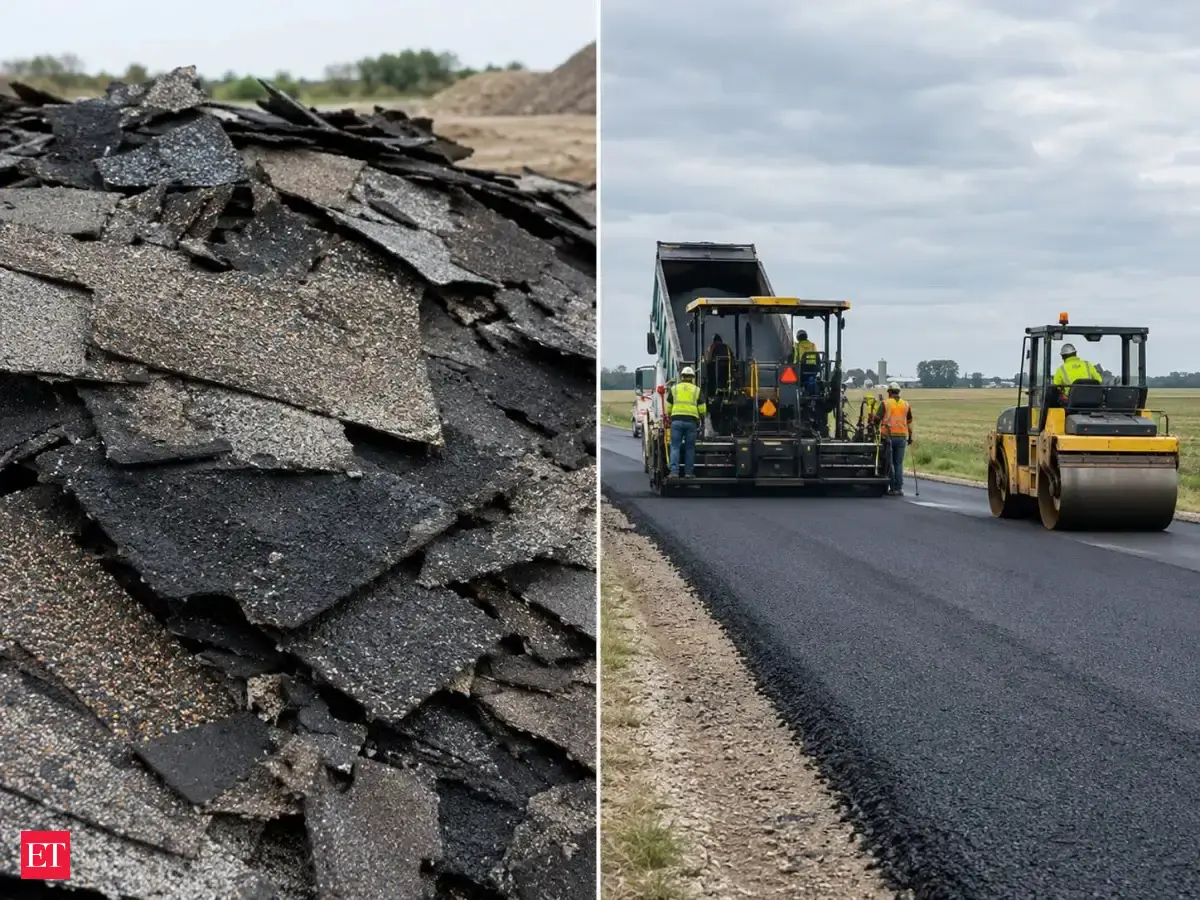
In 1991, Minnesota mixed factory-made shingle scrap into Highway 25 near Mayer. By late 1995, the asphalt performed at least as well as control sections. Engineers used this waste to save landfill space. While the results showed promise, they also saw cracking issues, so the state kept usage limits low.
Engineers in Minnesota have investigated the potential of recycled asphalt shingles for road construction to mitigate landfill waste. Their trials with manufacturer scrap shingles showed promising initial performance in pavement. Nevertheless, issues like cracking and restrictions on the amount of scrap used arose. The federal highway administration has noted inconsistent shingle quality within road mixtures, adding complexity to their usability in construction.
Roof replacements generate large volumes of discarded asphalt shingles, most of which are sent to landfills. In the early 1990s, two Minnesota engineers examined whether some of that waste could instead be incorporated into road construction. Minnesota Department of Transportation researchers David Janisch and Curt Turgeon documented that a 1991-1996 overlay on Highway 25 south of Mayer contained sections made of scrap shingles. By the end of 1995, those sections were performing at least as well as the control section. These findings are notable given that recycled shingles remain a real and sometimes contested part of American road-building.
A test road with a twist
Notably, the shingles used were not torn from residential roofs. Janisch and Turgeon's report specified that every field section used manufacturer scrap, primarily tab punch-outs from a Shakopee factory, with some discoloured or damaged shingles mixed in. The Highway 25 mixes used 5 and 7 percent shingle scrap by weight of aggregate.
An asphalt paving machine. Image credits: Wikimedia Commons
The results were positive, with caveats. The study also found that the main issue on the road was cracking at regular intervals, with no discernible difference between shingle, and control sections. The asphalt recovered from the shingle sections was harder, as expected, and the authors noted that sections with high in-place air voids were at risk of raveling or stripping over time, rather than speculating about what might happen in the future. Their own conclusion was cautious, acknowledging the limits of their data set, and the state had capped manufacturer scrap at 5 percent at the time of the report.
Why anyone bothered
Asphalt binder is the glue that holds a road together, and shingles contain lots of it. Janisch and Turgeon found that each percent of shingle scrap supplied 0.27 to 0.30 percent asphalt cement in wearing-course mixes. The caveat was that the benefit only appears if the cost of processing the scrap is less than the binder it replaced, and the report didn't quantify that.
Asphalt base. Image credits: Wikimedia Commons
Decades later, the
Federal Highway Administration still sees things this way. Its tech brief says that reclaimed shingles can yield initial savings by replacing some of the aggregate and virgin binder in a mixture, and that it keeps the material out of landfills.
The size of the pile
The scale is pretty hard to ignore. According to the Environmental Protection Agency, the US generated 13.5 million tons of asphalt shingle debris in 2014, and about 12.7 million of that came from demolition, a category that includes shingles removed during renovation. Now compare that to what goes into pavement. The FHWA brief estimates annual generation at 13.2 to 17 million tons, with 12 to 16 million tons landfilled. These two figures come from different sources and estimation windows and should not be read as directly comparable, though both point to a similar order of magnitude if waste. Only about 921,000 tons went into asphalt mixtures in 2019, down 12.5 percent from 2018 and the lowest total since 2010, per the same brief.
Factory scrap isn't the same as an old roof
That gap may be partially explained by chemistry. According to the FHWA, factory-waste shingles typically contain about 20 percent asphalt binder, while per the FHWA, post-consumer shingles contain about 30 percent, but the binder is more aged, oxidized, stiff, and brittle. This added stiffness, the brief notes, is likely to reduce a mixture's resistance to cracking.
One FHWA accelerated-loading study, cited in the brief, found that a mix with 6 percent shingles had less than 15 percent of the fatigue life of a virgin-mix control section. Typical shingle content runs 3 to 5 percent by weight, the brief adds, and it lists removing asbestos-containing shingles from the supply stream as one of the voluntary processing practices.
So, is it a good idea?
The evidence is mixed. The Minnesota trial showed that well-regulated factory scrap held up on a real highway during its first several years of service, while federal data indicate that post-consumer roofing material is a more difficult ingredient to work with, and that its volume far exceeds what current paving practices absorb. Taken together, the record suggests that quality control, not broad claims about recycling benefits, is what determines whether shingle-scrap pavement performs.