
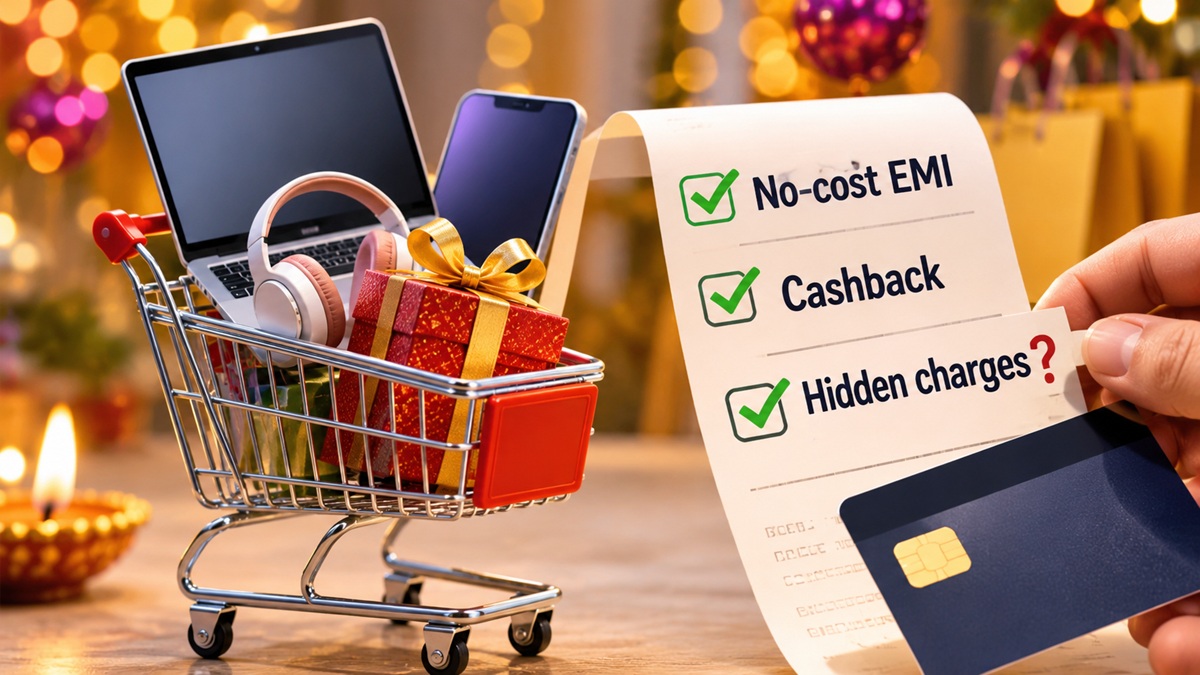
Festive shoppers often face hidden costs with no-cost EMI and cashback offers. Processing fees and GST on interest can make products expensive. Tanish Sharrma, CEO of BillCut, says, “The mistake isn’t choosing EMI. It’s assuming it costs nothing.” Buyers should calculate the total amount payable before choosing any payment option.
For a shopper planning to buy a new laptop, phone or television, the offer may seem like a good way to spread the cost. But there is a catch. The advertised price, the monthly EMI and the cashback amount do not always tell the full story.
Processing fees, GST on interest, the loss of an upfront discount and conditions attached to cashback can change the final cost. The EMI may also look affordable on its own but become difficult to manage when combined with other festive purchases.
This is why shoppers should calculate the total amount payable before choosing a payment option. A no-cost EMI or cashback offer can make sense, but only if the final deal works in their favour.
Tanish Sharrma, Co-founder and CEO of BillCut, says shoppers should not assume that no-cost EMI comes without a cost. The bank may still charge interest, while the seller or manufacturer offers a discount to offset it. The buyer may have to pay for the other charges involved in spreading the payment.
“The mistake isn’t choosing EMI. It’s assuming it costs nothing,” says Sharrma.
No-cost EMI is not always free. Check the extra charges
A no-cost EMI allows a shopper to pay for a product in instalments without bearing the interest cost in the usual way. In many offers, the seller or manufacturer provides a discount to offset the interest charged by the lender.
However, shoppers may still have to pay a processing fee and GST on the interest component. The discount may also mean they give up another offer available to customers who pay upfront.
Sharrma illustrates this with an Rs 80,000 laptop bought through a nine-month no-cost EMI at an interest rate of 15%. According to his estimate, the buyer could pay around Rs 915 as GST on interest and about Rs 235 as a processing fee. This would add approximately Rs 1,150 to the cost.
These figures are illustrative. The actual charges will depend on the lender, the EMI structure and the offer terms.
The important question is whether the additional cost is worth paying. If paying Rs 80,000 upfront would leave a buyer with little money for emergencies, spreading the payment may be a reasonable choice. But if the buyer has enough savings and can get a better upfront discount, paying in full may work out cheaper.
Shoppers should compare the final price under both options rather than rely on the words “no-cost EMI”.
They should also check whether the seller offers a bigger discount for upfront payment. If that discount is available only when the buyer pays in full, choosing EMI means giving up a potential saving.
The Reserve Bank of India (RBI) has previously raised concerns about zero-interest EMI schemes that do not transparently disclose the actual interest and related charges. Its September 17, 2013 circular addressed practices in which interest costs were passed on to borrowers through processing fees and service charges.
Cashback looks attractive, but check the conditions
Cashback is another common feature of festive sales. A shopper may see a Rs 50,000 phone with a promise of Rs 5,000 cashback and assume the final cost will be Rs 45,000.
But that saving may depend on using a particular bank card, meeting a minimum transaction value or satisfying other conditions. Some offers provide an instant discount at checkout, while others credit the cashback later.
The difference matters because an instant discount reduces the amount the buyer pays at the time of purchase. Cashback may require the buyer to pay the full eligible amount first and wait for the benefit to arrive.
Consider a phone priced at Rs 50,000. The seller advertises Rs 5,000 cashback on a particular credit card. Before paying, the shopper should check whether the card is eligible, whether the offer applies to that product and when the cashback will be credited.
If the buyer does not meet the conditions, the expected saving may not materialise.
Shoppers should also check whether the cashback can be used freely or comes as reward points or wallet credit. A benefit that cannot be used for ordinary spending may not be as valuable as cash.
The same applies to discounts that require shoppers to buy additional products. A deal may offer a bigger saving on a bundle, but the buyer could end up spending more on items they did not need.
The right comparison is the final amount paid after confirmed discounts and cashback, not the largest benefit advertised on the shopping page.
Key things to compare before choosing a festive deal
Small EMIs can add up to a big festive bill
The bigger risk is not always one expensive purchase. It is the accumulation of several purchases that look affordable when viewed separately.
A shopper may buy a phone on EMI, a television using a credit card offer and a washing machine through another financing scheme. Each purchase comes with a manageable monthly payment. But all the instalments eventually compete for the same monthly income.
Sharrma says festive overspending often happens through several small purchases spread across two or three cards. The buyer focuses on each monthly payment but fails to account for the combined burden.
His advice is to calculate the total amount payable and add all existing EMIs before taking on another commitment.
As a practical guideline, Sharrma suggests reconsidering a purchase if total EMIs cross roughly one-third of take-home pay. This is a rule of thumb, not a universal limit. A household’s affordable debt level will depend on its income, essential expenses, savings and other financial commitments.
For example, a shopper earning Rs 75,000 a month may find a new EMI of Rs 5,000 affordable. But if the shopper already pays Rs 18,000 towards a home loan and Rs 7,000 towards other EMIs, the additional instalment could leave less room for household expenses and savings.
The shopper should therefore look at the total monthly commitment rather than judge the new EMI in isolation.
A festive purchase should not force someone to cut essential expenses, stop saving for emergencies or borrow again to pay existing bills.
Credit card minimum due can turn a festive deal expensive
Credit cards can make festive shopping easier, especially when sellers offer discounts or cashback. The problem begins when shoppers spend more than they can repay by the due date.
A cardholder who cannot clear the full bill may choose to pay only the minimum amount due. This may help avoid an immediate overdue situation, but it does not clear the outstanding balance or stop interest from accumulating.
The RBI’s credit card directions require issuers to warn customers that paying only the minimum amount every month can stretch repayment over months or years, with consequential compounded interest. The directions also state that the interest-free credit period is suspended when a balance from the previous month’s bill remains outstanding.
This means a shopper who uses a credit card for festive purchases should plan how to clear the bill before making the transaction.
Sharrma gives an example of an Rs 80,000 festive credit card bill. If the cardholder pays around Rs 4,000 every month for a year, the total payments would amount to Rs 48,000. Yet, under his illustrative calculation, around Rs 41,000 could go towards interest and GST, while the outstanding balance could still be around Rs 73,000.
The actual figures will depend on the card’s interest rate, the way the issuer calculates charges and the timing of payments. The example highlights how slowly a balance can fall when interest consumes much of each payment.
Sharrma says credit card interest can be particularly expensive. He cites rates of around 45% a year, along with GST on interest, although the rate charged depends on the card issuer and the customer’s terms.
“The minimum due keeps your card active. It doesn’t get you out of debt,” he says.
A shopper who knows they cannot repay the full amount should compare the cost of carrying a credit card balance with other borrowing options before the bill becomes difficult to manage.
Sharrma illustrates this with an Rs 80,000 personal loan over two years at an interest rate of 16%. The EMI would be around Rs 3,917, with total interest of roughly Rs 14,000. Actual loan rates and charges will vary by lender and borrower.
A personal loan is not automatically the right solution. The point is to compare the full repayment cost instead of allowing a credit card balance to roll over without a repayment plan.
What if you want to close the EMI early?
Shoppers should also check what happens if they want to repay the EMI before the scheduled end date.
Some lenders may charge foreclosure fees or apply conditions that affect the benefit received under a promotional offer. Buyers should check the lender’s terms to understand whether early repayment changes the cost of the transaction.
The same care is needed when a shopper misses an EMI or credit card payment. Late fees, interest and other consequences may apply under the lender’s terms.
Before accepting an offer, read the key conditions on processing fees, interest, repayment dates, early closure and missed payments. Do not rely only on the sales pitch or the amount shown in the monthly instalment box.
When should you choose no-cost EMI?
No-cost EMI is not necessarily a bad deal. It can help a shopper manage cash flow, especially when paying upfront would significantly reduce emergency savings.
It may make sense when the product price is competitive, the additional charges are reasonable and the monthly instalments fit comfortably within the household budget.
Paying upfront may be better when the seller offers a larger discount, the EMI adds significant charges or the buyer already has several loan commitments.
Cashback can also be useful, provided the buyer qualifies for the offer and understands when and how the benefit will arrive.
The key is to compare the actual cost of the available options. A large cashback does not automatically make an expensive product cheaper, and a small EMI does not automatically make it affordable.
The final check before you pay
Before completing a festive purchase, shoppers should ask themselves three questions.
First, how much will the product cost after all confirmed discounts, processing fees, taxes and other charges? Second, can the monthly instalment fit into the budget after accounting for existing EMIs and essential expenses? Third, can the full credit card bill be repaid by the due date?
If the answers are unclear, it is worth pausing before making the purchase.
Festive deals can offer genuine savings and useful payment flexibility. But shoppers should compare the final cost, understand the conditions and make sure the purchase does not put their savings or monthly budget under pressure.