
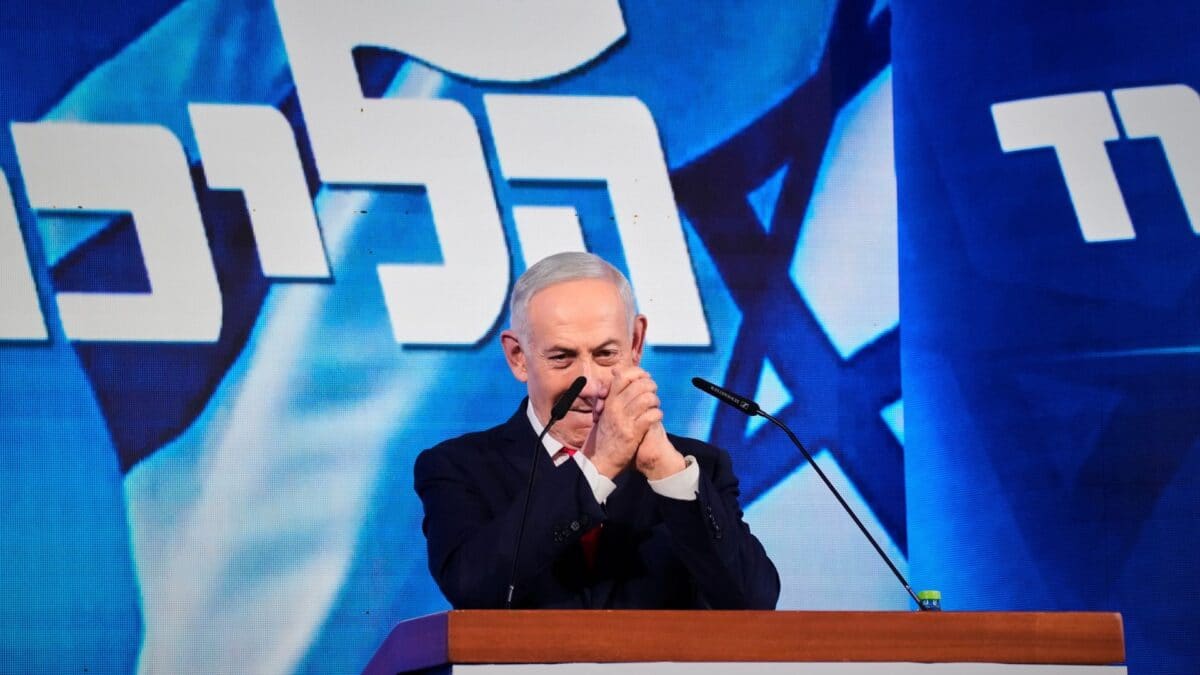
Israeli Prime Minister Benjamin Netanyahu’s allies intensified pressure on Arab parties over unproven Qatar funding claims after Tuesday’s election. With the 120-member Knesset deadlock persisting, Likud said, “The Raamgate scandal is a political earthquake.” Neither bloc reached the 61 seats needed to form a government as vote counting nears completion.
Israeli Prime Minister Benjamin Netanyahu’s allies have intensified pressure on Arab political parties over unproven allegations of foreign funding, raising the stakes in efforts to form a government after an inconclusive election left neither the ruling bloc nor the opposition with a parliamentary majority.
National Security Minister Itamar Ben Gvir called on Israel to order the immediate arrest of Arab party leaders, while Netanyahu’s Likud party accused the Arab-led Raam party of receiving money from Qatar. Government officials, however, have not provided evidence to substantiate the allegations.
The developments come as Israel nears the completion of vote counting from Tuesday’s election, which saw Arab parties make significant gains but left the political balance in the 120-member Knesset unresolved.
With nearly 93% of the votes counted, Netanyahu’s bloc was projected to win 53 seats, while the opposition grouping led by former military chief Gadi Eisenkot was set to secure 48. Both remain short of the 61 seats required to form a government. The two main Arab political groupings were projected to win a combined 19 seats, potentially giving them the numbers to help the opposition reach a majority.
The allegations against Raam could make cooperation with Arab lawmakers more politically difficult for Eisenkot, who has faced repeated attacks from Netanyahu over the prospect of an opposition government relying on Arab parties.
Qatar allegations raise political tensions
Supreme Court Justice Noam Sohlberg, a conservative who heads Israel’s Central Election Commission, requested an investigation by the Shin Bet security service into allegations that Raam received funding from Qatar, a Gulf state that maintains channels of communication with Hamas.
“The Raamgate scandal is a political earthquake. Israel's elections have been stolen!” Likud said in a statement.
The government has not presented evidence to support the allegations. Netanyahu himself has faced scrutiny over Qatar-related allegations following the arrests last year of two of his aides on suspicion of receiving payments from the Gulf country.
For years, Netanyahu tacitly supported Qatari funding to Gaza, which was governed by Hamas, in the hope of preserving stability. That approach collapsed on October 7, 2023, when Hamas carried out its deadliest attack on Israel.
The election also exposed tensions over the position of Israeli Arabs, descendants of Palestinians who remained in the country after its establishment in 1948. Their parties made substantial gains amid anger over calls by ministers, including Ben Gvir, to treat the minority community like Israel’s approach towards Palestinians in Gaza and the occupied West Bank.
Opposition faces pressure over Arab alliance
Yousef Jabareen, leader of the leftist, Arab-majority Joint List, said on Wednesday that he was willing to cooperate with opposition parties to remove Netanyahu from power, but not to join an opposition-led government.
Jabareen said his priority was to end what he called “Netanyahu's blood-soaked government”. He also acknowledged significant differences between Arab lawmakers and Eisenkot, who has largely supported Israel’s military campaign in Gaza following the October 7 attack.
Eisenkot said he was receiving updates on the allegations and pledged “utmost vigilance” against election interference. He also warned against allowing political actors to use the controversy to influence the timing of the inauguration of the 26th Knesset.
Avigdor Lieberman, a right-leaning ally of Eisenkot, described the allegations as “dramatic and unprecedented” and called for a swift investigation.
Israeli police said they would investigate every complaint concerning the integrity of the election.
The latest allegations follow earlier accusations by Netanyahu that Arab parties were attempting to manipulate the vote. He had cited reports of cash-filled envelopes and urged his supporters to turn out in greater numbers. Police arrested three suspects, but the Central Election Commission described the incident as an isolated local case.
Possible Iran conflict adds to uncertainty
The political deadlock is unfolding amid concerns that Israel could return to war with Iran alongside its ally, the United States. Netanyahu has repeatedly threatened to strike Iran, while US President Donald Trump has signalled that Washington could launch further attacks after next Tuesday’s US midterm elections.
Trump’s Republican Party is forecast to lose ground in those elections, adding another layer of uncertainty to the regional situation.
Eisenkot has warned the military that Netanyahu has no mandate to act for political reasons and said officers must not respond to the prime minister’s “political needs”.
A renewed attack on Iran could increase pressure on Eisenkot to reconsider his opposition to joining an emergency unity government. He has publicly ruled out that option, while continued political deadlock could eventually lead to another Israeli election.
President Isaac Herzog will decide whom to give the first opportunity to form a government after the official election results are published.