
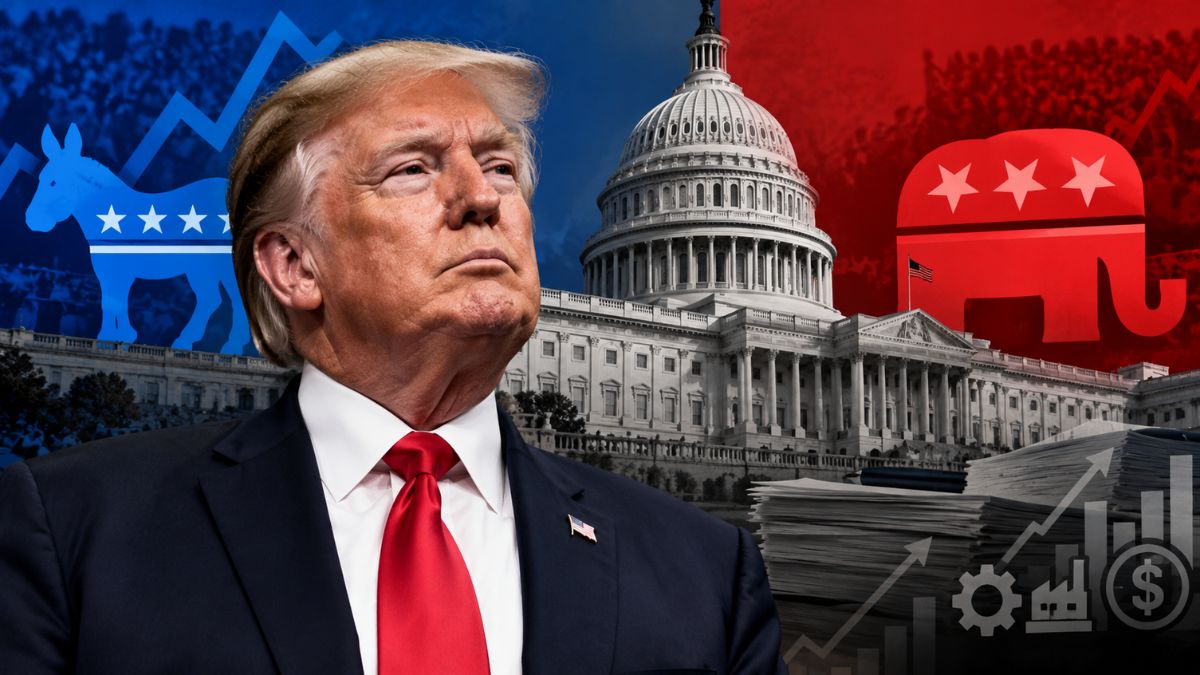
The Morgan Stanley Institute said the November elections are unlikely to bring a major shift in the administration’s core policy agenda. Ariana Salvatore said, "the midterms are unlikely to change the core executive-led policy agenda." Even if Congress changes, many policies on trade and deregulation will likely stay the same.
According to the Morgan Stanley Institute, the November elections are unlikely to bring a major shift in the administration’s core policy agenda. Even if Democrats gain control of the House of Representatives or both chambers of Congress, a divided government could make it harder to pass major legislation.
Instead, the effects of the elections may be felt through greater congressional oversight, continued policymaking by federal agencies and a growing role for state and local governments in deciding where and how AI infrastructure can expand.
Affordability is expected to remain a key issue for voters, but the election outcome may not translate into significant changes in the policies shaping markets and businesses. Ariana Salvatore, head of US public policy research at Morgan Stanley, stated that the midterms are unlikely to change the core executive-led policy agenda.
A change in Congress may not mean a change in policy
A change in congressional control could create political friction in Washington, but it would not necessarily result in a major policy reversal. If Democrats win control of the House, the Senate or both, passing large, partisan legislation could become more difficult. One key factor is budget reconciliation, a process that allows certain fiscal legislation to pass the Senate with a simple majority. A change in congressional control or divided government could limit the scope for using this route.
President Trump could also veto legislation passed by a Democratic-controlled House and Senate, making major policy changes harder to enact.
Much of the administration’s agenda on trade, tariffs, deregulation, immigration and foreign policy is being implemented through executive action and federal agencies. These policies could therefore continue even if Republicans lose control of one or both chambers of Congress.
The more immediate change could come from increased congressional scrutiny of the president and his administration. Federal agencies may also assume a greater role in policymaking as legislative action becomes more difficult. This means the political balance in Washington may change without necessarily changing the policies that currently influence business decisions.
Fiscal policy and markets may see limited change
Fiscal policy is another area to watch, although Morgan Stanley expects the direction to remain largely unchanged after the elections. Neither party has a strong incentive to pursue substantial spending cuts or tax increases, limiting the likelihood of a major shift in the government’s fiscal approach.
However, a divided government could make it harder to approve large-scale fiscal support. Negotiations over government funding, the debt ceiling and defence spending could also become more contentious, increasing uncertainty around budget decisions.
The United States’ national debt crossed $40 trillion for the first time in August, adding to concerns surrounding government borrowing. Morgan Stanley expects political disputes over funding and debt limits to generate more uncertainty than actual changes in fiscal policy.
Markets are also unlikely to see an immediate reversal in the major policy drivers that have shaped recent performance. Tariffs are already an established market factor, tax policy has largely been set, and much of the administration’s deregulation framework is in place.
Morgan Stanley Research noted that periods of elevated policy uncertainty and related market volatility since January 2025 have largely been linked to executive actions rather than legislative decisions. Fiscal policy and deficit-financed stimulus have also supported strong nominal economic growth in the US.
Historical market performance offers another perspective. According to Morgan Stanley Wealth Management’s Global Investment Office, the S&P 500 recorded its strongest average performance in the year following midterm elections when a Republican president governed alongside a split Congress. Average returns in this scenario were 23%. When a Republican president faced a Democratic Congress, average performance in the following year was 15%.
These historical figures, however, do not guarantee similar returns after the upcoming elections. Jim Caron, chief investment officer of the Portfolio Solutions Group at Morgan Stanley Investment Management, cautioned investors against assuming that divided government automatically benefits markets. He said investors should assess longer-term policy implications and identify the companies and sectors likely to be affected rather than react to the initial market response.
AI data centers may face more conditions on expansion
AI infrastructure could become a more significant area of political debate after the midterms. The expansion of data centers has raised concerns over electricity costs, pressure on local infrastructure and the impact on communities. These issues have prompted debate across both Republican-led and Democratic-led states.
Governors in New York, Virginia and Texas have introduced executive orders, frameworks and audits related to data center development, focusing on the growing role of state governments in determining how projects proceed.
Morgan Stanley expects this trend to continue, describing the outlook as a “conditional buildout”. Under this approach, AI infrastructure investment would continue, but development could become concentrated in regions where projects meet local requirements and address community concerns.
Ariana Salvatore said the elections could have meaningful consequences at the local level, with investment continuing in selected regions depending on community engagement and other mitigation measures.
Data center developers could increasingly be expected to absorb energy costs, contribute to new infrastructure, accept different tax and utility arrangements or address concerns raised by residents. Such agreements could also affect utilities, transportation and other industries that stand to benefit from AI-related investment.
Despite these conditions, the scale of the expected expansion remains substantial. Morgan Stanley Research forecasts $1.5 trillion in capital expenditure by hyperscalers in 2027.
National security considerations could also support continued investment. US policymakers have argued that restrictions on data center development could weaken the country’s ability to compete with China, particularly as access to electricity and computing capacity becomes more constrained.
Morgan Stanley Research has forecast that US data center developers will face a power shortfall of more than 30% through 2028. Federal legislation on AI is likely to move more slowly, while a nationwide pause on data center development remains unlikely. State and local governments could therefore have greater influence over decisions that directly affect individual projects.
What investors and companies should watch
The midterms may change the political environment without fundamentally changing the economic policies already in place. Morgan Stanley recommends staying disciplined and looking beyond short-term political headlines for investors. Political disagreements and legislative gridlock can sometimes limit sudden policy changes, potentially supporting market stability.
Monica Guerra, head of policy and geopolitical strategy at the Wealth Investment Office, said investors should pay attention to actions taken by state and local governments rather than focusing only on political disputes in Washington. She also encouraged investors to work with their financial advisers to identify opportunities instead of reacting to headline-driven volatility.
For companies, a divided government would not mean an end to policymaking. Businesses should prepare for increased congressional oversight, continued action by federal agencies and greater state and local influence over AI infrastructure.
Josh Wilsusen, head of government relations at Morgan Stanley, said companies should expect important decisions on AI infrastructure to increasingly emerge at the state and local levels. He also noted that the technology industry’s response to criticism of data centers could develop into a stronger counter-narrative, leaving room for bipartisan agreement.
The focus is that the elections may not determine whether the US continues investing heavily in AI, but they could influence where that investment takes place and what developers must do to secure approval. For markets and businesses, the next phase may be less about a sweeping policy shift in Washington and more about how existing policies are implemented on the ground.