
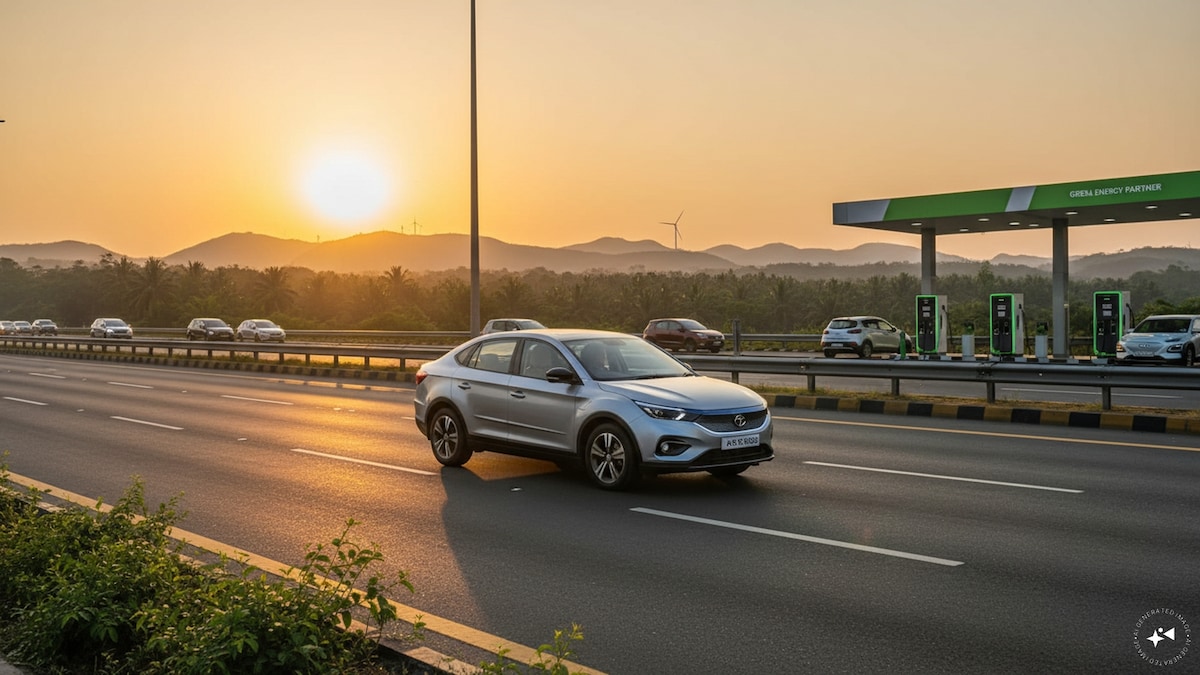
Maharashtra aims for electric vehicles to reach 30% of new registrations by 2030. Chief Minister Devendra Fadnavis said the state is building charging corridors on key highways like the Samruddhi Mahamarg. The government now wants to shift focus toward advanced automotive software, artificial intelligence, and battery technology for global markets.
Maharashtra is scaling up charging corridors and battery recycling facilities to position the state as a global future mobility hub, shifting focus from traditional manufacturing to advanced automotive software and artificial intelligence. Find out how luxury automakers plan to leverage this expanding ecosystem for wider export markets.
Maharashtra Chief Minister Devendra Fadnavis has said that the state aims for electric vehicles to account for 30% of all new registrations by 2030 under its EV policy.
The Maharashtra government is working to transform the state from a major automobile manufacturing hub into a global centre for future mobility, Fadnavis said at the launch of Mercedes-Benz's all-new GLC Electric at the company's Chakan facility in Pune district on Wednesday.
"Under the state's electric vehicle policy, we have set a target of ensuring that 30% of new vehicle registrations are electric by 2030," he stated.
The government is promoting fast-charging infrastructure along highways, sustainable mobility corridors along the Mumbai-Pune Expressway and (Mumbai-Nagpur) Samruddhi Mahamarg, and battery recycling facilities, the CM maintained.
Maharashtra's ambition extended beyond vehicle manufacturing to establishing global leadership in electric vehicles, battery technology, power electronics, semiconductors, artificial intelligence, automobile software, design and research and development, he noted.
"The future vehicle will not merely be a vehicle running on four wheels. It will be an integrated mobility platform combining computing, energy systems and artificial intelligence. Maharashtra is ready to lead this transformation," Fadnavis emphasised.
The chief minister further said Maharashtra accounted for more than 20 per cent of India's total automobile production, with Pune city and adjoining Pimpri-Chinchwad industrial township emerging as major automotive manufacturing clusters.
The state was now moving from 'Make in Maharashtra' to 'Innovate in Maharashtra', with an emphasis on research, engineering, technology development and innovation alongside manufacturing, he stressed.
Fadnavis urged Mercedes-Benz to use its Chakan unit not only to cater to India, but also to manufacture vehicles for wider Asian and global markets. He called upon the German luxury car maker to consider Maharashtra as a centre for future battery technology, software engineering and mobility research.
Highlighting the state's infrastructure advantages, he said the new Navi Mumbai International Airport, the one proposed at Purandar in Pune district and Vadhavan Port in Palghar district adjoining Mumbai would further strengthen Maharashtra's connectivity with global markets.
He said around 650 prospective customers had expressed interest in the newly launched GLC Electric within just 36 hours of its launch.
The Mercedes-Benz's Chakan facility provides direct jobs to around 1,200 persons, while its supplier and service ecosystem generates employment opportunities for another 18,000 people, Fadnavis said. The German auto giant has invested around ₹3,200 crore in its Maharashtra operations.
Deputy Chief Minister Sunetra Pawar, who was also present at the event, highlighted that Mercedes-Benz had made a significant contribution to Maharashtra's industrial development over the past three decades.
She said the commencement of local production of electric vehicles marked an important milestone and demonstrated Pune's readiness for the future of mobility.
The state government would extend full support to industries and work towards resolving issues faced by investors, she added.
Mercedes-Benz Group AG supervisory board chairman Martin Brudermüller, chairman of the board of management and global head Ola Kallenius, chief technology officer Joerg Burzer and Mercedes-Benz India managing director and CEO Santosh Iyer were among those present at the event.