
Calcutta has no direct flights to Europe or the US in the winter schedule that started on October 25, 2026. Airlines said rising fuel costs and the war in West Asia forced them to suspend services. An official said, "None has approached us," as the aviation crisis continues to grow.
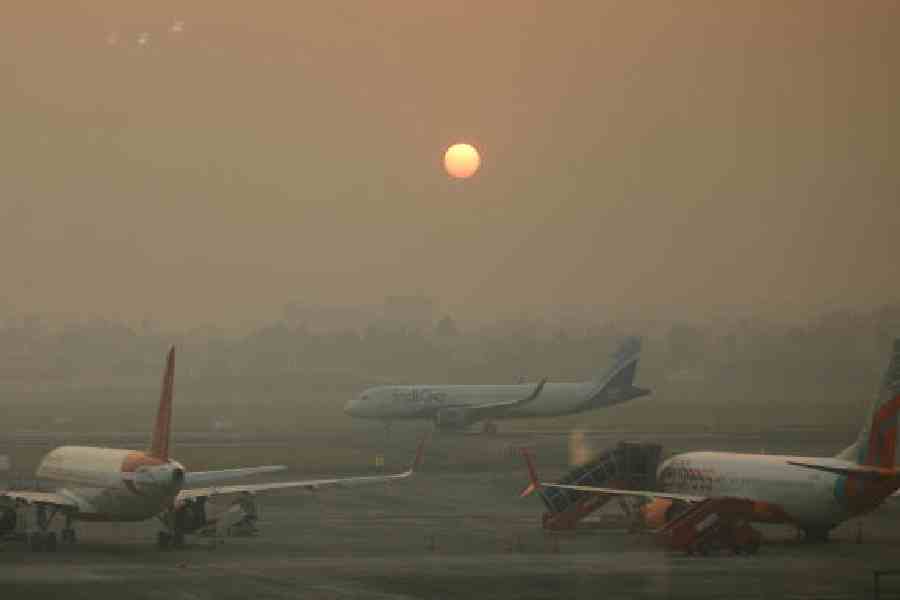
An IndiGo aircraft taxis at the Calcutta airport. The airline has suspended its London services amid rising operating costs and geopolitical tensions. (File picture)
The city's hopes of getting a direct flight to London remain distant, as airlines recently announced a winter schedule with no direct connections from Calcutta to Europe or the US.
Sources in Indian carriers said the war in West Asia, which has forced Europe-bound flights to take longer routes, rising fuel costs and declining passenger numbers had prompted airlines to suspend some services.
The winter schedule, which began on October 25, 2026, will remain in force until March 27, 2027. Air India has suspended select European routes, including flights from New Delhi to Vienna and Birmingham. IndiGo has also halted its London services, sources said.
In October, Union civil aviation minister Kinjarapu Rammohan Naidu said the Centre would take up with domestic airlines the proposal for direct flights from Calcutta to London and other European cities, following a request from chief minister Suvendu Adhikari.
At the Calcutta airport, IndiGo has restored international services to destinations such as Singapore, Shanghai in China and Siem Reap in Cambodia, which it had suspended for several months, officials said.
However, the winter schedule has no direct flights connecting Calcutta to Europe, they said.
The airport is handling 420 domestic flights a day in the winter schedule, up from 390 in the summer schedule. The number of international flights, including arrivals and departures, has risen to 60 from 50.
However, airport officials cautioned that the increase in flight numbers did not necessarily indicate growth in the aviation sector.
"Initially, in the summer schedule, between April and June, there were more flights. However, the numbers dipped as fuel prices started rising, passenger numbers fell, and the war in the Gulf region forced flights to take longer routes. The airlines began incurring heavy losses," an airport official said.
"We were expecting some airlines to show interest in starting a direct flight to London, but none has approached us. This could be because of the ongoing crisis in the aviation industry," the official said.
An Air India source said the airline's Europe-bound flights had to spend an additional two and a half to three hours in the air to avoid conflict zones in West Asia.
"This has also forced flights to make technical stops at Vienna and Rome. The additional fuel consumption, coupled with rising aviation turbine fuel (ATF) prices, has pushed up costs. The airline is, therefore, not looking at introducing new flights to Europe at the moment," the source said.
IndiGo, another Indian carrier that could potentially operate direct flights to Europe, discontinued its wide-body aircraft operations from October 25. Such aircraft are used on long-haul routes, including Calcutta-London, said aviation experts.
The airline, which had suspended services to Singapore, Shanghai and Siem Reap in July, has resumed flights on these routes. However, IndiGo sources said its London operations from India had been put on hold.
"Due to the challenging operating environment triggered by the ongoing geopolitical tensions, IndiGo today announced that it will discontinue its wide-body operations effective 25 October 2026 and conclude its damp lease agreement with Norse Atlantic Airways effective 31 October 2026," the airline had said in a statement.
"The airline will temporarily discontinue its services to and from London Heathrow until such time that its A350-900s are delivered," it said.
IndiGo had entered into a damp lease agreement with Norse Atlantic Airways for six Boeing 787-9 aircraft in early 2025. The arrangement had enabled the airline to launch services to destinations in the UK and Europe.
"The operating environment, however, has changed considerably since the programme was announced, with significant escalation in costs. Airspace constraints, elevated fuel costs and currency pressures have impacted route efficiency, schedule integrity, connectivity and overall competitiveness. These factors have created operational and economic challenges at a time when volatility across aviation markets has reduced industry-wide risk appetite, prompting a comprehensive review of the project and evaluation of possible alternative solutions," the airline had said.
Tour operators said high airfares and longer flying times were discouraging many passengers from travelling to Europe.
"Earlier, it would take months during the festival season to get a visa interview slot for the Schengen countries. Now, slots are available within two days because of a lack of demand," said Anil Punjabi, chairman (east), Travel Agents Federation of India.