
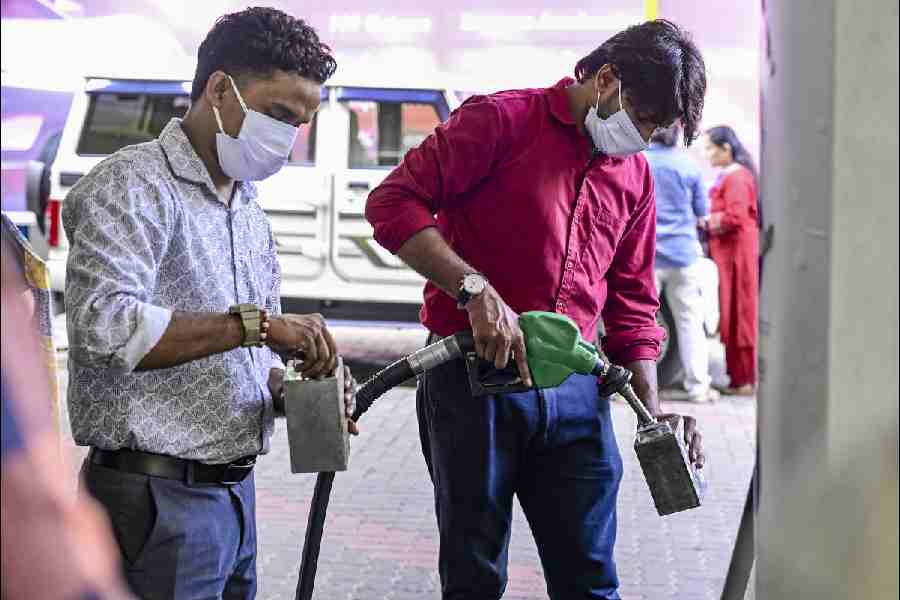
The Keralam government started surprise checks at fuel pumps on Monday to test ethanol levels in petrol. Officials collected samples across five districts to ensure blending stays within the 20 per cent limit. Minister Anoop Jacob said, "Consumers have the fundamental right to know the exact composition of the fuel."
Officials collect fuel samples at a pump in Thiruvananthapuram on Monday. PTI
The Keralam government on Monday conducted surprise sample collections at random fuel retail outlets in five districts to determine whether ethanol blending in petrol had exceeded the permissible level of 20 per cent.
The checks are being conducted against the backdrop of a similar drive in neighbouring Karnataka during which 63 petrol samples were found to have 30 per cent ethanol content.
A day after Keralam food and civil supplies minister Anoop Jacob said department officials would collect random samples in Thiruvananthapuram, Kochi, Kozhikode, Thrissur and Kannur, the officials started the exercise on Monday.
"We asked oil company representatives to be present wherever the civil supplies officials were collecting the samples. The next step was to send the samples to the government's chemical labs. Depending on the test outcomes, we will take further steps, if necessary. Consumers have the fundamental right to know the exact composition of the fuel they are buying. We are yet to receive complaints from motorists in Keralam regarding a high level of ethanol being blended in petrol," Jacob said.
The officials visited several gas stations across the five districts to collect samples of "petrol blended with 20 per cent ethanol" for chemical analysis. They took the samples in the presence of Oil Marketing Company (OMC) representatives for analysis.
"Fuel samples were collected from two pumps in Thiruvananthapuram. Six samples were collected from each station, and the results are expected within 10 days. The samples will be sent to a lab accredited by the National Accreditation Board for Testing and Calibration Laboratories (NABL) for analysis," S.R. Smitha, Thiruvananthapuram district supply officer, told The Telegraph.
Karnataka minister
Rizwan Arshad, Karnataka's minister for food and civil supplies and consumer affairs, rejected the OMC's explanation that the ethanol issue was limited to a few outlets. On Monday, Arshad said the state government stands by its finding that petrol samples collected in Karnataka contained more than 20 per cent ethanol.
The state government released its test findings on Friday, leading to an awkward situation for oil companies, but the Centre rejected the results. The Karnataka government's revelations raised concerns about potential financial losses to motorists.
Speaking to reporters on Monday, Arshad said ethanol blending with petrol was an automated and controlled process. "Six one-litre samples were collected: two were given to the dealer, two were retained by the oil company/department, and two were sent to a designated NABL-accredited laboratory. The sample labels must carry the joint signatures of all the concerned parties," he said.
Later, he wrote on X that the Karnataka government's petrol tests were conducted strictly in accordance with the Motor Spirit and High Speed Diesel Order, 2005, ensuring complete transparency at every stage.
"Every sample was collected in the presence of petrol bunk owners and company representatives, with due signatures and acknowledgements from all stakeholders. When the OMCs' laboratories failed to report ethanol percentages in the initial 63 samples, Karnataka approached independent NABL-accredited, ISO-certified and BIS-recognised laboratories for verification. If the sampling process was transparent and the laboratories were accredited, why are the findings being questioned instead of answering the actual question: What is the ethanol percentage in the petrol being sold to consumers?" Arshad said.