
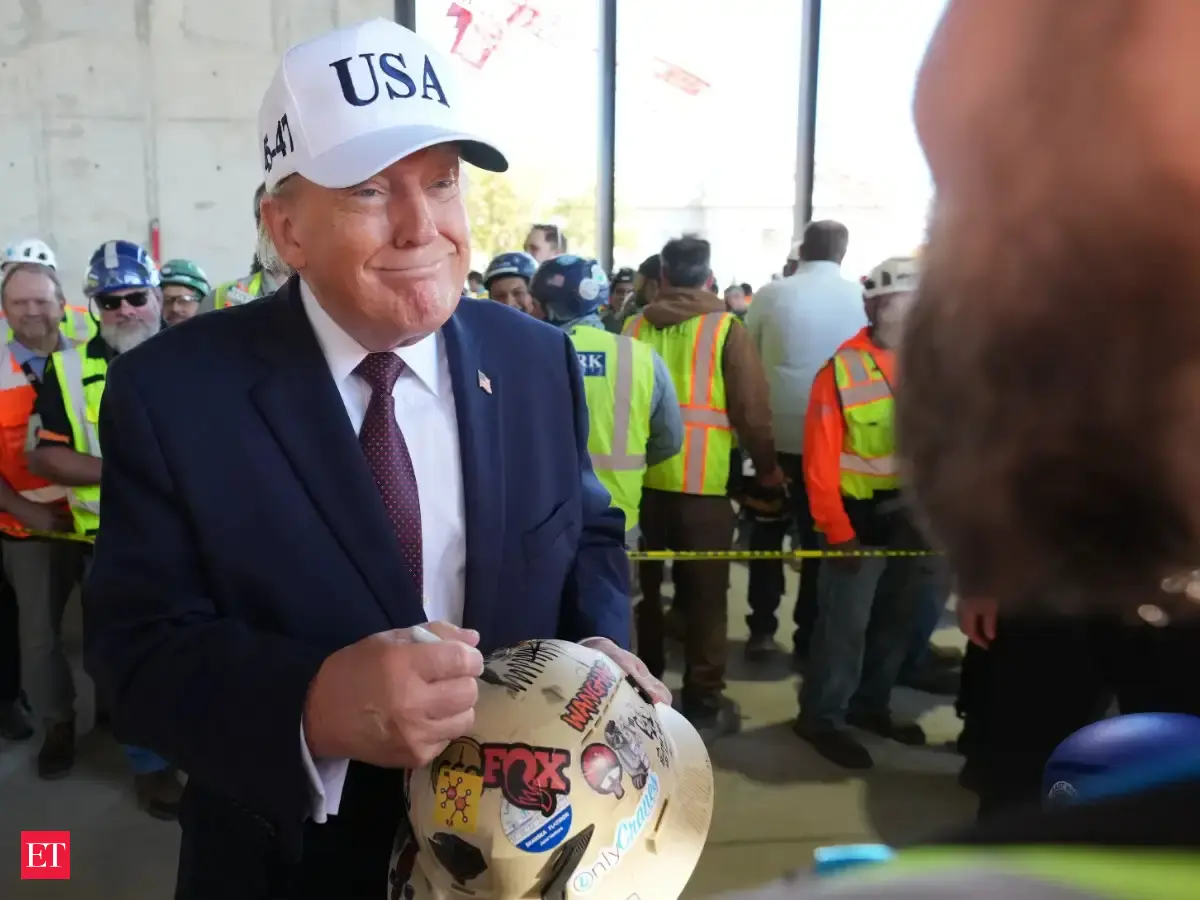
US President Donald Trump faced a voter backlash over inflation and rising living costs as Democrats scored sweeping victories in the 2026 midterm elections. An AP Voter Poll showed two-thirds of voters blamed Trump’s policies for inflation. Trump said, "I've done a great job," but voters rejected his economic record.
Synopsis
US President Donald Trump faced a voter backlash over inflation, tariffs and rising living costs as Democrats scored sweeping victories in the 2026 midterm elections. An AP Voter Poll found that about two-thirds of voters blamed Trump's policies for fuelling inflation, while concerns over inequality, healthcare costs and democracy deepened Republican losses.
US President Donald Trump’s economic record came under sharp scrutiny in the 2026 midterm elections, with rising prices, controversial tariffs and growing concerns over the cost of living contributing to sweeping Republican losses across House, Senate and gubernatorial races.
Voters largely blamed Trump’s own policies for fuelling inflation and weakening economic conditions, rejecting his attempts to pin the blame on his predecessor, former President Joe Biden, according to an AP Voter Poll of roughly 100,000 midterm voters.
About two-thirds of voters said Trump's policies had contributed to inflation, compared with roughly half of voters who held Biden's policies responsible during the 2022 midterm elections, according to the poll. Voters across states, from California to Mississippi, also broadly agreed that Trump's tariffs on foreign imports had done more harm than good, the Associated Press reported.
The findings reflected growing frustration with the administration's handling of the economy, an issue that had dominated voter concerns for months. Yet Trump continued to defend his economic record on the campaign trail, dismissing concerns over rising prices.
Live Events
"I've done a great job," Trump said at one of his final midterm rallies in Iowa. "Prices are coming way down."
Cost of living becomes Republicans' biggest electoral liability
The election results suggested that voters were increasingly unconvinced by Trump's claims of an economic turnaround. Consumer prices have risen 3.7% over the past 12 months, compared with an inflation rate of 3% when he began his second term, according to AP.
The administration's economic challenges were compounded by the fallout from Trump's decision to launch a war with Iran in February, which sent energy costs higher. Speaking to reporters on Wednesday, Trump acknowledged that the conflict had affected fuel prices but defended the military action.
The Iran war "drove the gasoline up a little bit short-term," he said, adding that the decision was justified by concerns over Tehran's nuclear ambitions. "If I had to do it again, I'd have to do it again," he said.
The cost of living emerged as a decisive factor in congressional races. About nine in 10 voters said it was either a "crucial" or "major" consideration in their vote, while roughly six in 10 of those voters backed Democratic candidates in their local House races.
The Democratic victories, however, do not automatically translate into an economic recovery. Addressing persistent inflation will require cooperation between the White House and Congress, or a sufficiently stable economic environment for the Federal Reserve to continue bringing inflation down through interest-rate decisions.
The broader economy has continued to expand, with the S&P 500 rising more than 10% so far this year and unemployment at 4.2%. Financial markets also responded positively to the Democratic victories, with stocks rising on Wednesday, AP reported.
AI anxieties, wealth gap add to economic discontent
Despite the stock market's gains and continued economic growth, voters expressed reservations about who was benefiting from the expansion. The rapid development of artificial intelligence, which has become a major driver of economic growth, has not generated the optimism Trump has sought to project.
About six in 10 voters believed AI would do more harm than good for society, reflecting concerns that automation could displace workers and that a potential financial bubble could threaten retirement savings. Trump has actively encouraged the AI boom while resisting calls for more aggressive federal oversight.
The concentration of wealth among technology billionaires has also added to concerns about economic inequality. Meta chief Mark Zuckerberg, Nvidia's Jensen Huang and Elon Musk have become frequent visitors to the White House, but voters remained unconvinced that the benefits of economic growth were reaching ordinary Americans.
Around seven in 10 voters said the economy favoured wealthy people, while only about three in 10 believed it was fair to everyday Americans. Even among California households earning more than $300,000 annually, a majority felt the economy was tilted towards the rich.
Healthcare costs were another source of dissatisfaction, with roughly six in 10 voters saying the government should play a bigger role in addressing medical expenses. Most also believed Trump's policies had made healthcare more expensive, AP reported.
The economic divide was particularly visible across income groups. Among voters earning less than $50,000 annually, about six in 10 said they were financially worse off than they had been two years earlier, before Trump returned to the White House.
Higher-income voters, meanwhile, were more concerned about the state of American democracy. About four in 10 households earning more than $200,000 in 2025 identified democracy as their biggest electoral concern, placing it roughly on a par with the economy.
The distinction exposed a political dilemma for Trump. While lower-income voters were primarily concerned about their financial circumstances, wealthier voters were increasingly troubled by the administration's approach to governance.
Trump's use of executive power to dismiss thousands of federal workers, alter government spending and impose hundreds of billions of dollars in tariffs, some of which the Supreme Court ruled illegal earlier this year, added to those concerns.
Overall, a slim majority of voters identified government corruption as a crucial factor in their electoral choices, while roughly half cited high prices.
The broader verdict was particularly damaging for a president who had positioned himself as an economic dealmaker. Most voters, around six in 10, believed Trump's priorities were misplaced and said he was not fighting for people like them.
The midterm results suggested that promises of economic growth and a stronger America had failed to overcome a more immediate concern among voters: the rising cost of living.`