
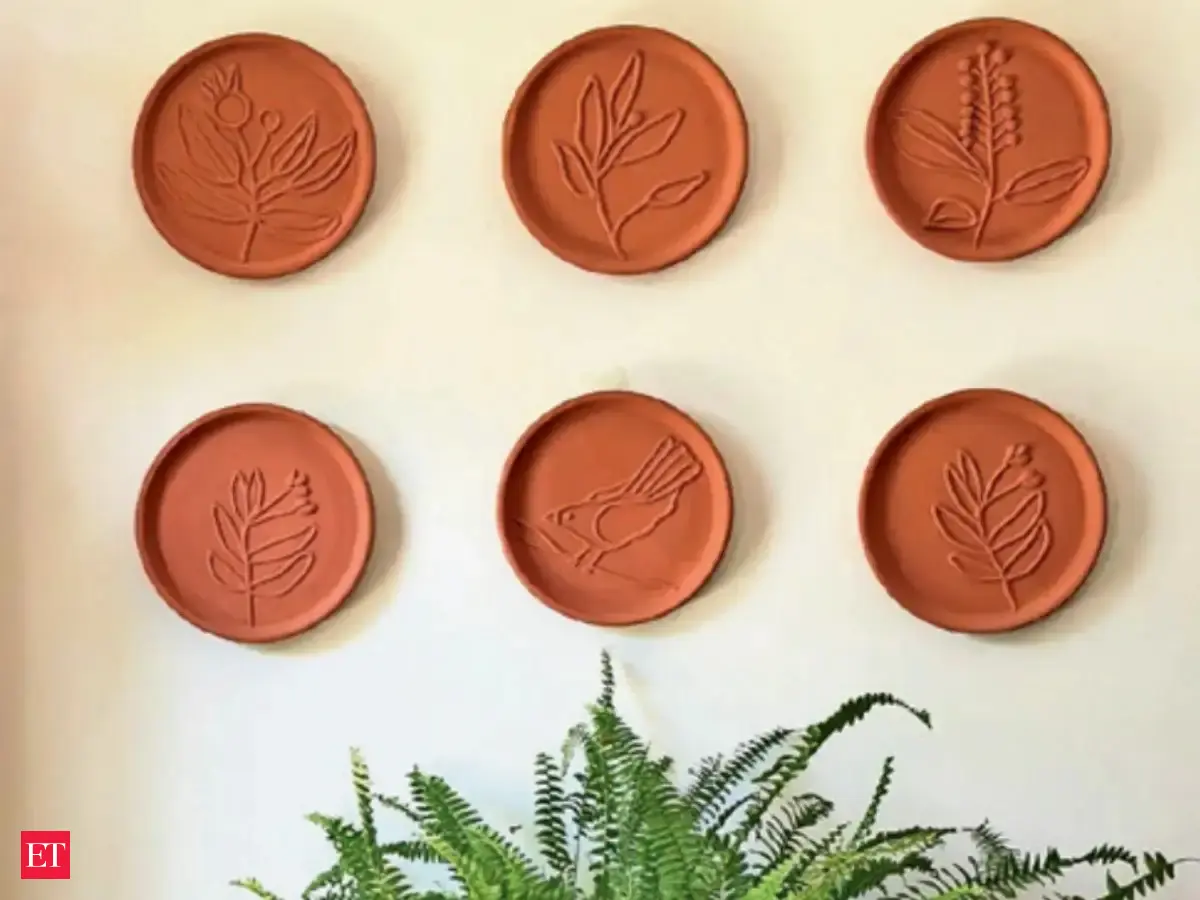
Indian artists and architects are reviving terracotta for modern homes, moving beyond traditional pots to create stylish wall art and architectural features. Designer Anita Jayaprakash says, "I started putting my work on Instagram." Many people now prefer these natural, regional materials over glossy marble to add value to spaces.
Indian artists, architects and designers are reviving terracotta beyond traditional uses, incorporating it into contemporary interiors, sculptural lamps, wall installations and architectural features, driven by a shift away from glossy marble-heavy aesthetics toward natural, regional materials.
Last year, Chennai-based Anita Jayaprakash decided to trade years of corporate life for mud, to literally play with it. From PowerPoint to pottery, from meetings to murals, she is shaping a version 2.0 of herself as a terracotta artist. "I started putting my work on Instagram. Soon people contacted me to create customised wall art, drawing inspiration from Indian mythology, folklore and architecture," she says. Jayaprakash gives traditional narratives a contemporary interpretation on terracotta.
She recently completed a series of 10 circular murals inspired by Kerala folklore for a client and is now working on a Life of Buddha series. Her murals start at around ₹3,500 for a 10-inch piece. What set them apart, she says, are the minimal design and storytelling.
Artists, architects and product designers are taking terracotta beyond the familiar matka, planters and earthen lamps. There are sculptural lamps, wall installations, jaalis, tiles and objets d'art-all crafted in one of India's oldest building and craft materials that sits seamlessly in contemporary interiors. The humble clay has had an upgrade.
Call Of Red EarthFor architects, terracotta never really went away. What has changed is the way it is used and perceived. Yashwin Dev, an architect who works out of Mangaluru, Bengaluru and Delhi, has used exposed terracotta brick walls, jaalis, tiled roofs and flooring across projects. Recently he designed the BuCo cafe in Koramangala, Bengaluru, where he incorporated terracotta flooring and Mangalore roof tiles, the latter as an architectural feature rather than as a functional roof.
A lot more of his clients are now asking for terracotta. "They realise that Italian marble and other expensive materials aren't the only way to show good design or the only things that add value to a space. A terracotta floor can work just as well," he says.
Part of this rediscovery, he believes, is courtesy of Instagram and Pinterest, which have made design ideas accessible to people. The other attraction is terracotta's versatility. Bricks can be stacked and laid in unconventional ways, while blocks, jaalis and tiles can become design features. Dev cites the late architect Laurie Baker's inventive use of brick for form and ventilation as an example of what a familiar material can achieve.
Anisha Menon and Sabyasachi Routray, cofounders of Bengaluru-based architecture and design practice ma+rs, see a similar shift. The firm favours exposed concrete ceilings, brick, terracotta jaalis and natural materials over heavily clad, polished surfaces. They have often deployed the earthy material as a backdrop wall, its warm colour allowing furniture and artwork to stand out. Menon says, "It instantly adds an Indian touch to a space. You immediately feel rooted when you see this material."
What drives the terracotta trend is also a possible fatigue with the shiny, marble-heavy interiors that have dominated aspirational homes. She says, "The shiny aesthetic is beginning to lose some ground to natural finishes. In South India, particularly, we receive enquiries from clients who want homes with a stronger regional character."
Manufacturers, too, are making terracotta more interesting. Designers now work with smaller and larger formats, unusual shapes and decorative inserts. Like Nuvocotto, formerly Bangalore Tile Company, that works only with clay. Menon mentions local Kerala-based vendors too who offer different colours and finishes.
The cost is also attractive, she adds. In a recent project, ma+rs used 6 inch x 6 inch terracotta cladding priced at approximately ₹55 per square foot. By comparison, Indian marble starts at ₹150-200 per square foot, excluding installation and finishing. Its ultimate plus point, according to Dev, is that it suits Indian climate. "Concrete absorbs a lot of heat, while a terracotta block of the same size stays much cooler. Plus, it ages well. You can see that in old homes along the coast and across South India, terracotta roofs have lasted for generations," he says.
Play With ClayEven design studios are trying to free clay from its traditional forms. Take Ara Living Studio in Bengaluru. For founders Jyotsna Pant and Shambhavi Kothari, the interest began at home, with their collective love for all things terracotta. Pant and Kothari have collected terracotta objects from different corners of the world and are drawn to its earthy colour. Coming from textile and fashion design backgrounds, they looked at familiar pots and wondered how their shapes could be altered. Kothari says, "Over time, we realised there was so much more to terracotta. It has such a rich history in Indian craft and architecture, but we felt that its potential in contemporary homes and spaces was largely unexplored."
Pant says, "We were keen to move beyond the conventional idea of terracotta being just rustic or utilitarian and explore it in forms that could sit just as naturally in modern interiors." The studio works with local artisans to translate its designs into objects for indoor and outdoor spaces. Its collection ranges from ₹300 to ₹6,500, with custom projects priced separately. There are banana-shaped incense-stick holders, vases, wall plates and slab fillers.
Like Ara, Bengaluru-based Naaya Studio creates sculptural ceramic lamps-from pendants and wall sconces to chandeliers. Kerala-based The House of Nirmiti explores terracotta through vessels, architectural components and spatial installations. Mumbai-based Harshita Jhamtani also uses it to create sculptural lamps.
Chips & CracksBut clay comes with its own complications. For Ara, it's getting artisans to experiment with unconventional shapes and proportions. Artisans accustomed to predictable bulk orders can be reluctant to invest time in unfamiliar designs, they say. Consistency is another issue: drying conditions, firing temperatures and variations in clay can change the final product. Then there is the risk of cracking and breakage, especially with larger pieces.
"We've come to accept that these variations are part of working with terracotta, and we see them as part of its charm rather than flaws," Kothari adds. Convincing customers accustomed to identical, factory-made products to appreciate these differences is also part of the process.
The challenge extends to architecture. Dev says terracotta's brittleness makes transportation and installation difficult. Traditional Mangalore tile roofs, while suited to the climate, require more skill and time than concrete or metal alternatives. He adds, "The bigger challenge is that the craft itself is fading. Mangalore tile factories are slowly shutting down, and fewer people now specialise in traditional terracotta roofing."
Matte MattersDelhi-based interior designer Lipika Sud, who has used terracotta extensively in architectural and decorative applications, says the possibilities outweigh the challenges. She recalls introducing tall sculptural installations in the reception of The Lalit Great Eastern Kolkata. The idea was to create a dramatic Indian craft statement within a heritage property. Sud believes terracotta's matte, earthy texture works alongside marble, brass, stainless steel and glass.
She says, "Terracotta ticks all three boxes: a growing appreciation for natural materials; handcraft becoming cool and the new approach towards luxury. Today's luxury is increasingly about authenticity and meaningful design, not just opulence. And terracotta represents this new luxury."
For Jayaprakash, however, the draw remains something more elemental: the earthiness. "Terracotta has the magic of clay. It's literally earth," she says. "Mud talks to us, earth talks to us." And people are ready to listen.