
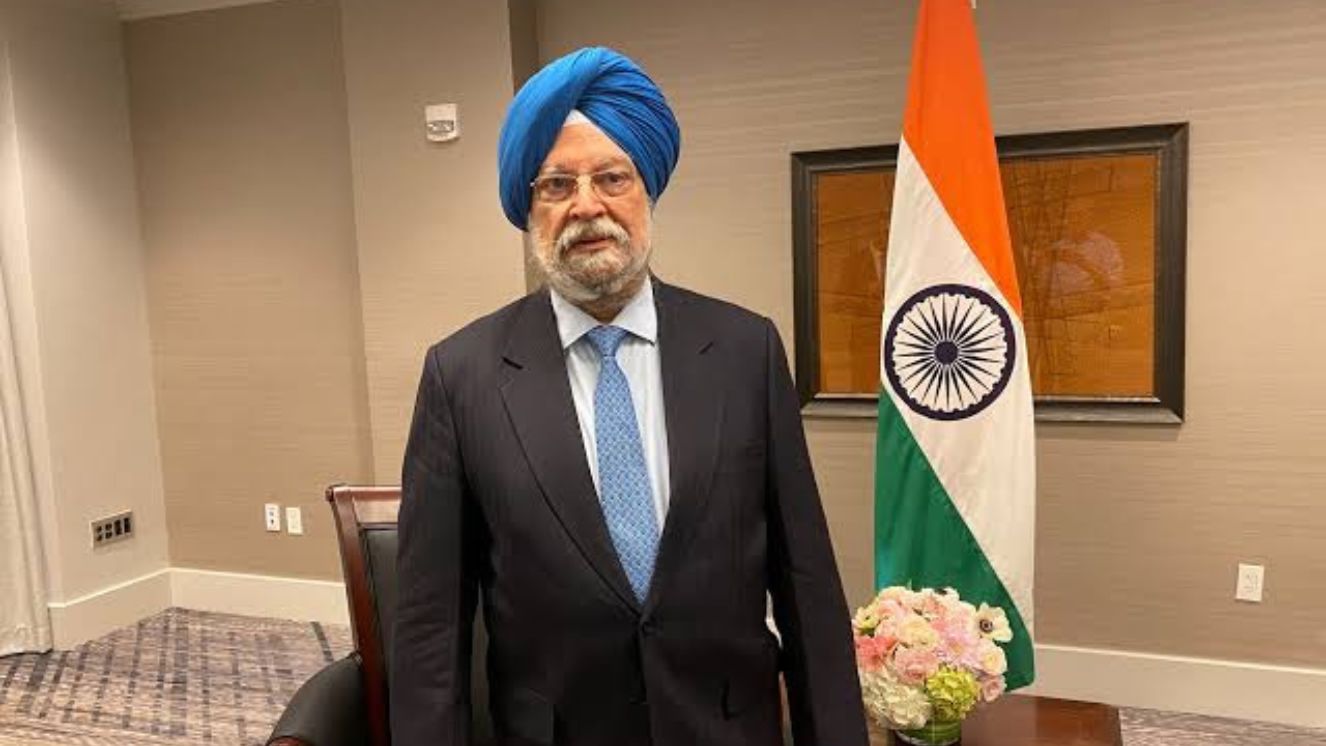
Petroleum Minister Hardeep Singh Puri said on Thursday that India is not out of the woods regarding oil supply risks. He noted that tensions in the Red Sea and the Russia-Ukraine conflict persist. "Discussions are going on. So we are encouraged," he said about efforts to reopen the Strait.
India is "not completely out of the woods" on oil supply risks as discussions on reopening the Strait of Hormuz continue, tensions persist in the Red Sea and talks over the Russia-Ukraine conflict remain underway, Petroleum Minister Hardeep Singh Puri said on Thursday.
Speaking to reporters after FICCI's Annual General Meeting and Convention, Puri referred to discussions on an agreement to reopen Hormuz.
"It involves parties like the United States, Iran, the Gulf states. Discussions are going on. So we are encouraged," he said.
The minister noted that crude oil prices had climbed from around $67-68 to $120 per barrel during the crisis and were still hovering near $92.
"So one can only hope that the global situation will be conducive to the price of oil coming down and that the impediments to free flow will be removed," Puri said.
"Apart from the state of Hormuz there is still tension in the Red Sea," he added, while also referring to ongoing Russia-Ukraine discussions.
Despite the uncertainties, Puri said India could manage oil supplies even if tensions escalated.
The minister said Hormuz-linked supplies accounted for approximately 45% of India's crude imports, 90% of LPG imports and 55% of LNG imports.
Despite the disruption, there was no rationing or stockout at petrol pumps or LPG distributorships.
"The idea was that no kitchen should run dry or 107,000 petrol pumps should not run dry," he said.
Refineries increased daily LPG production from around 34,000 tonnes to nearly 54,000 tonnes. Daily LPG bookings surged from 52 lakh to 92 lakh cylinders, but the household delivery backlog did not exceed six days.
Daily piped natural gas connections also increased from around 3,000 to 9,000 where pipeline infrastructure existed.
Meanwhile, Puri said India's petrochemical demand was projected to reach 55 million tonnes by 2030 and 120 million tonnes by 2047, against current capacity of 36.4 million tonnes per annum.
"Our petrochemical consumption is one-third of the global average, while our consumption of other fuels is three times the global average," he said.
India's refining capacity is expected to increase from around 267 million tonnes per annum to 290 million tonnes over the next two to three years, while crude import dependence remains close to 88%.
On OMC losses, Puri said government reimbursements were a continuing process rather than a one-time compensation package. The companies were losing hundreds of crores of rupees daily, he said.
The minister cited an earlier instance when the government reimbursed ₹22,000 crore against LPG-related losses of ₹28,000 crore.