
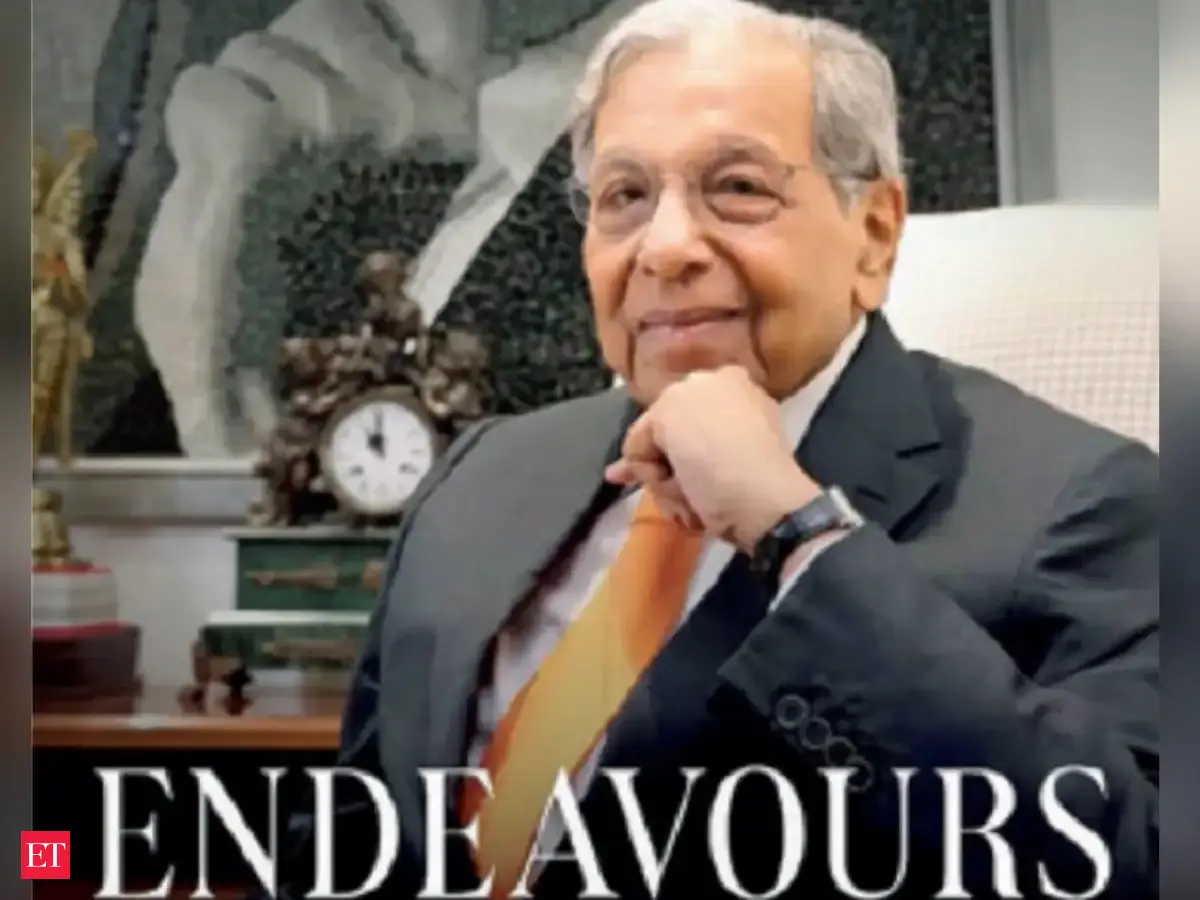
NK Singh’s memoir, Endeavours: An Ensemble of My Life, explores how Japan’s culture of remembrance left a lasting impression on him. He said, "In Japan, memory attaches itself to objects." Singh recalled how the Japanese preserved visiting cards and photographs to build relationships, showing deep respect for every moment.
An excerpt from NK Singh's memoir 'Endeavours: An Ensemble of My Life', recounting how Japan's deep instinct for preserving moments-through photography, visiting cards and patient attentiveness-left a lasting impression during his diplomatic posting there.
In Endeavours: An Ensemble of My Life, NK Singh, economist and former chairman of the Finance Commission, recalls how Japan's instinct for preserving the moment left an enduring impression. Excerpt from the memoir:
Diplomatic work has its own rhythm. There were meetings, official calls, negotiations, visits by delegations and journeys connected with investment and development assistance. But between these engagements, there were intervals that photography began to fill.
The morning before the day's work began, the short journey back after a meeting, a weekend visit to Nikko or Hakone or a longer journey north or south all became opportunities to observe Japan more closely.
The Japanese themselves took photography seriously. Cameras were not treated merely as tourist accessories. There was a respect for equipment, craft and the discipline required to produce a good image. Many Japanese photographers were passionate about medium-format cameras, particularly those made by Mamiya. Their interest was not casual. It reflected a broader Japanese attitude: that beauty deserved preparation and that tools had to be equal to the seriousness of the task.
This instinct for preserving the moment was not confined to photography. In Japan, memory often attached itself to objects: a visiting card, a letter, a photograph or a carefully retained token of an earlier meeting. Such objects were not treated casually. They could preserve an association, kindle nostalgia and sometimes become the basis of a continuing relationship, personal as well as professional.
Memory CardsI recall an interesting incident during Mrs Gandhi's 1982 visit to Japan. The visit had been preceded by preparatory missions led by LK Jha, then one of India's most distinguished civil servants and a former governor of the Reserve Bank of India. At a small dinner hosted for him by Nissho Iwai, an elderly gentleman who had long since retired from the company came up to him and showed him a visiting card that Jha had given him decades earlier, when he was joint secretary in the Ministry of Commerce. Jha was startled and asked why he had preserved it for so long. The gentleman replied that even at that first meeting he had been struck by Jha's brilliance and had felt certain that he would rise to high public office.
The incident stayed with me because it revealed something characteristic of Japan. A first meeting was not necessarily forgotten once the formal purpose was over. A card could become a record of judgement, memory and expectation. It was another way of preserving the moment, not unlike photography itself, but within the domain of human association.
There was, however, another visiting-card episode connected with the same visit in which I was myself the embarrassed participant. During an official call on
Zenko Suzuki, then prime minister of Japan, the officials lined up to be introduced to him in the proper sequence. It was only at that moment did I discover, with some horror, that I had made the rather silly mistake of forgetting to carry my visiting card. In Japan, this was no small oversight. The exchange of cards was part of the grammar of respect, identity and order. My embarrassment was complete when Prime Minister Suzuki shook my hand, handed me his card and said, with disarming courtesy, 'My name is Zenko Suzuki, Prime Minister of Japan.' I bowed my head respectfully, but not without a deep sense of embarrassment. The incident remained with me because it showed, in the gentlest possible way, how seriously Japan took form, and how easily an outsider, even with the best intentions, could fail to meet its exacting standards.
Preparedness became a lesson in more than one sense. It applied to official calls but also, in a different way, to photography. It was during this period that the camera became a constant companion. At first, I carried it almost instinctively to meetings, journeys and weekends outside Tokyo. Gradually, however, my experience of Japan made the act of photographing more deliberate. The subject was no longer merely something before the eye; it had to be approached with patience, preparation and an awareness that the right moment might not return. This realization led naturally to a more serious concern with cameras, lenses and film.
Pausing Before Autumn ColoursOne incident in 1984 remains especially vivid in my memory. I was travelling along the winding mountain road from Nikko to Lake Chuzenji when I noticed an unusual colour in the autumn foliage. The late afternoon sun had touched the leaves in a way that could not be easily repeated. In photography, such moments are often brief. If one hesitates, the light changes and the picture is lost.
I stopped the car and began taking photographs. In most countries, stopping on a mountain road in this manner might have invited irritation, honking or perhaps even abuse. In Japan, however, the cars behind me simply waited. Not a single horn was sounded. For several minutes, the road remained still while I took my photographs.
That small incident told me a great deal about Japan. It was not merely that the Japanese were disciplined drivers, although they undoubtedly were. They seemed to understand why one might pause before autumn colour. They accepted that the journey could wait because the moment would not. For me, it also clarified something about photography: a photograph is often made before the shutter is pressed. One must notice, stop, wait and sometimes inconvenience oneself. Japan made this possible because the society itself respected that kind of attentiveness.