
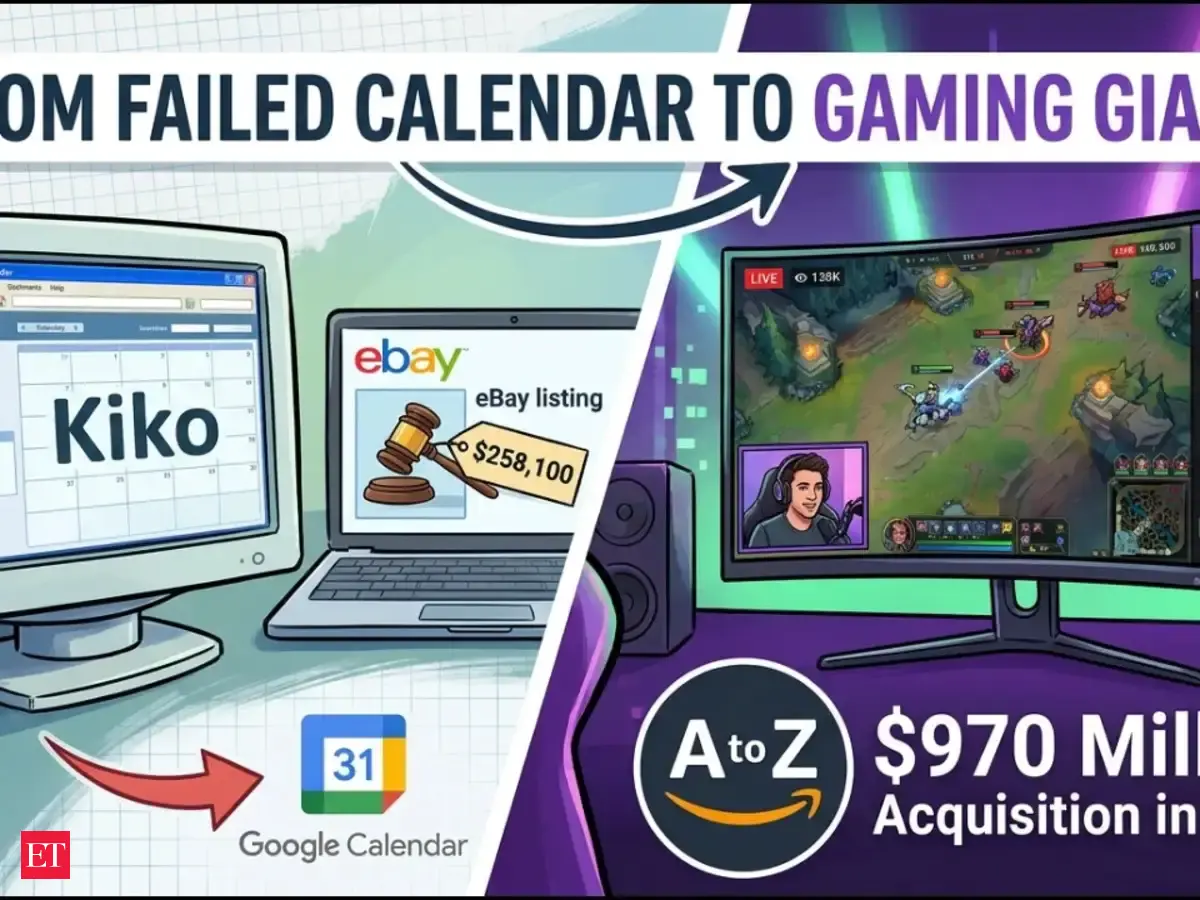
Justin Kan and Emmett Shear sold their first startup, Kiko, on eBay for $258,100 in August 2006. The business struggled after Google launched a competing calendar service. The founders moved on to build Justin.tv, which eventually became Twitch. Amazon later bought the popular streaming platform for about $970 million in 2014.
Synopsis
Justin Kan and Emmett Shear’s first startup, Kiko, struggled after Google launched its own calendar service. The founders sold Kiko on eBay for $258,100 in 2006 before moving into live streaming. Their next venture, Justin.tv, eventually gave rise to Twitch, which Amazon agreed to acquire for about $970 million in 2014.
Justin Kan and Emmett Shear hadn't started out trying to build a gaming-streaming platform. Their first business was an online calendar called Kiko and it struggled after Google launched a competing service. In August 2006, the founders put Kiko’s website and code up for auction on eBay and it sold for $258100.
The sale gave the two entrepreneurs a chance to move on from a product that failed to find its footing. Their next venture took a very different direction, broadcasting live video online. That experiment eventually led to Twitch. Which Amazon later acquire it for about $970 million in 2014.
Google Calendar put pressure on Kiko
Kan and Shear developed Kiko while studying at Yale University. The calendar service launched in August 2005 and received funding from startup accelerator Y Combinator.
At first, Kiko was trying to establish itself in the growing market for online calendars. That became harder in April 2006, when Google introduced Google Calendar.
Kiko struggled to make money from its free online calendar. A 2006 report by TechCrunch said the company had failed to generate revenue from the service and had not developed its planned enterprise product. Justin Kan also told the Los Angeles Times that Kiko had never made money, although he had planned to sell advertising on the site.
Live Events
You Might Also Like:
Binance hack investigation: How a compromised employee laptop may have led to the largest crypto heist
Google’s entry was a major setback, but it was not the only issue. Kiko had struggled to build a sustainable business, and its founders decided they would rather pursue other projects than continue competing in the calendar market.
Why Kiko was sold on eBay
In August 2006, Kan and Shear listed Kiko’s domain and computer code on eBay. While the auction was an unusual way to sell a startup, but it was a way to an exit without continuing to invest time in a business they wanted to leave behind.
The auction closed at $258100. Tucows, then led by CEO Elliot Noss, emerged as the winning bidder, according to a TechCrunch report.
The sale didn't turn Kiko into a major success, but it allowed the founders to move on. Shear later recalled that he and Kan auctioned off the business after Google Calendar launched, while Kan has described the sale as part of the process of deciding what to do next, as per an Inc report.
You Might Also Like:
Google loses nearly half a trillion in market value: What went wrong with Alphabet?
Justin.tv began with a camera attached to Kan’s head
The founders’ next major venture was nothing like Kiko. Launched in 2007, Justin.tv began as an experiment in which Kan wore a camera attached to his head and livestreamed his daily life. And viewers could follow what he was doing online.
The concept gradually expanded beyond Kan himself. Justin.tv opened its service to other broadcasters, turning the project into a wider live video platform. The founding team also included Michael Seibel and Kyle Vogt.
Gaming eventually became a significant category on Justin.tv. So instead of keeping it as one part of the broader service, the company launched Twitch in June 2011 to focus on live video for gamers.
How Twitch became a major acquisition
Twitch (Photo: Wikimedia)
Twitch grew into dedicated platform for people who wanted to watch and broadcast gameplay. Its audience expanded beyond the original Justin.tv experiment, making gaming livestreams the company’s central business.
You Might Also Like:
Intel Stock crashes 21% despite earnings beat: Why is Wall Street worried about INTC’s Q4 outlook?
Then in August 2014, Amazon announced that it would acquire Twitch for about $970 million in cash. And at that time, Amazon said that Twitch had more than 55 million unique visitors who had watched Twitch content in July and over one million broadcasters had contributed videos.
Amazon founder Jeff Bezos said, “Like Twitch, we obsess over customers and like to think differently, and we look forward to learning from them and helping them move even faster to build new services for the gaming community,” as quoted by the company in its release.
Kiko and Twitch were built around very different ideas. The first struggled to attract and retain users in a market that Google had entered, while the second grew from an experiment in live broadcasting into a dedicated gaming service.
Selling Kiko on eBay did not guarantee Kan and Shear another successful venture. It simply gave them the chance to start again. Their subsequent work on Justin.tv eventually produced Twitch, turning an unusual startup exit into the beginning of a much larger story.
Can new data protection law guard against SBI-like data breaches?
KYB and KYC: Quick commerce, the Damani premium and what DMart must deliver – 3rd and concluding part
The tough business behind the walls
KYC and KYB: Inside Damani’s DMart, the retail chain for the middle class. And stock for the long term? – Part 2 of 3
Will it be a regulatory nightmare if an exchange lists on its own platform?
KYC and KYB: Inside Damani’s Avenue Supermarts that refuses to charge more – Part 1 of 3