
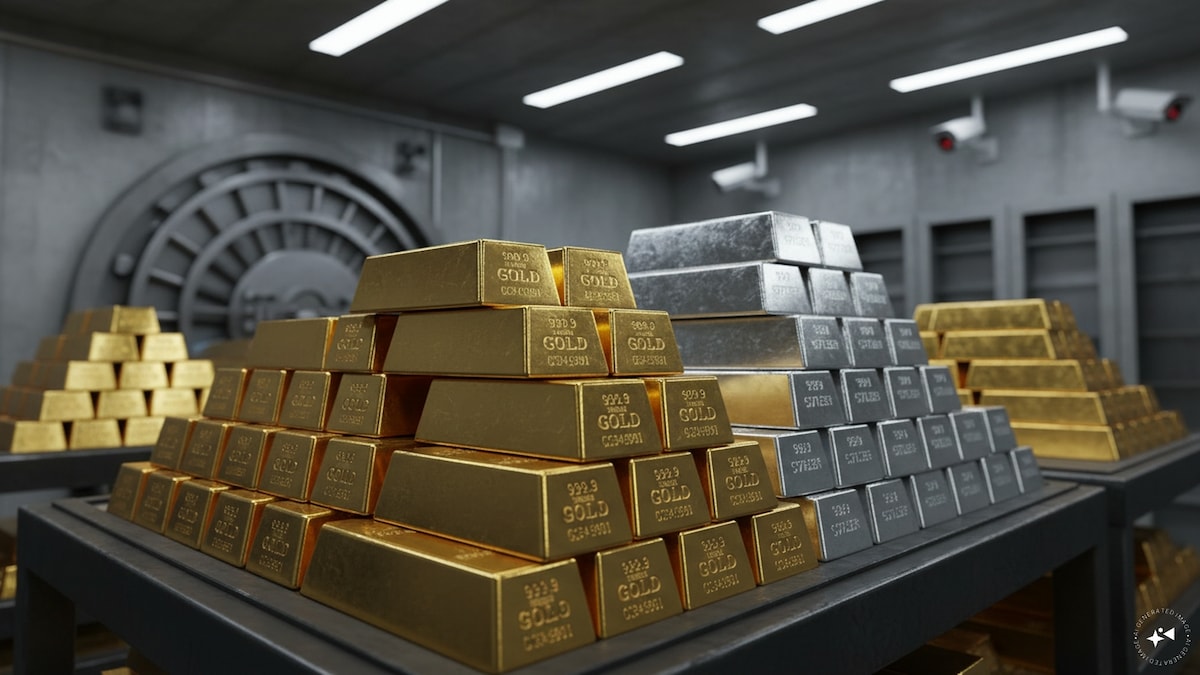
Gold and silver prices fell on COMEX on Friday, October 30, as investors weighed US interest rate outlooks and geopolitical tensions. Gold futures traded at $4,017.30 per ounce. Expert Arun Patel said, "Investors should view consolidation phases as opportunities to accumulate rather than enter after a significant rally."
Gold and silver prices traded lower on COMEX as investors weighed US interest rate outlooks and geopolitical tensions, while experts advise gradual accumulation.
Gold and silver prices traded lower in international markets on Friday, October 30, as investors assessed the outlook for US interest rates and developments around geopolitical tensions.
On COMEX, gold futures were trading at $4,017.30 per ounce, down $14.10 or 0.35% from the previous close of $4,033.60 an ounce. Silver futures were trading at $51.535 per ounce, down $0.845 or 1.61%, compared with the previous close of $52.255 an ounce.
The decline in precious metals comes amid continued uncertainty over the US Federal Reserve's monetary policy outlook and inflationary pressures.
A stronger interest-rate outlook can weigh on non-yielding assets such as gold and silver, as investors assess the relative attractiveness of interest-bearing investments.
Meanwhile, developments in West Asia remain in focus. Crude oil prices rose on Friday amid concerns that the US could resume military strikes against Iran, raising the possibility of fresh disruptions to energy supplies. Higher oil prices can add to inflation concerns and complicate the outlook for interest rates.
What is the outlook for gold and silver?
Precious metals have witnessed significant price movements over the past two years, with gold recording a sharp rally before entering a correction phase.
Arun Patel, Founder and Partner, Arunassets Investment Services, said precious metals have historically delivered returns in spurts, followed by extended periods of consolidation.
Gold appreciated approximately 26% in 2024 and 64% in 2025, with the rally extending into January 2026, when prices touched $5,595 per ounce. Since then, the metal has corrected approximately 28%, Patel said.
He believes investors should view consolidation phases as opportunities to accumulate rather than enter after a significant rally. However, he cautioned that investors should not expect immediate returns, as gold could remain around current levels for an extended period before its next meaningful upward movement.
Patel pointed to continued central bank demand as a factor supporting the longer-term outlook. Central banks purchased 863 tonnes of gold in 2025 and another 289 tonnes in the second quarter of 2026, he said.
He recommends considering gold accumulation with an investment horizon of two to three years rather than attempting to time the next rally.
Jewellery demand during the festive season
Despite elevated precious metal prices, jewellers are expecting demand to remain encouraging during the festive and wedding season, with some consumers also exploring diamond jewellery.
Eshwar Surana, Managing Director of Raj Diamonds, expects jewellery sales to grow 20-25% in value during the festive season. He said the company has witnessed an encouraging customer response, with buyers considering diamond jewellery alongside gold.
Surana attributed the demand to changing preferences among younger consumers and the overlap of the festive and wedding seasons.
He also pointed to a shift towards lightweight, contemporary jewellery, including 18-karat and 14-karat designs. Natural diamond jewellery, he said, is finding demand beyond bridal purchases, including for everyday wear and gifting.
What should investors keep in mind?
The recent correction in gold prices does not necessarily indicate a sustained reversal in the longer-term trend. However, investors should distinguish between short-term price movements and their investment horizon.
Gold can help diversify a portfolio, but its prices can remain volatile and may move sideways for extended periods. Investors considering fresh purchases should assess their existing allocation, investment objectives and ability to stay invested through price fluctuations.
Patel's view is to accumulate gradually during consolidation rather than make large investments after a sharp rally, keeping a two-to-three-year investment horizon in mind.