
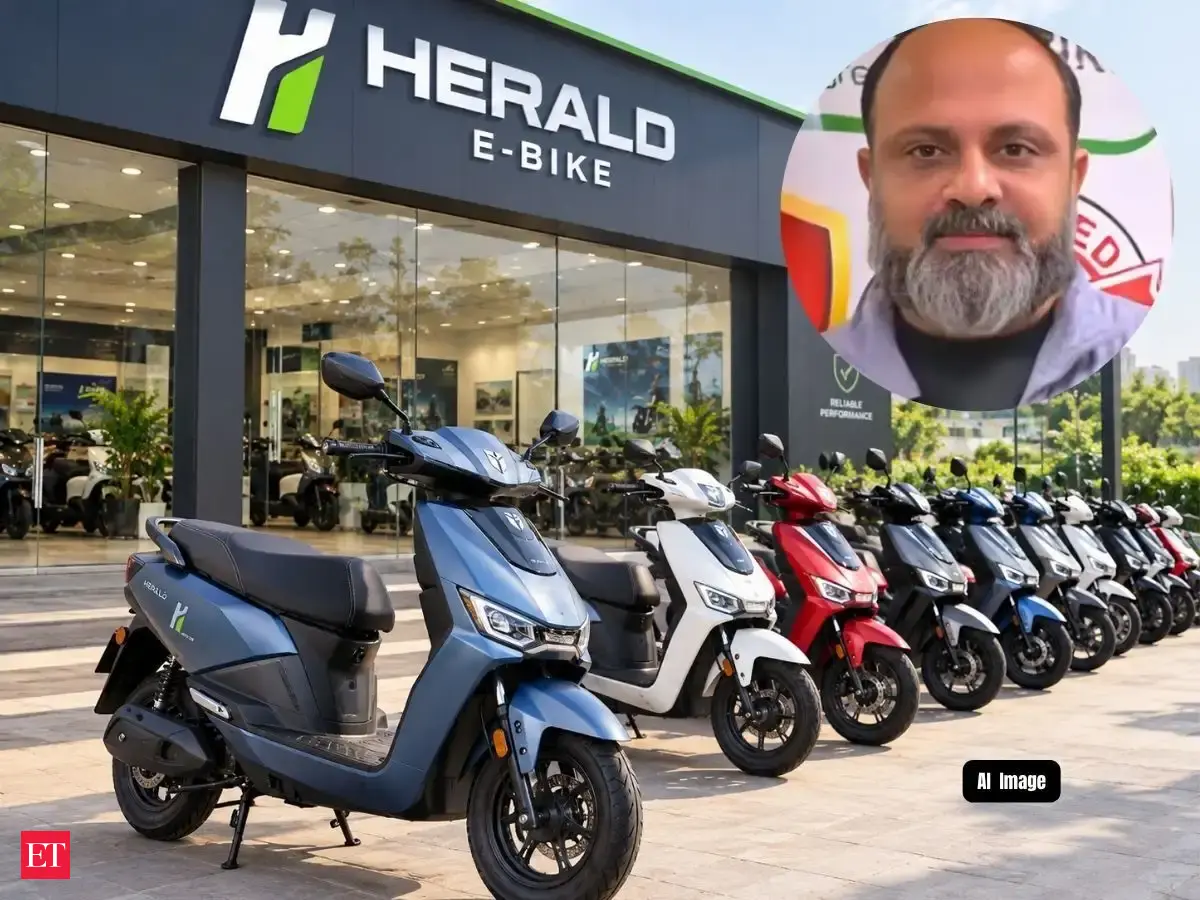
Ghaziabad entrepreneur Krishna Grover built Herald E-Bike, a company now earning Rs 1.5 crore monthly. Grover started his career in 2005 with a Rs 3,500 salary. He later left his corporate job and used his wife’s savings to start the venture, which now operates 34 models and 550 active showrooms.
Synopsis
Ghaziabad's Krishna Grover, who started his career with a monthly salary of Rs 3,500, left his corporate job to build Herald E-Bike with support from his wife's savings. The Ghaziabad-based electric two-wheeler company now has 34 models, over 550 active showrooms and a reported monthly revenue run rate of Rs 1.5 crore.
Krishna Grover once earned Rs 3,500 a month working in the corporate sector. Today, he has build an electric two-wheeler business with a monthly revenue run rate of Rs 1.5 crore. The turning point came when he decided to leave his corporate job and start a venture with financial support from his wife, Ritika, a NBT report stated. Based in Ghaziabad, Grover is the entrepreneur behind Herald E-Bike, a brand targeting electric vehicle buyers in India's smaller cities. The company has expanded its product range to 34 models and built a distribution network of more than 550 active showrooms.
From a Rs 3,500 salary to business success
Grover's journey began in 2005, when he took up a job that paid Rs 3,500 per month. His path to financial independence began early. He lost his father at the age of 13 and learned to take responsibility at a young age. Over the next few years, he progressed in his career and secured a management position at an international business process outsourcing (BPO) company by 2014.
But a stable corporate job was not his final destination. Grover wanted to build a business of his own and create a long-term foundation for his family. He eventually walked away from his established career to pursue that ambition. His wife, Ritika, backed the decision by contributing her savings to help start the venture.
How Herald E-Bike entered the electric vehicle market
Grover began his entrepreneurial journey in 2018 with Krishika Services. The business later developed into Krishika EV India, which was incorporated in December 2022. Vinay Kumar, a former colleague and friend, joined him as a co-founder. The founders saw an opportunity in the electric two-wheeler market, particularly in Tier-2 and Tier-3 cities. Rising petrol prices and concerns about pollution were creating interest in electric mobility, but many potential buyers remained hesitant.
Live Events
You Might Also Like:
₹45 lakh in 90 days: Bengaluru farmer earns Rs 50,000 per day by selling small lauki to Qatar buyers
Concerns about product quality, unreliable suppliers and inadequate after-sales service made customers cautious about investing in electric scooters from unfamiliar brands. Herald E-Bike sought to address these concerns by focusing on affordable products and customer confidence. The company introduced an extended warranty of five years on batteries and motors as part of its effort to build trust.
34 models and a network of 550 showrooms
Herald E-Bike is headquartered in Vaishali, Ghaziabad, and has a manufacturing facility in Duhai. Its portfolio includes 34 electric two-wheeler models. Of these, 23 are low-speed, non-RTO models, while 11 are high-speed models approved for registration with the Regional Transport Office (RTO). The company has also adopted an asset-light manufacturing model, using job-work arrangements instead of relying entirely on heavy investments in its own manufacturing infrastructure.
This approach has helped it expand distribution while limiting the need for large capital expenditure on manufacturing assets. The brand now has more than 550 active showrooms across India, according to the company's reported figures. Its focus on smaller cities is central to the business strategy, where affordability, product reliability and access to service can influence purchasing decisions.
Revenue grows from Rs 78 lakh to Rs 7.8 crore
As per NBT report, Herald E-Bike has reported a significant increase in revenue over three financial years. The company recorded revenue of Rs 78 lakh in FY2023-24. This increased to Rs 1.9 crore in FY2024-25 before reaching Rs 7.8 crore in FY2025-26. It now reports a monthly revenue run rate of around Rs 1.5 crore and has set a target of Rs 20 crore in annual revenue for FY2026-27.
You Might Also Like:
This Bengaluru man rejected Paris job offers to grow mushrooms in an old poultry shed, he now earns Rs 4 lakh a month
A monthly run rate is an annualised estimate based on the current pace of business. It should not be confused with revenue already earned during the full financial year. While the reported growth points to an expanding operation, sustaining that momentum will depend on demand, distribution, competition and the company's ability to maintain customer confidence.
Nepal, Sri Lanka and an IPO on the horizon
Herald E-Bike's ambitions extend beyond the domestic market. The company is looking at Nepal and Sri Lanka as potential destinations for international expansion. It has also set a target of pursuing an initial public offering (IPO) by 2029. This remains a future ambition, not a confirmed listing.
For Grover, the journey from a Rs 3,500 monthly salary to running an expanding electric two-wheeler business began with a decision to give up the certainty of corporate employment. Support from his wife helped him take the first step. The next phase will test whether Herald E-Bike can turn its growing distribution network and rising revenue into sustained growth in India's competitive electric mobility market.
The ABCD of the US mid-term elections – Part 1: Why it matters across the globe
Onion inflation at 108%? Yes, but not really. What is different this time?
Curbing rupee bets: What the RBI’s new rules mean for the hedge-now-or-wait question