
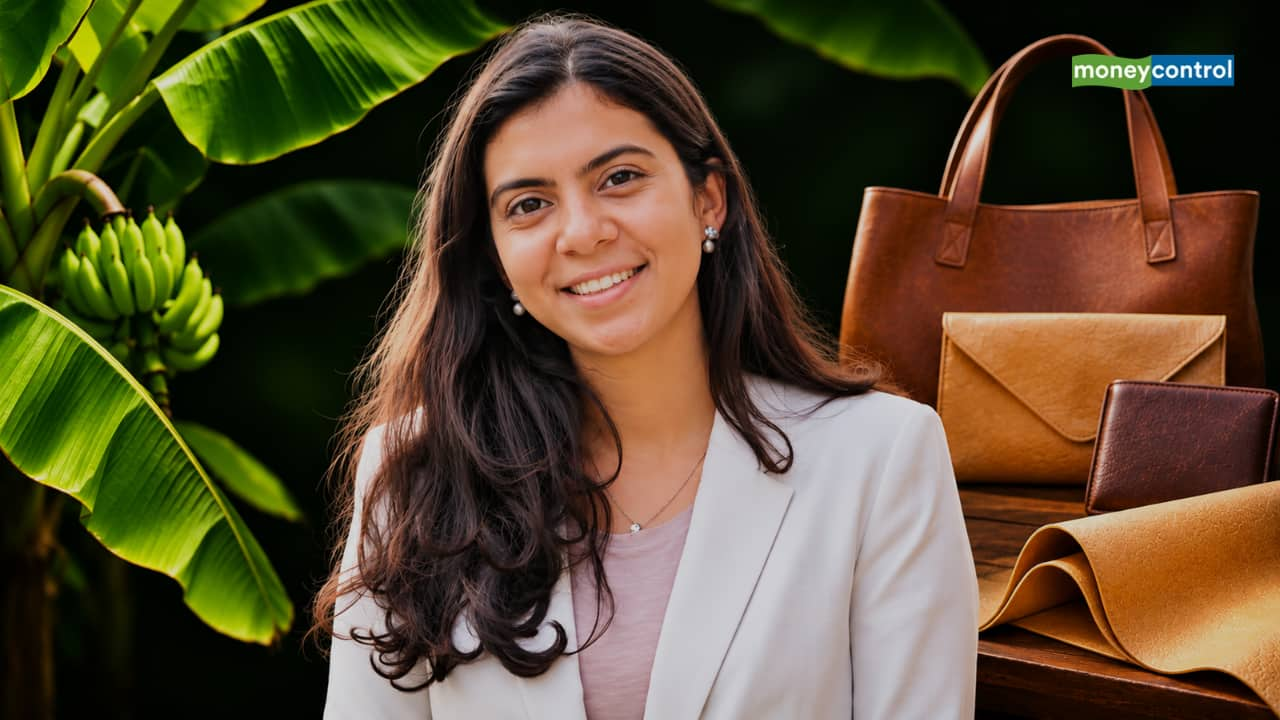
Kolkata-based startup Banofi turns discarded banana stems into plant-based leather. Founded in 2022 by Jinali Mody, the company uses agricultural waste to create sustainable fashion materials. The business got a big boost recently, reporting revenue of nearly 2 crore in FY25. Many farmers now earn extra money by supplying these stems.
What if the waste left behind after harvesting bananas could be turned into a material used in handbags, fashion accessories and even automobiles? That is the business idea behind Banofi, a Kolkata-based startup founded by Jinali Mody, which is attempting to convert agricultural waste into an alternative to conventional leather. Kolkata-based Banofi, founded in 2022, manufactures plant-based leather using discarded banana stems, an agricultural byproduct that is often left to decompose or burnt after harvesting. The startup has moved beyond product development, reporting revenue of nearly 2 crore in FY25.
Banofi, legally registered as Atma Innovation Private Limited, focuses on extracting cellulose fibres from banana stems and converting them into sheets that can replace conventional leather. The idea emerged while Mody was pursuing a master's degree in Environmental Management at Yale University. A biochemistry graduate from Mumbai's St Xavier's College, she had previously worked as a business analyst at McKinsey & Company between 2018 and 2021. She also worked with plastic recycling startup Plastic-ScrapWala before setting up Banofi. During her research, Mody explored agricultural waste as a potential source of raw material for manufacturing leather alternatives.
Options included rice straw, wheat husk and mango waste, before the company settled on banana stems. The manufacturing process involves extracting cellulose-rich fibres from banana stems, blending them with natural binders and starches, and pressing the mixture into sheets. These are then processed to achieve the texture and appearance of leather. The company says its manufacturing process avoids conventional tanning, which can involve chemicals such as chromium and generate industrial wastewater. According to the United Nations Environment Programme (UNEP), Banofi's material uses 95% less water and produces more than 90% lower carbon emissions than conventional leather.
The figures are based on the programme's profile of the company. The business model also involves creating a supply chain for agricultural waste. Once a banana plant produces fruit, its stem is cut to allow a new plant to grow. These stems are generally discarded, providing Banofi with its primary raw material. The company works with around 100 smallholder banana farmers, according to UNEP. Its sourcing model also involves labour and transportation, creating additional economic activity around the collection of waste. The company claims that its material uses 93 percent less water and generates 97 percent less carbon dioxide than conventional leather.
Banofi's early development received support through entrepreneurship competitions. Mody pitched the idea at Startup Yale in April 2022 and won the $25,000 Sustainable Venture Prize, which helped finance the initial development. The company's first order came from Yale's Tsai Center for Design and Innovation, which commissioned notebooks made using its material. In 2023, Banofi won the $1 million Hult Prize, a global student entrepreneurship competition. The award was presented in Paris by fashion designer Stella McCartney. The company also won the Wege Prize, receiving $30,000. The startup subsequently expanded its product development from materials suited to hard leather goods to versions intended for softer applications, including fashion accessories.
Banofi says it has piloted its material with more than 150 brands across fashion, lifestyle and automotive segments. It has also announced the availability of its material in the US and Europe. In September 2025, Mody was named one of the winners of UNEP's Young Champions of the Earth award. The recognition came with $20,000 in funding, mentoring and international exposure. The company has also received support through the Climate Tech Incubator programme run by Villgro in partnership with Mercedes-Benz Research and Development India. In a LinkedIn update, Villgro said Banofi had upcycled more than 14,600 kg of organic waste in six months.
According to Tracxn data, the company's revenue increased from approximately Rs 30.2 lakh in FY23 to Rs 1.58 crore in FY24. It reported revenue of around Rs 1.63 crore in FY25, registering growth of about 4 percent over the previous year. However, total expenses increased from Rs 2.11 crore in FY24 to Rs 3.20 crore in FY25. Consequently, its net loss widened from approximately Rs 39.6 lakh to Rs 1.87 crore during the same period. The company also reported negative EBITDA of around Rs 1.47 crore in FY25. Its total assets increased from Rs 2.88 crore in FY24 to Rs 3.59 crore in FY25, according to Tracxn.