
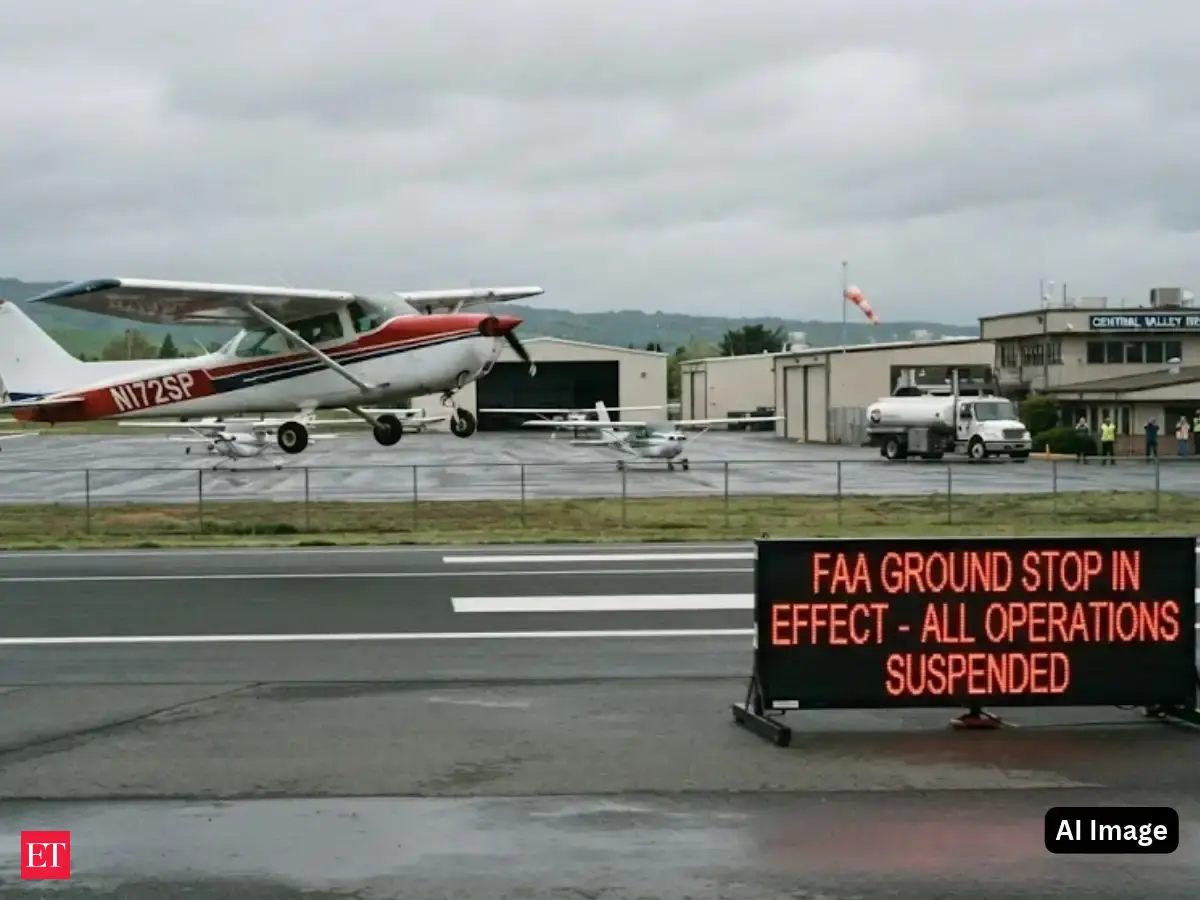
The FAA ground stop on November 13 disrupted thousands of flights across the US. While major airports shut down, aircraft still used two smaller Colorado airports. These sites often use visual flight rules for training, though they were not exempt from the rules that caused many delays and cancellations nationwide.
The FAA's November 13 ground stop disrupted thousands of flights across the US, but aircraft continued to be spotted at two smaller Colorado airports. Their use for flight training and general aviation, where pilots often operate under visual flight rules, helps explain the activity. However, such flights were not automatically exempt from the nationwide restrictions.
While a nationwide Federal Aviation Administration (FAA) ground stop disrupted thousands of flights across the US on Friday, November 13, residents near smaller airports in Colorado reported seeing aircraft continuing to take off and land. The activity at Rocky Mountain Metropolitan Airport and Erie Municipal Airport raised questions about why some local flights appeared to be operating even as major airports faced widespread delays and cancellations.
The FAA issued the emergency restriction at approximately 1:54 pm Mountain Time after a telecommunications failure disrupted the country's 22 regional air traffic control centres. The ground stop remained in effect for around four hours and 21 minutes before being lifted at approximately 6:15 pm. An estimated 10,000 flights were delayed and around 5,000 cancelled nationwide, according to NPR, citing FlightAware data.
Residents near Rocky Mountain Metropolitan Airport (RMMA), located between Superior and Broomfield, and Erie Municipal Airport reported seeing aircraft take off and land during the disruption, Yellow Scene reported.
Why were smaller airports still seeing aircraft movements?One explanation lies in the type of aviation activity at these airports. RMMA and Erie Municipal Airport serve flight schools, training aircraft, private planes and business jets, rather than primarily handling scheduled commercial airline services.
Many local flight-training aircraft operate under Visual Flight Rules (VFR). This allows pilots to navigate using visual references and maintain separation from other aircraft when weather conditions permit. By comparison, commercial airlines and many business jets operate under Instrument Flight Rules (IFR), which involve greater reliance on instrument-based navigation and air traffic control services.
The distinction can help explain why local aviation activity may look different from operations at major commercial airports during a disruption affecting regional air traffic control centres. However, VFR operations are not automatically exempt from FAA restrictions.
How do air traffic control arrangements differ at the two airports?Rocky Mountain Metropolitan Airport operates in Class D controlled airspace and has a local air traffic control tower. According to the FAA, pilots departing while the tower is operating must obtain the required clearance and follow applicable instructions.
Erie Municipal Airport, on the other hand, is an uncontrolled airport without an operating air traffic control tower. Pilots coordinate their movements using a Common Traffic Advisory Frequency (CTAF), communicating their positions and intentions to other aircraft operating in the area.
These differences mean that aircraft at the two airports may rely on different local procedures and levels of air traffic control support. Some local flights may also remain within airspace that does not require services from the affected regional control centres.
Did the FAA ground stop allow smaller aircraft to keep flying?Not automatically. The FAA's initial nationwide directive instructed departing aircraft to remain on the ground. The agency subsequently allowed some departures through coordination with its National Command Center as regional facilities recovered, according to ABC News.
Aircraft that were already airborne could also continue to their destinations. This is an important distinction when interpreting reports of aircraft movements during the shutdown: seeing a plane land does not necessarily mean it was permitted to depart during the restriction.
Yellow Scene said it had not independently confirmed which aircraft departed from RMMA or Erie during the initial ground stop, or whether particular local VFR operations received specific authorisation to continue.
The FAA's ground-stop procedures require aircraft affected by a restriction to receive authorisation from the authority that issued it before being released. Therefore, the presence of aircraft at smaller airports does not establish that those airports were exempt from the nationwide order.