
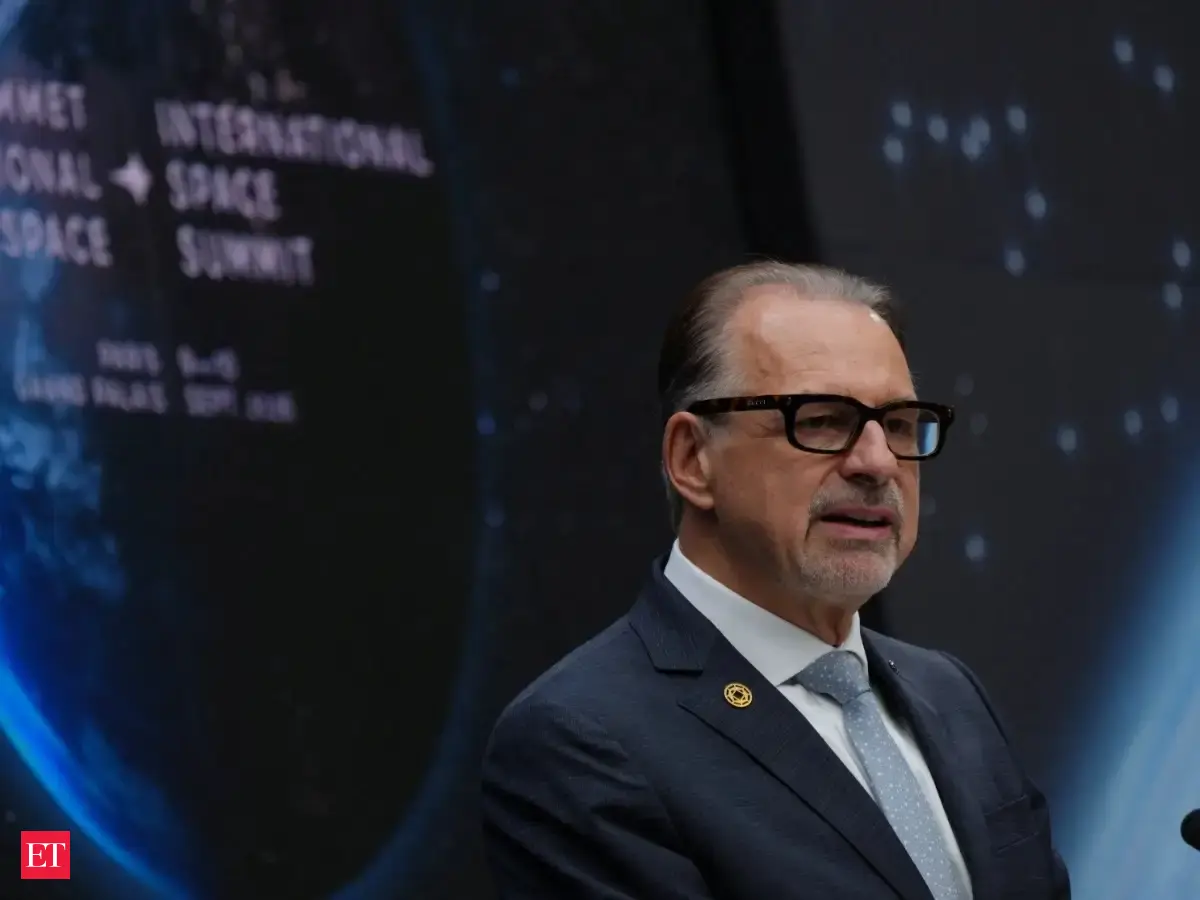
The head of the European Space Agency will visit the United Arab Emirates this week to discuss space collaboration. Europe wants to reduce its reliance on the United States. Josef Aschbacher said, "We realised that in exploration, Europe is very exposed to the United States." Many new partnerships are planned.
Synopsis
The head of the European Space Agency will visit the United Arab Emirates to discuss collaboration. This meeting aims to reduce Europe's dependence on the United States for space exploration. The ESA hopes to establish a framework agreement with the UAE to strengthen its exploration initiatives. Additionally, discussions may include potential investments and participation in upcoming programs. European governments must first ensure adequate funding before pursuing international cooperation.
PARIS: The head of the European Space Agency will meet officials in the United Arab Emirates this week as Europe seeks new partners and aims to reduce its reliance on the United States for space exploration.
The rise of Elon Musk's SpaceX has laid bare Europe's reliance on American space technology.
"Number one, we should strengthen our capability, become a stronger player in the global ecosystem, but one that uses its strength to still work with other partners," Josef Aschbacher, director general of the ESA, told Reuters. He will attend meetings in Dubai and Abu Dhabi.
"We realised that in exploration, Europe is very exposed to the United States," Aschbacher added, saying that European political leaders had told him that the region needed "more autonomy and more strength".
COOPERATION WITH NASA WEAKENED
Live Events
The ESA's decades-long cooperation with US space agency NASA has weakened after Washington scaled back or halted common projects, including the Lunar Gateway programme to deploy a space station in lunar orbit and the Mars Sample Return mission.
About 5% of the ESA's budget is linked to cooperation with the US, Aschbacher said. Europe also relies on US providers to send its astronauts into space.
Aschbacher said that over the longer-term the ESA hopes to sign a framework agreement with the UAE, which launched the Arab world's first mission to Mars in 2020.
The UAE operates several satellites, and sent two of its nationals into space through its astronaut programme, but cannot yet organise launches on its own and does not own an independent satellite navigation system like the EU's Galileo or the US Global Positioning System (GPS).
Discussions between ESA and the UAE include a possible lunar rover launch and the potential participation of an Emirati astronaut in the EPIC programme, which would fly a crew to the International Space Station aboard a SpaceX spacecraft.
Aschbacher will visit a joint venture between Franco-American startup Loft Orbital and Abu Dhabi-backed Marlan Space to develop a satellite constellation, after France and the UAE agreed to deepen a strategic defence agreement between the two countries.
Asked if the UAE could invest in projects in collaboration with the ESA, Aschbacher declined to discuss ongoing talks. He said in September that Europe would need €10 billion ($11.2 billion) over the next 10 years to strengthen its autonomy in space.
Aschbacher said the funding gap may be discussed with the UAE but he added that the ESA first needs European governments to agree on their own level of funding.
"Once this decision is made, we will look into international cooperation," he said.