
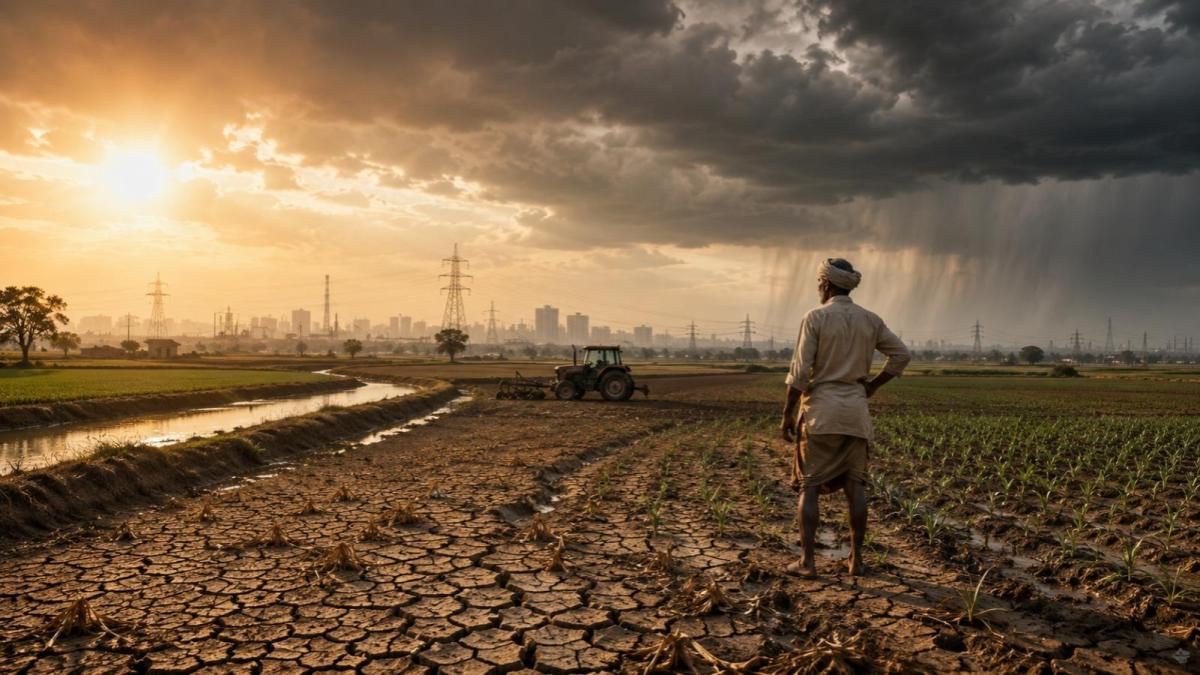
Southern India faces a tough winter crop season as reservoir levels fell to 42.34% on October 22. Many farmers struggle with drought, while Maharashtra expanded its drought declarations to 305 talukas. Government relief efforts started, but the arrival of El Nino leaves many worried about getting enough water for planting.
Rain has returned to parts of southern India but farmers preparing winter crops still face depleted reservoirs and losses from the summer season. With drought declarations widening, the next few weeks will test whether rainfall and government relief arrive in time to support sowing.
According to the Central Water Commission (CWC), its 50 monitored southern reservoirs were just 42.34% full on October 22, down from 47.22% on October 8. Karnataka and Maharashtra have expanded their drought declarations, while Andhra Pradesh is distributing subsidised seeds for the rabi season.
The northeast monsoon offers an opportunity to replenish water supplies. But its arrival, alongside forecasts of a strengthening El Nino, leaves farmers facing an uneven outlook: some districts could receive useful rain, while others remain short of the moisture needed to plant.
What the national averages hide
The national reservoir picture looks considerably better than the southern one. CWC's 178 monitored reservoirs were 66.70% full on October 22, although their combined storage remained 18.43% below the corresponding ten-year average.
In the south, the normal filling level for this date is 77.94% -- substantially above the current 42.34%.
The differences become sharper at state and reservoir level. Andhra Pradesh's monitored reservoirs were 28.44% full and Karnataka's 51.53%. Maharashtra's stood at 80.38% but Manjara held only about 11% of the water it normally stores at this time.
For farmers, these differences matter more than an all-India storage figure. Rabi prospects depend on the moisture remaining in their fields and the irrigation supplies they can actually access.
Maharashtra expands cash and fodder support
Maharashtra has now declared drought in 305 of its 358 talukas, up from 265 in the earlier assessment.
According to Indian Express, the government announced a Rs 5,000 advance payment per farmer ahead of Diwali, pending central drought assistance. However, IE reported on October 19 that guidelines and eligibility criteria had yet to be issued. The announcement therefore should not be treated as confirmation that farmers have received the money.
The state has also launched "Mission Murghas" to preserve green fodder as silage and sanctioned an additional Rs 76.41 crore for fodder-related measures, Indian Express reported.
A separate programme in 19 Vidarbha and Marathwada districts offers eligible livestock owners a subsidy of Rs 3 per kg of silage, subject to limits. Payment follows purchase and submission of proof.
The intervention addresses another source of rural financial pressure: fodder shortages can affect animal health and milk yields, reducing income when crop earnings are already under strain.
Karnataka seeks a larger central package
Karnataka's drought declaration now covers 226 taluks, compared with 217 in the earlier assessment.
In his latest statement, Deputy Chief Minister G Parameshwara said the state had sought Rs 20,585.73 crore under the National Disaster Response Fund. He put estimated agricultural losses at Rs 62,481.88 crore.
The request covers crop-loss assistance, support for small and marginal farmers, drinking water and livestock protection. Parameshwara also urged the Centre to expedite its assessment following a visit by an inter-ministerial team. These amounts represent assistance sought by Karnataka, rather than funds already released.
For the coming crop, the timing of relief matters: farmers must finance fresh cultivation while absorbing losses from the previous season.
Andhra Pradesh steps up seed distribution
Andhra Pradesh declared drought in 388 mandals across 21 districts through an October 1 order, with 283 classified as severely affected. According to Indian Express, the state acted before the October 31 declaration deadline following a substantial monsoon rainfall deficit.
The state agriculture department's seed-distribution dashboard records that 71,667 farmers had received subsidised rabi seeds by October 24, involving a subsidy of approximately Rs 30.06 crore.
Can the northeast monsoon repair the deficit?
The India Meteorological Department (IMD) said northeast monsoon rainfall began on October 15. The southern peninsula subsequently received 20% more rain than normal during October 15-21.
However, its cumulative rainfall for October 1-21 remained 45% below normal. A wetter week has provided relief without erasing the accumulated shortage.
IMD's seasonal outlook projects normal October-December rainfall across a defined southern belt covering Tamil Nadu, Kerala, coastal Andhra Pradesh, Rayalaseema and south interior Karnataka, including the associated Union Territory subdivisions.
Even within this area, the forecast is uneven: southern Kerala and Tamil Nadu are favoured for normal to above-normal rain, while much of the remaining region could receive below-normal rainfall. Maharashtra and north interior Karnataka fall outside this seasonal forecast area.
There is also a risk from excessive rain. IMD's October 25 cyclone bulletin forecasts extremely heavy rainfall at isolated places in Andhra Pradesh on October 27-28 and warns of damage to standing crops and plantations along the affected coast. Rain capable of replenishing supplies can also disrupt farming when it arrives with destructive winds or flooding.
How much could El Nino worsen conditions?
The World Meteorological Organization's October 21 update forecasts further strengthening of El Nino, with warming expected to peak around December.
Its models project sea-surface temperatures in the Pacific's Nino 3.4 monitoring region averaging about 3.8°C above normal during November 2026-January 2027; that figure describes Pacific Ocean warming.
For farmers, the concern is how changing rainfall and temperature patterns affect already limited water supplies. IMD's northeast monsoon outlook anticipates above-normal daytime and nighttime temperatures across much of southern peninsular India. It also warns that deficient rainfall in some areas could increase soil-moisture stress and irrigation requirements.
The strength of El Nino alone cannot establish how much a particular district's harvest will suffer.
What will decide the winter crop?
The immediate decisions are already becoming more cautious. IMD's October 23 agrometeorological advisory for north Karnataka recommends sowing only when adequate soil moisture is available and favouring short-duration, drought-tolerant crops. For wheat, it specifically advises sowing after sufficient rainfall or where irrigation is available.
The rabi season will therefore depend on several developments together: rain reaching depleted catchments, irrigation remaining available after sowing and financial assistance reaching farmers when they need to purchase inputs. A promising seasonal forecast offers an opening. Its value will be measured in water available to fields and crops farmers can afford to grow.