
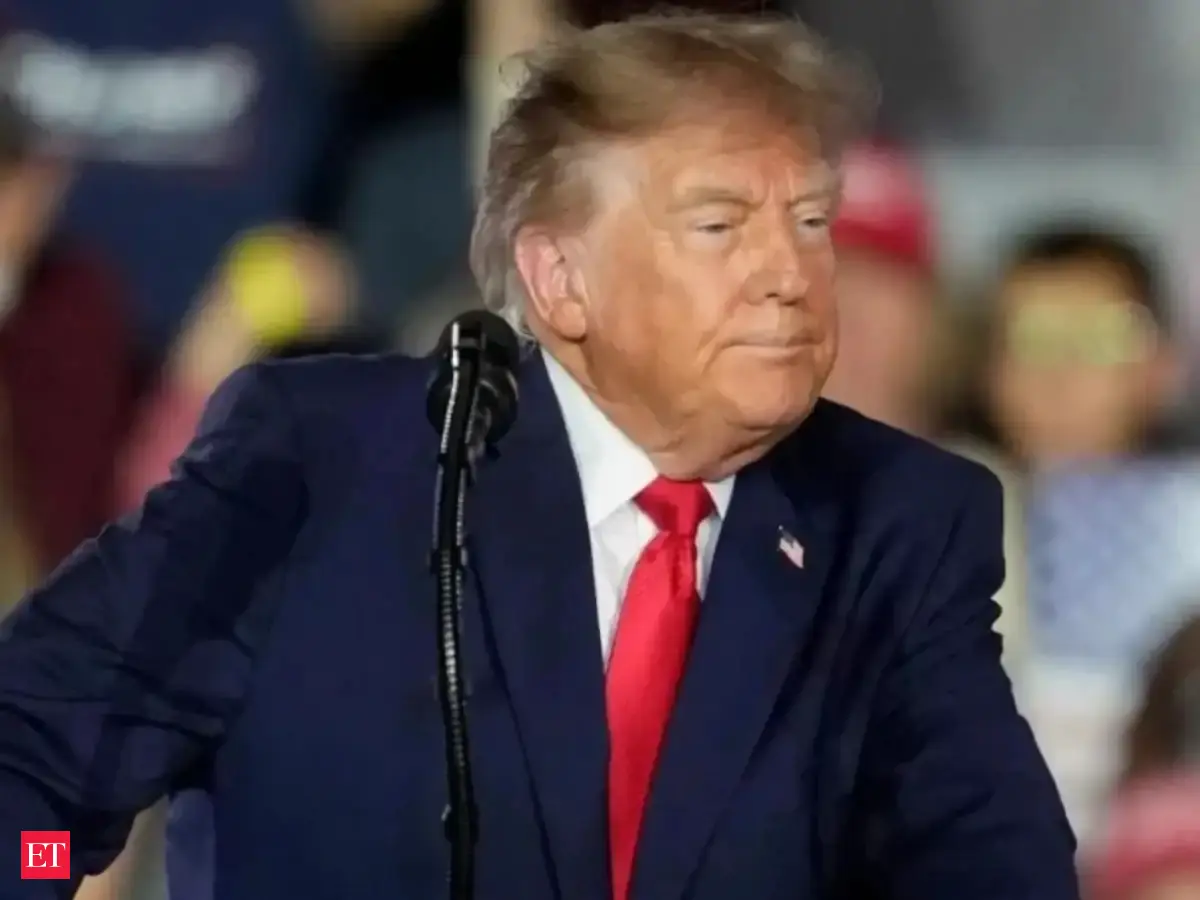
Democrats taking control of both US Congress chambers may ease pressure on India during trade talks with the Trump administration. Experts said, "The results have changed the equation significantly." While the existing 18% tariff is unlikely to change immediately, increased Congressional scrutiny could create new opportunities for Indian exporters soon.
Synopsis
The Democrats' takeover of both chambers of the US Congress could ease pressure on India in trade negotiations with the Trump administration, experts said. Greater Congressional scrutiny of tariffs may create opportunities for Indian exporters, although the existing 18% tariff is unlikely to change immediately and the bilateral trade agreement could face delays.
New Delhi: The sweeping blow to US President Donald Trump and his party in the midterm elections can significantly ease pressure on New Delhi in negotiations for a balanced trade deal with Washington, experts said. India should leverage the changed political landscape in the US to ensure all its sensitivities are addressed in the proposed bilateral trade agreement (BTA), they said.
Going forward, the setback to Trump's second term in office, with the Democrats seizing control of the House and the Senate, could henceforth provide greater clarity on tariffs and market access, helping drive India's exports to the US, experts said.
"The results have changed the equation significantly," said Biswajit Dhar, a leading trade expert. "The power of the US President will be curtailed as Congress will not give him a free hand."
According to Dhar, the negotiating counter has shifted in favour of India post the elections. "It will ease pressure on the government, and the changed situation should be leveraged to seal a balanced deal which looks eminently possible," he said.
Madan Sabnavis, chief economist at Bank of Baroda, said the US trade pact is unlikely to be affected by the election outcome, expecting the existing provisions of the deal to remain unchanged.
Live Events
Tariff may be reviewed
"While the trade agreement itself is unlikely to undergo any changes, a review of tariffs remains a possibility, particularly if Americans increasingly view higher tariffs as a key contributor to rising inflation in the US," Sabnavis said, adding such a move could benefit several countries, including India.
Last month, US secretary of state Marco Rubio said Washington is "trying to finalise a trade deal with India" and is "very close to doing that."
The US is the largest export market for India.
Vijay Agarwal, former chairman of the Textile Export Promotion Council, said the Democratic Party's victory could heighten Congressional scrutiny of Trump's tariff policies, creating potential opportunities for Indian textile and apparel exporters to seek more favourable trade terms.
"However, the existing 18% tariff is unlikely to change immediately, while the India-US trade agreement may face some uncertainty and delays," he said, adding India should therefore engage proactively with both the Trump administration and the Democrat's control of Congress to secure a stable and mutually beneficial trade framework.
With trade issues within the Congress's remit, experts expect the US government's overall policy regime to remain stable for the remainder of Trump's tenure sans any further irrational tariff hikes.
"What will matter to Indian exporters in the months ahead is how US policy on tariffs and market access takes shape," said Ajay Sahai, director general of the Federation of Indian Export Organisations (FIEO). "MSMEs, in particular, need predictable trading conditions to price orders confidently and plan shipments months in advance."
As part of the framework announced in February by the two countries for the first phase of the BTA, the US had committed to withdrawing the additional 25% tariff on Indian imports linked to New Delhi's procurement of Russian oil, while bringing down the reciprocal tariff to 18%.
However, the US Supreme Court, on February 20, struck down the reciprocal duties imposed under the International Emergency Economic Powers Act (IEEPA).
Subsequently, US slapped fresh 10% duty on Indian goods under a Section 301 probe into alleged forced labour practices. The measure applies to 16 other countries as well and is lower than the 12.5% tariff proposed by Washington in June as part of a broader Section 301 probe.
India's exports to the US rose 11% year-on-year to $50.8 billion in the first half of FY27. Imports climbed 26% to $32.3 billion in the same period.
(You can now subscribe to our Economic Times WhatsApp channel)
Some elections matter more than you know: No crop changed in the fields, yet sugar, coffee and soya got cheaper in a day
You can buy a walkie-talkie online. But can you legally use it?
KYB and KYC: Quick commerce, the Damani premium and what DMart must deliver – 3rd and concluding part
KYC and KYB: Inside Damani’s DMart, the retail chain for the middle class. And stock for the long term? – Part 2 of 3
Will it be a regulatory nightmare if an exchange lists on its own platform?
KYC and KYB: Inside Damani’s Avenue Supermarts that refuses to charge more – Part 1 of 3