
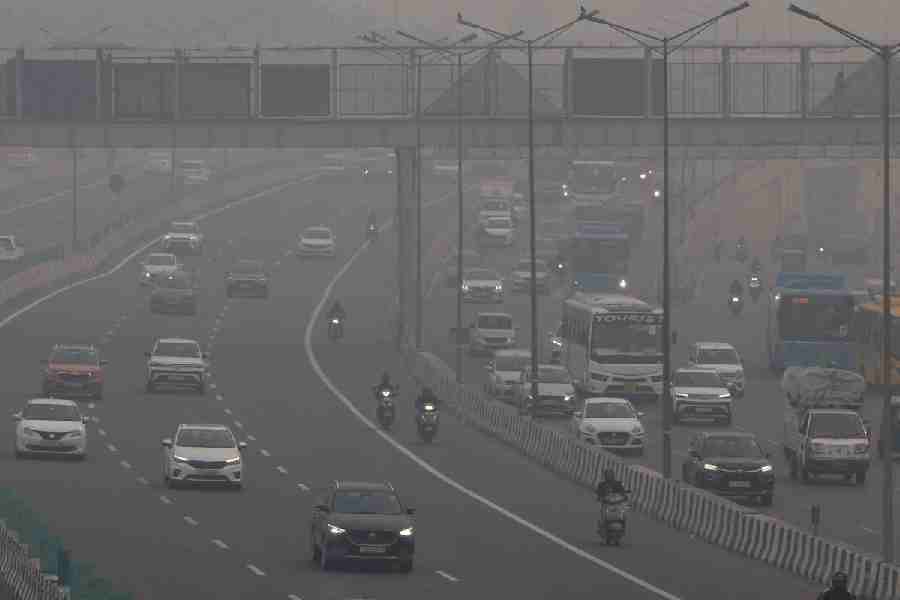
Delhi overtook Lahore as the world’s most polluted city on Friday as thick smog blanketed the capital. The Central Pollution Control Board recorded a severe air quality index of 403. Cold winter air trapped vehicle emissions and dust, making it hard for many people to see on the roads.
Delhi overtook Lahore in Pakistan to become the world's most polluted city on Friday, with air quality reaching hazardous levels and visibility dropping as smog blanketed the city of 20 million people.
Air quality index (AQI) in Delhi was "hazardous" at 334, making it the most polluted global major city, according to Swiss group IQAir, which measures air quality levels based on the concentration of toxins.
An AQI reading up to 50 is considered good with little or no health risk.
India's official Central Pollution Control Board pegged the AQI higher at 403 and rated it "severe".
The Swiss and Indian readings vary due to the different AQI scales and methodologies used to calculate and classify air pollution levels.
Cars and motorcycles emerged from dense smog, which also appeared to obscure street lights on the city's main roads, videos from news agency ANI showed.
Pollution is a seasonal problem in many parts of northern India and neighbouring Pakistan, as the cold, heavy air of winter traps vehicle emissions, construction dust and smoke from agricultural burning.
Delhi's air quality rises to 494
Delhi's air quality plunged into the severe category for the first time this season on Friday morning, with the national capital recording an average AQI of 403.
The Air Quality Index stood at 403 at 6.05 am and remained at the same level at 8 am and 9 am, according to the Central Pollution Control Board's (CPCB) Sameer app, which provides hourly updates on air quality. The city's overall 24-hour average AQI for the day will be recorded at 4 pm.
Of the 58 monitoring stations that recorded data at 8 am, 33 were in the severe category, 24 in very poor and one in the moderate category.
IIT Delhi recorded the worst air quality with an AQI of 488, followed by Chandni Chowk at 479 and North Campus of Delhi University at 478.
Burari Crossing recorded an AQI of 456, while both ITO and Jawaharlal Nehru University stood at 451.
Other areas in the severe category included Jahangirpuri at 430, Wazirpur at 427, Anand Vihar at 419, Rohini at 413, IGI Airport (T3) at 403 and Tikri Kalan at 402.
At 6.05 am, IIT Delhi recorded an AQI of 487, while North Campus and Chandni Chowk recorded 476 each. Pusa recorded 468 and NSUT Jaffarpur 461.
The thick blanket of smog reduced visibility in several parts of the city.
According to the CPCB, an AQI between zero and 50 is classified as 'good', 51 and 100 as 'satisfactory', 101 and 200 as 'moderate', 201 and 300 as 'poor', 301 and 400 as 'very poor', and 401 and 500 as 'severe'.
Delhi last recorded a severe air quality day on January 19 this year, when the 24-hour average AQI stood at 410.
The Commission for Air Quality Management (CAQM) had invoked Stage III of the Graded Response Action Plan (GRAP) across the National Capital Region on November 6, under the 'severe' air quality category, in anticipation of further deterioration in pollution levels.
Under Stage III, restrictions include a ban on several dust-generating construction and demolition activities across the NCR, closure of stone crushers and mining activities, and curbs on the movement of certain categories of vehicles.
These include restrictions on BS-III petrol and BS-IV diesel or older light motor vehicles in Delhi and high-vehicle-density districts of Gurugram, Faridabad, Sonipat, Ghaziabad and Gautam Buddha Nagar. Restrictions have also been imposed on the entry of certain diesel-operated BS-IV and older goods vehicles into Delhi.
If the city's 24-hour average AQI crosses 450 and enters the 'severe plus' category, Stage IV of GRAP, the highest level of anti-pollution restrictions, is triggered.
The minimum temperature at Safdarjung was recorded at 16.2 degrees Celsius, 2.7 degrees above normal.
Biomass burning, organic aerosols drive over half of Delhi's pollution load
Biomass burning and secondary organic aerosols emerged as the primary contributors to Delhi's air pollution on Thursday, accounting for 25.4 per cent each of the city's pollution load, according to source-apportionment estimates by the Indian Institute of Tropical Meteorology (IITM).
Vehicular emissions were the third-largest source, contributing 17 per cent, while secondary inorganic aerosols accounted for 11.8 per cent of the pollution load.
Within secondary inorganic aerosols, nitrate contributed 4.9 per cent, ammonia 4.1 per cent and sulphate 2.9 per cent.
Mixed combustion accounted for 10.7 per cent of the pollution, followed by firecrackers at 7.1 per cent. Waste burning, including municipal and plastic-rubber containing waste, contributed 1.5 per cent, while mineral dust and ash accounted for 0.9 per cent and industrial emissions 0.2 per cent.
Experts said secondary organic aerosols are formed through chemical reactions in the atmosphere and can originate from emissions linked to certain industries, diesel and petrol vehicles, and biomass burning.