
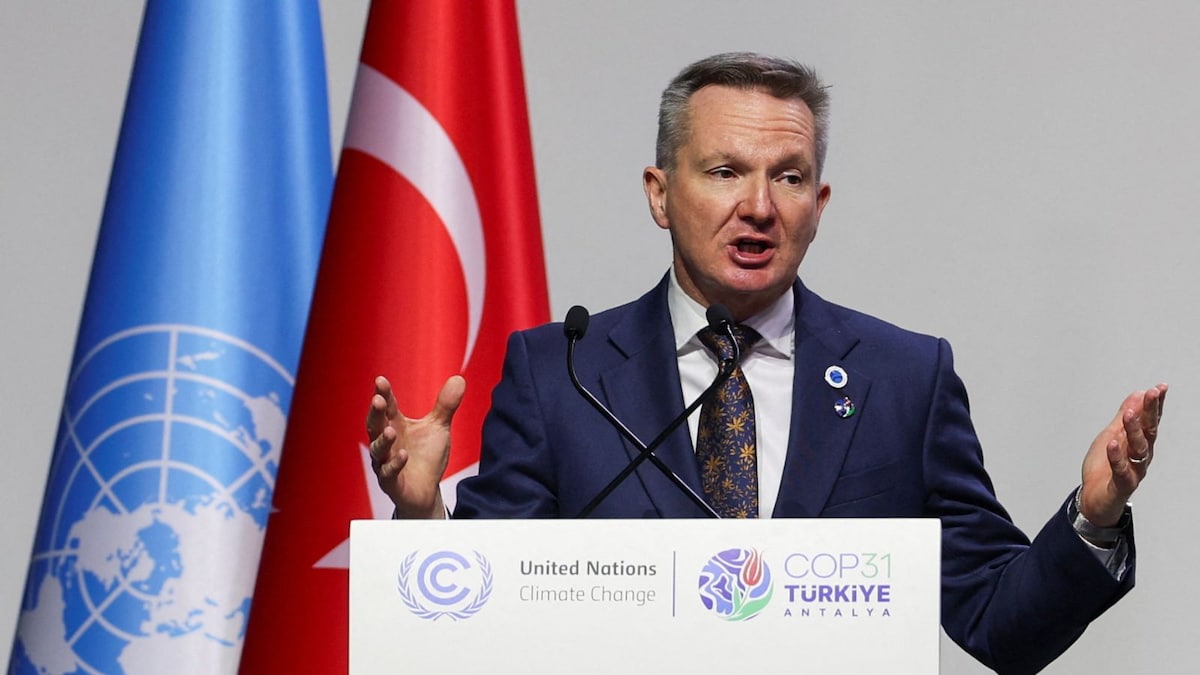
The COP31 climate summit opened in Antalya, Turkey, on Monday, November 9. World leaders said climate action is falling far behind as temperatures rise. UN Secretary-General António Guterres said, "We have entered a new age of climate extremes." Officials now want countries to focus on implementing their existing climate goals.
The COP31 climate summit opened in Antalya, Turkey, on Monday, November 9, with world leaders and climate officials calling for faster action against global warming as rising temperatures and increasingly frequent extreme weather events threaten lives, livelihoods and the global economy.
The two-week United Nations climate conference, running until November 20, comes amid growing concerns that the world is on track to breach the Paris Agreement's 1.5°C warming threshold, even as governments grapple with competing challenges, including geopolitical conflicts, inflation and the rapid rise of artificial intelligence.
"The urgency of this moment must drive us forward," UN Climate Change Executive Secretary Simon Stiell said in prepared remarks at the opening of the summit. He warned that progress on tackling climate change so far was "nowhere near fast enough".
The growing imbalance is expected to intensify extreme weather events, including heatwaves, droughts and tropical cyclones.
The WMO said the average global surface temperature between January and September 2026 was around 1.47°C above the pre-industrial average. Sea surface temperatures also reached monthly records, while global sea levels were at their highest since records began.
The oceans absorb around 90% of the excess heat trapped by greenhouse gases, and 2026 is on track to become the 10th consecutive year of record ocean heat.
"We have entered a new age of climate extremes," UN Secretary-General António Guterres said.
"A supersized El Niño is colliding with a planet already superheated by manmade climate change. Climate records keep falling. The human costs keep rising. And those least responsible are suffering first and worst," he added.
A separate United Nations Environment Programme report published in October warned that the world was already on course to overshoot the 1.5°C threshold above pre-industrial levels, the limit countries agreed to pursue under the 2015 Paris Agreement to avoid the most severe consequences of global warming.
The year has already witnessed extreme heatwaves across Western Europe and a glacier collapse in Nepal that triggered catastrophic flooding, killing more than 1,450 people, with thousands still missing.
COP31: Focus shifts from climate pledges to implementation
Beyond securing fresh commitments, COP31 is expected to place greater emphasis on implementing existing climate goals and ensuring that countries have the resources to deliver them.
In an interview with UN News ahead of the summit, Selwin Hart, the UN Special Adviser on Climate Action and Just Transition, said the challenge was no longer simply finding solutions to climate change, but ensuring that countries could access and afford them.
Clean-energy technologies, including solar power, electric vehicles and battery storage, have advanced rapidly. However, their benefits remain unevenly distributed across the world.
Emerging and developing economies outside China, which account for nearly two-thirds of the global population, received just 18% of global clean-energy investment in 2025.
Africa highlights the scale of the gap. Despite its significant renewable-energy potential, the continent attracts only a small share of global investment, while around 600 million people still lack access to electricity.
Hart identified the cost of capital as one of the biggest barriers to expanding clean-energy projects in developing economies. Financing renewable-energy projects in these countries can cost several times more than in wealthier nations, even when the technology involved is identical.
"We need solutions on finance that will not increase debt," Hart said, stressing that countries already struggling with debt burdens have limited resources to invest in climate protection alongside healthcare and education.
What is on the agenda at COP31?
Climate finance, adaptation, emissions reductions and a just transition to cleaner economies are among the key issues expected to dominate negotiations at the summit.
Developing countries are pressing wealthier nations to fulfil their financial commitments under the Paris Agreement, while disagreements remain over funding responsibilities and access to resources.
Negotiators will also work towards establishing a mechanism to support countries and communities through the transition to cleaner economies, alongside discussions on measuring progress on climate adaptation.
COP31 will also launch the second global stocktake, the Paris Agreement's formal process for assessing collective progress towards its long-term climate goals.
Türkiye, which is hosting and presiding over the summit, has placed particular emphasis on implementation, with initiatives spanning clean energy, food security, resilient cities, greener industries, oceans and waste reduction. Australia is leading the negotiations in coordination with Pacific Island countries.
The Turkish presidency has also called on countries to support a target of electrifying more than a third of the global economy by 2035, compared with around a fifth currently.
Is the 1.5°C climate target still within reach?
While scientists warn that the world is on course to temporarily exceed the 1.5°C warming threshold, the extent and duration of this overshoot will depend on the actions taken by governments, businesses and societies.
Hart cautioned against treating the prospect of overshooting the target as a reason to abandon climate efforts.
"Overshoot is not surrender. Overshoot should really lead to a much greater degree of urgency," he said, calling for faster emissions reductions and greater investment in protecting vulnerable communities.
He also pointed to the rapid expansion of solar power, electric vehicles and battery storage as reasons for optimism, arguing that the world is better equipped than ever to tackle the climate crisis.
COP31 is unlikely to resolve the climate crisis over its two weeks of negotiations. However, its ability to address financing barriers, improve access to clean-energy technologies and turn existing commitments into tangible action will be an important measure of its success.