
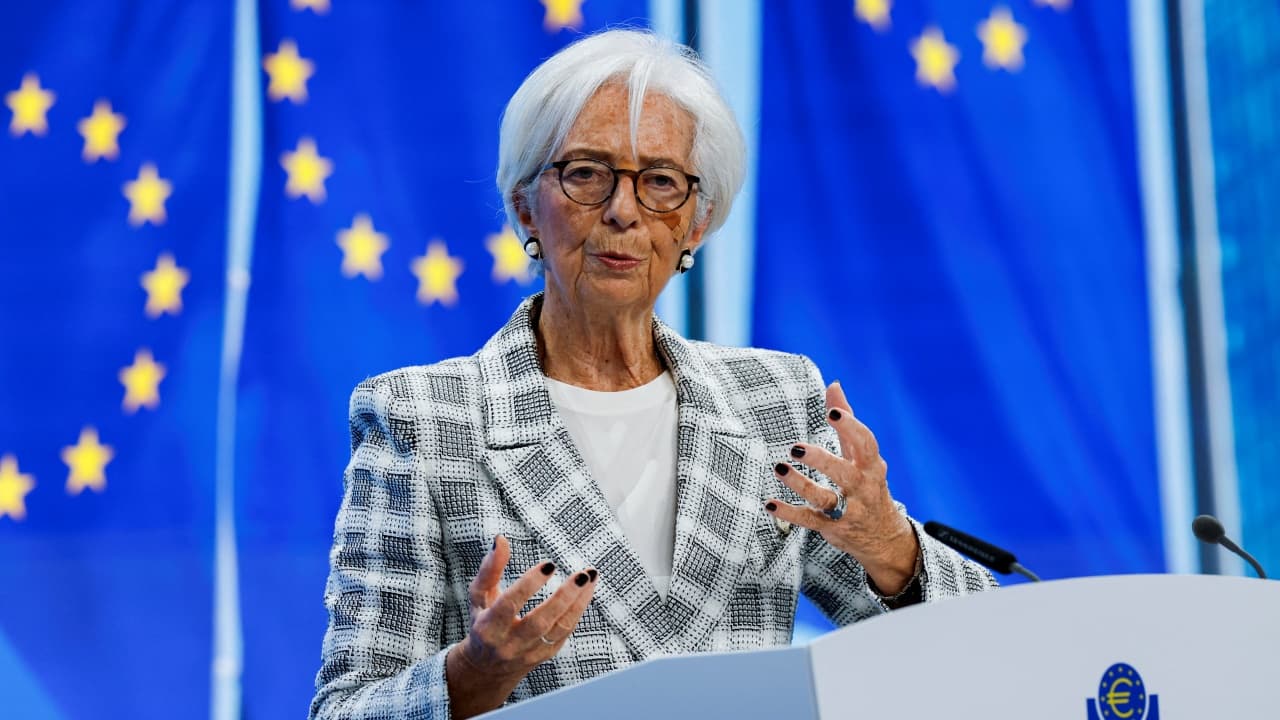
European Central Bank President Christine Lagarde will leave office on February 7. She resigned to weigh in on political issues in France and internationally. “I leave this institution with a sense of good work done and an ECB that is fit for the future," Lagarde said in a video.
Market Mastery
Webinar by Vishal Malkan
Find the weak links
in your portfolio by Vishal Malkan
European Central Bank (ECB) President Christine Lagarde has decided to step down before the end of her term, bringing forward a leadership transition at a time when Europe faces renewed inflation risks, rising government borrowing costs and political uncertainty in France.
Lagarde, 70, will leave office on February 7, Reuters reported on Thursday. Her term was originally due to end in October 2027. The early departure is intended to give European Union leaders time to select her successor before France’s presidential election, according to the report.
The decision has also prompted questions about Lagarde’s plans after the ECB. A source with direct knowledge of the matter told Reuters that she had resigned to give herself greater scope to weigh in on political issues in France and internationally. As head of the central bank, she was expected to maintain political neutrality to preserve its independence.
The World Economic Forum (WEF) has emerged as a possible destination for Lagarde after her departure, Reuters reported. The organisation declined to comment on the speculation.
“I leave this institution with a sense of good work done and an ECB that is fit for the future," Lagarde said in a short video shared on social media.
Why is Lagarde leaving before her term ends?
The timing of Lagarde’s exit is central to the debate surrounding her decision. Leaving in February would allow EU leaders to appoint a successor several months before France’s presidential election, avoiding a leadership change at the ECB closer to the vote.
A source familiar with the matter told Reuters that Lagarde wanted the freedom to engage with political issues in France and globally. Her position at the ECB, however, requires her to remain above domestic political considerations.
Lagarde has previously said she would not run for the French presidency. She has nevertheless indicated that she would support pro-European values in France “in whichever capacity" she considered most effective.
Her departure has drawn different reactions from European officials and economists.
Markus Ferber, a German member of the European Parliament from the centre-right European People’s Party, criticised the timing, arguing that it could raise questions about the ECB’s political independence.
“The impression arises that such a departure is timed around national elections, it damages trust in an institution that must stand above any domestic political calculation," Ferber told Reuters.
Ferber sits on the parliamentary committee involved in confirming Lagarde’s successor.
Marcel Fratzscher, president of German economic think tank DIW, viewed the move differently, describing it as “a strong sense of responsibility towards Europe".
“By leaving office early, Christine Lagarde gives European governments and institutions an opportunity to appoint a successor who will safeguard European values and protect the ECB’s independence," Fratzscher told Reuters.
What happens next at the European Central Bank?
European Council President Antonio Costa said the process to identify Lagarde’s successor would begin immediately, Reuters reported.
The selection comes amid other changes expected at the ECB’s executive board. Executive board member Isabel Schnabel is due to leave in early January, while chief economist Philip Lane is scheduled to depart in May. The appointments could therefore form part of a wider reshuffle of senior positions at the institution.
Klaas Knot, the former head of the Dutch central bank, and Pablo Hernandez de Cos, the former governor of the Bank of Spain, are widely viewed as leading contenders to replace Lagarde, according to Reuters.
The successor will inherit responsibility for setting monetary policy across the eurozone, which comprises countries that use the euro. The central bank’s decisions affect borrowing costs, inflation, business investment and economic activity across the bloc.
Market participants have so far appeared relatively unmoved by the prospect of a leadership change.
“The rumoured successors are both very competent, well established central bankers, so for markets, it won’t matter too much," Piet Haines Christiansen, an economist at Danske Bank, told Reuters.
Simon Dangoor, Goldman Sachs’ head of Fixed Income Macro Investing, said the ECB’s established institutional framework was likely to limit the impact of a change at the top.
“The ECB is now quite well established, the market is familiar with the way it operates," Dangoor said. He added that the institution’s behaviour was likely to remain broadly similar regardless of who took over.
Iran war and oil prices add to the ECB’s challenges
Lagarde’s exit comes as the ECB confronts the possibility that higher energy prices linked to the Iran war could push inflation higher across Europe.
An increase in oil prices can raise transport, manufacturing and household energy costs. If these increases spread to the prices of other goods and services or lead to faster wage growth, inflation could remain elevated for longer, complicating the central bank’s decisions on interest rates.
The ECB must weigh the risk of persistent inflation against the possibility that higher borrowing costs could weaken economic growth. Raising interest rates can help restrain demand and price pressures, but it also makes loans more expensive for households and businesses.
The central bank is also facing pressure from rising government bond yields, particularly in France. Higher yields increase the cost of borrowing for governments and can feed into financing costs across the economy. For heavily indebted countries, sustained increases can further constrain public finances.
Will the ECB raise interest rates again?
Ahead of Thursday’s policy announcement, the ECB was widely expected to keep its deposit rate unchanged at 2.5%, while leaving the door open to another increase, potentially as early as December, Reuters reported.
Oliver Rakau of Oxford Economics said the possibility of higher energy prices feeding into inflation could increase the likelihood of another rate hike.
“There is likely a low bar to another hike in December, given the likelihood of another upward revision of the ECB’s inflation forecast due to higher energy prices," Rakau said.
The ECB was scheduled to announce its interest rate decision at 1315 GMT on Thursday, followed by Lagarde’s press conference at 1345 GMT.
Money markets were pricing in three further rate increases by the end of next year, which would take the deposit rate to 3.25%. These market expectations are not a confirmation of future ECB decisions.
The leadership transition will therefore take place alongside a crucial monetary policy challenge. The ECB will need to assess whether the energy-price shock is temporary or likely to become embedded in broader inflation, while accounting for the impact of higher borrowing costs on economic growth.
Lagarde’s early departure brings forward the question of who will lead the institution through this period. Her successor will inherit both the ECB’s established policy framework and the immediate challenge of balancing price stability with the economic consequences of tighter financial conditions.