
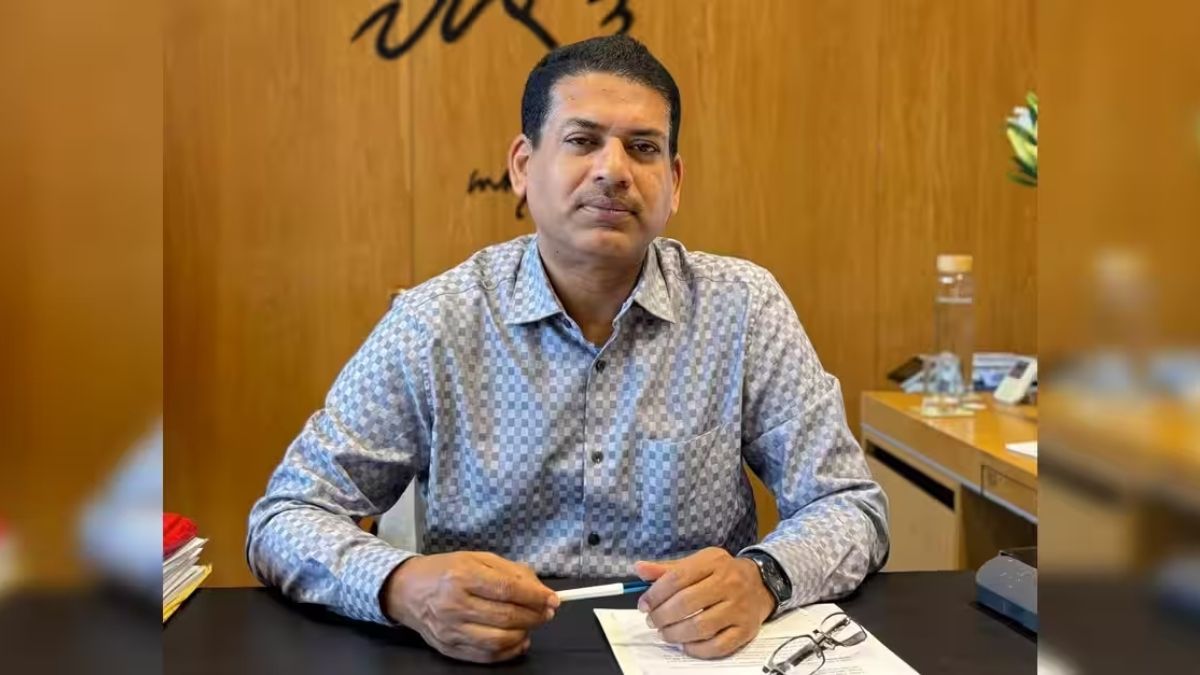
The Centre is weighing a Rs 35,000-crore outlay for PM-KUSUM-II, said MNRE’s Santosh Kumar Sarangi. The government plans to focus on farm solarisation and efficient irrigation. Officials said, "The next phase is being discussed with the Agriculture Ministry with a greater focus on convergence between renewable energy and agriculture."
The government plans a Rs 35,000 crore follow-up to PM-KUSUM, focusing on farm solarisation, efficient irrigation, and water conservation, while addressing challenges in solar project demand with acceptable pricing and storage solutions.
Q. What is being planned after PM-KUSUM? Could the new programme have an outlay similar to the existing scheme?
A. The financial support could be broadly similar to the existing PM-KUSUM outlay, though the final amount has not been decided.
The next phase is being discussed with the Agriculture Ministry with a greater focus on convergence between renewable energy and agriculture. It could incorporate modern water-conservation measures and more effective irrigation planning, rather than treating solar pumps as a standalone intervention. The structure and funding mechanism are still under discussion.
The existing PM-KUSUM programme has central financial support of about Rs 34,422 crore.
In several cases work is going on in the current scheme but payments have not been made. So there may be some spillover (in case of funds). In the case of legacy schemes, any legacy amount usually gets carried forward.
Q. A large renewable project pipeline is facing delays in signing PPAs and PSAs...
A. Some developers might exit as demand for plain, or "vanilla", solar projects (those without backward integration/storage support etc.) has weakened. Recent regulatory changes have provided an exit route without the earlier consequence of forfeiting certain bank guarantees linked to connectivity.
Some people will exit because the interest in vanilla solar is not very high. But vanilla solar with BESS is now selling well.
Rather than simply replacing every surrendered project with an identical tender, SECI is being asked to first understand what states and distribution companies actually require.
What we have now pushed SECI to do is to constantly talk to the states and discoms, understand their power profile and requirements, and only after understanding bring out those bids.
The idea was you keep on tendering, people will eventually buy. But we have reached a point where people are not going to buy vanilla solar. You have to offer them in a configuration that will be acceptable to them, and not only configuration but also the prices that are acceptable.
Q. Can India sustain renewable additions of around 50 GW annually?
A. This will be sustainable provided we also pick up on battery manufacturing capacity.
Dependence on imported batteries currently creates long delivery periods. Domestic manufacturing could accelerate storage deployment substantially. CEA projections envisage another 400 GW of renewable capacity by 2035-36, requiring battery storage, pumped hydro and green hydrogen to support growing solar and wind generation.
Q. Where does PM Surya Ghar stand against its one-crore household target?
A. Around 60 lakh households have been covered so far, with installations expected to cross 85 lakh and potentially reach 90 lakh by March 2027.
It has picked up pace, so we are confident of touching 85 to 90 [lakh]. The remaining roughly 10 lakh could take "one or two months" beyond March.
Q. Why has offshore wind failed to attract the same investor interest as solar and onshore wind?
A. Economics remain difficult. Onshore wind costs about Rs 7-7.5 crore/MW, against roughly Rs 25 crore/MW for offshore wind. Offshore power could cost around Rs 8-9/unit, while solar is available at Rs 2.40-2.50.
In India's case, the choice today is not compelling in favour of offshore wind because you have alternative access to cheaper electricity. The ministry is examining ways to attract developers without committing substantially higher incentives.