
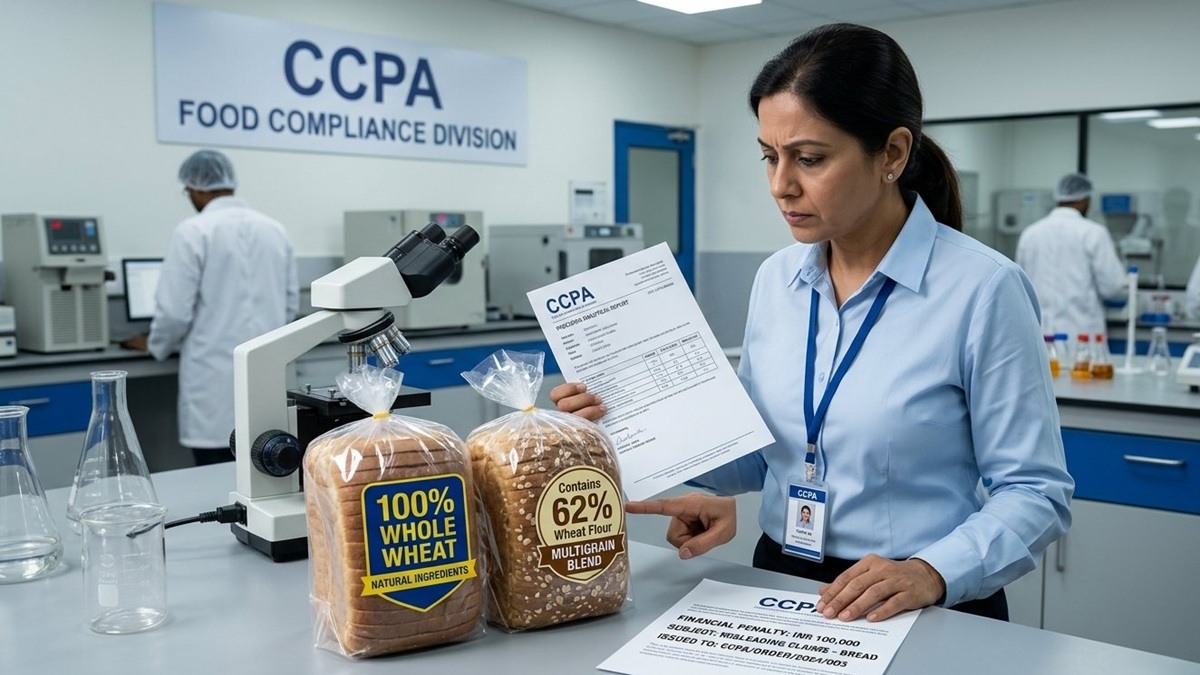
The CCPA fined a company Rs 1 lakh on October 22 for misleading bread labels. The product claimed to be 100% whole wheat but only contained 62% wheat flour. Officials said the claim "unequivocally conveys to an average consumer that the impugned product is composed entirely of whole wheat flour."
The order said the claims "100% Whole Wheat Bread" and "0% Maida" clearly led consumers to believe the product contained only whole wheat flour.
In its October 22 order, the CCPA held that the claim amounted to a misleading advertisement and unfair trade practice, and violated consumers' right to accurate information about a product's quality, quantity and composition.
According to the IE report, the company marketed the product as "100% Whole Wheat Bread" and also used the claim "0% Maida". According to the CCPA, these claims together created the impression that the bread was made entirely of whole wheat flour. However, the product's packaging showed that whole wheat flour accounted for only 62% of the total ingredients. The remaining portion included other ingredients such as water, yeast, wheat bran and other constituents.
The authority said the label did not merely exaggerate the wheat content; it also used the term "whole wheat" despite the product not meeting the legal threshold required for such a description.
Why CCPA called it misleading
Chief Commissioner Nidhi Khare and Commissioner Anupam Mishra observed that an ordinary consumer reading "100% Whole Wheat Bread" alongside "0% Maida" would reasonably believe the product was composed entirely of whole wheat flour.
"The claim of '100% Whole Wheat Bread', when read in conjunction with the accompanying claim '0% Maida', unequivocally conveys to an average consumer that the impugned product is composed entirely of whole wheat flour," the order said, Indian Express reported. The CCPA held that this created an "unambiguous, categorical and misleading impression" about the bread's actual composition, quality and characteristics.
Legal threshold for 'whole wheat'
Under food labelling requirements, a product described as "whole wheat" must contain at least 75% wheat. The bread in question contained only 62% wheat, falling short of that minimum requirement.
The CCPA said the company had therefore committed two separate violations: first, by representing the product as containing 100% whole wheat when its actual whole wheat content was 62%; and second, by using the term "whole wheat" even though the product did not meet the prescribed composition standard.
Company's defence rejected
The company argued that its labelling and advertising complied with applicable laws and regulations. It said the reference to the "goodness of wheat" was justified because wheat flour was the main ingredient and no other flour was used in the bread.
It also contended that "100%" was intended to convey that the wheat content was pure and that the product did not contain refined wheat flour, or maida, unlike competing products.
The CCPA rejected this interpretation. It said accepting such reasoning would allow products containing only a marginal proportion of atta -- for example, 5% -- and no maida to be marketed as "100% Atta Bread", leading to "absurd and impermissible consequences", IE reported.
FSSAI also flagged the advertisement
The CCPA initiated action on its own and first sought an inquiry into the company's claims. After the initial findings, it issued a notice on January 13, 2025, asking the company to explain why a detailed investigation should not be launched.
The company replied that its advertisements and labels were lawful. The CCPA then sought comments from the Food Safety and Standards Authority of India (FSSAI), which said the advertisement was misleading and could lead consumers to misinterpret the product's composition.
According to IE, FSSAI also clarified that meeting the composition requirement based on the flour used did not validate the use of the expression "100%" on the product.
Penalty and withdrawal order
The CCPA concluded that the company's conduct constituted an unfair trade practice and violated the consumer's right to be informed about the quality, quantity, purity, standard and other characteristics of goods. It directed the company to pay a Rs 1 lakh fine and immediately discontinue the misleading advertisement across all print and electronic media, including social media platforms.
The order reinforces the regulator's position that "100%" is an absolute numerical claim and must accurately reflect a product's factual composition, rather than being used as a broad health or purity message.