
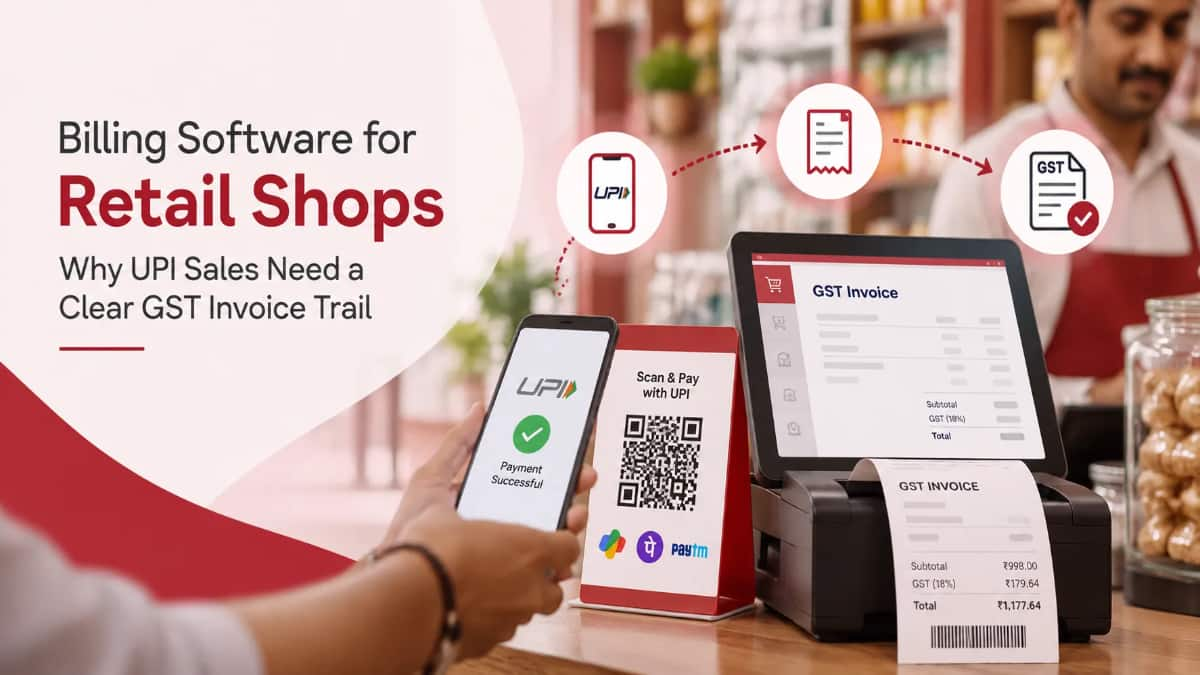
Retailers now need smart billing software to manage GST invoices alongside UPI payments. While UPI confirms money received, it lacks vital tax and inventory details. Good software connects sales, stock, and financial reports, helping shop owners track every transaction accurately. This simple shift saves many shops from messy accounting errors later.
India's retail counters have become faster at collecting payments. A customer selects a product, scans a QR code, completes a UPI payment, and leaves within minutes. But for a retailer, receiving the money is only one part of completing the sale.
The business must also maintain records of what was sold, the applicable GST, discounts, payment status and changes in inventory. When these details are maintained separately, even a successful digital payment can create accounting and reconciliation challenges.
This is why choosing the right billing software for retail shops has become increasingly important. Retailers need more than a tool that generates invoices. They need a system that connects billing, payments, inventory, and financial reporting.
Why a UPI Payment Confirmation Is Not a Complete Sales Record
UPI makes collecting payments convenient, but a payment confirmation does not replace the business records required for accounting and tax compliance.
A UPI transaction generally helps establish the payment amount, status, and transaction reference. A GST tax invoice, where required, records additional information such as the invoice number, date, item description, quantity, taxable value, and applicable tax.
Consider a customer who purchases grocery items worth ₹1,500 and pays through UPI.
The payment notification confirms that ₹1,500 was received. However, it does not necessarily explain:
Without a connected sales record, the retailer may need to reconstruct these details later.
A practical billing software solution should make it easier to keep transaction information together instead of maintaining disconnected records across notebooks, spreadsheets and payment applications.
What Billing Software for a Retail Shop Should Do
Good retail billing software should simplify everyday business operations rather than merely replace handwritten invoices.
The software should help businesses generate invoices with the applicable tax details, item descriptions, invoice numbers, and other information required for their transactions.
Retailers should be able to identify whether an invoice was paid through UPI, cash, card, or another method. Partially paid and unpaid invoices should also remain visible.
When a product is sold, the corresponding stock quantity should be updated so the retailer can monitor availability and plan purchases.
Sales returns, cancellations, and refunds should have a traceable connection to the original transaction.
Daily sales, payment collections, outstanding balances, expenses, and inventory reports should help shop owners understand business performance.
For shops handling numerous products and regular customer transactions, billing software for retail shop operations should also support practical needs such as faster checkout, item-wise billing, and stock management.
A Simple Example: How Day-End Reconciliation Works
Consider a small retail shop that made four sales in one day.
At the end of the day, the retailer checks the actual UPI payments and discovers that Sale 3 received only ₹2,500 instead of ₹3,000.
This means ₹500 remains pending from Sale 3.
After checking the payments, the retailer finds:
With connected billing and payment records, the retailer can identify the ₹500 discrepancy, correct the payment entry, and follow up with the customer.
This is why day-end reconciliation matters. It helps retailers spot missing payments, keep accurate records, and avoid accounting confusion.
Why Billing and Inventory Should Stay Connected
Payment accuracy is only one part of retail management.
Suppose a shop sells five packets of a product but updates its stock register only at the end of the day. If several employees are billing simultaneously, the recorded quantity may differ from the actual stock available.
When billing and inventory are connected, sales entries can update stock records as transactions occur.
This helps retailers identify fast-moving products, monitor low-stock items, manage purchase planning, and reduce the effort involved in physical stock verification.
It is particularly useful for grocery shops, supermarkets, pharmacies, hardware stores, and other businesses that handle many products.
How Better Billing Records Support GST Reporting
For GST-registered retailers, accurate sales records are essential to preparing returns and maintaining supporting documentation.
GST reporting requirements vary by transaction type. Relevant outward supplies may need to be reported at the invoice level or in consolidated form.
Errors in the original billing records can therefore create additional work during return preparation.
For example, inconsistent invoice amounts, missing tax details, or incorrectly classified transactions may require manual review before reporting.
A structured billing system helps businesses maintain more consistent source records, making it easier for owners and accountants to review sales information.
However, using billing software does not automatically guarantee GST compliance. Businesses must still apply the correct tax treatment and review their records.
Questions to Ask Before Choosing Billing Software
Retailers should evaluate software based on how well it supports their daily workflow rather than selecting a product solely because it offers invoice printing.
A retailer should ideally test these capabilities using everyday transactions before making a long-term decision.
Conclusion: A Digital Payment Should Be Part of a Complete Business Record
UPI has made retail payments faster and more convenient. But receiving money digitally does not automatically make billing, accounting or inventory management more organized.
The real operational improvement comes when a sale can be traced from the items purchased and the invoice generated to the payment received, inventory updated, and relevant GST records maintained.
For Indian retailers, suitable billing software can reduce repetitive work, make day-end reconciliation easier, and provide clearer visibility into daily operations.