
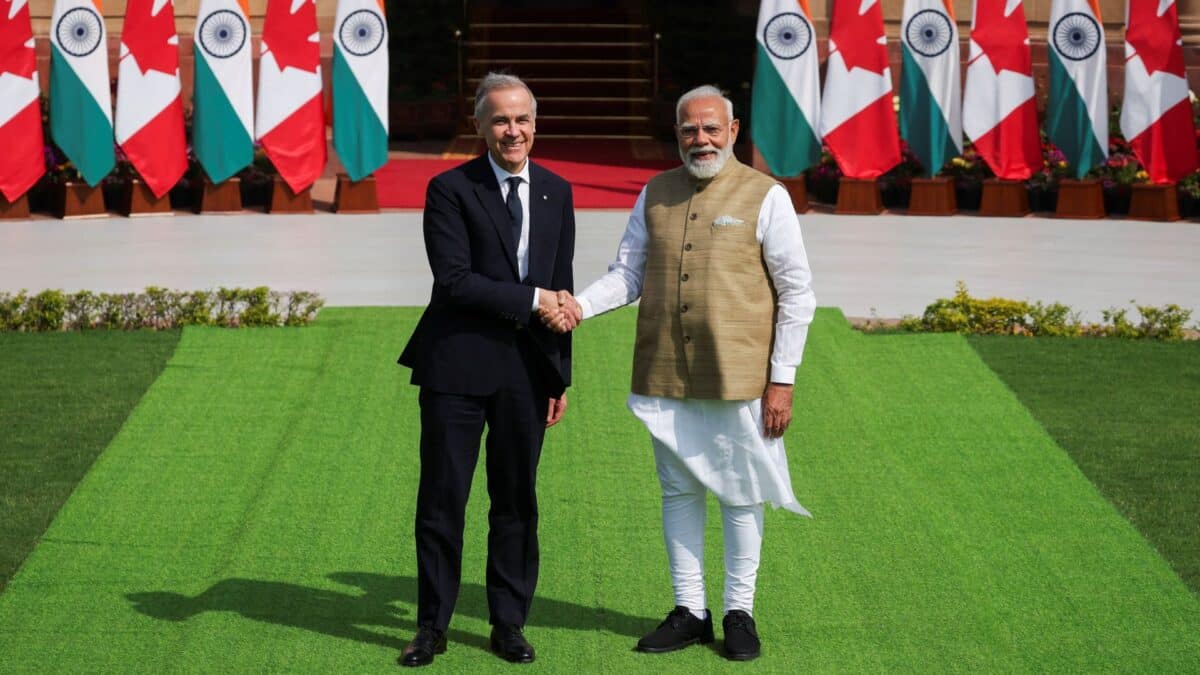
India and Canada are negotiating defence and information security agreements alongside a bilateral trade deal. High Commissioner Dinesh Patnaik said, "We're looking at space co-operation." These talks gained momentum before Prime Minister Narendra Modi’s visit next month. Both nations hope to reset their relationship and boost joint production in aerospace.
As part of a reset in India-Canada relations, the two countries are negotiating far more than a bilateral trade agreement.
Dinesh Patnaik, India's High Commissioner to Canada, said the two countries are also negotiating defence and information-security agreements.
The talks have gained momentum ahead of Prime Minister Narendra Modi's visit to Canada next month. The two countries are also expected to announce the bilateral trade deal during the visit.
Patnaik told The Globe and Mail that the proposed defence agreement would cover a range of areas, from strategic co-operation, including reciprocal port calls, to joint training for capacity building and joint production in the aerospace, naval, and space sectors. He described it as a win-win arrangement.
"We're looking at early warning and surveillance aircraft, and Canada's Bombardier is the best platform for it. We're looking at seaplanes from De Havilland. We're looking at space co-operation," said Patnaik.
Like Russia and France, Canada appears to be emerging as a potential partner for India's co-production ambitions in the defence sector.
"You need a lot of ammunition. You need a lot of explosives. There are Indian companies who are one of the top producers in the world who are willing to come and set up factory here to produce those things: 155-mm shells, shell casings, missile guidance systems, control systems," said Patnaik.
Since Canadian Prime Minister Mark Carney assumed office last year, the two countries have been working to reset their relationship. In 2023, then-Prime Minister Justin Trudeau linked the Indian government to the killing of Khalistani leader Hardeep Singh Nijjar and expelled Indian diplomats, triggering a cycle of diplomatic reprisals that plunged India-Canada relations to their lowest point. After Carney took office, both sides began efforts to repair ties.
As US President Donald Trump slapped the world's highest tariffs on India and mounted unprecedented political and economic pressure on Canada, including threats to annex the country and make it the 51st state, India and Canada have also sought to work together to minimise the impact of his disruptive policies.
Carney has emerged as a leading advocate of middle powers' convergence, and the India-Canada trade deal, along with the energy and defence agreements under discussion, is part of a broader churn in the global order. The effort complements both the India-EU trade deal and the growing Canada-EU alignment.
India and Canada upgrading security co-operation
Patnaik said India and Canada are working to transform their periodic NSA-level exchanges into a more institutionalised framework.
Patnaik said that the two countries are negotiating an agreement to share "sensitive, classified and deep-tech information" while ensuring its protection. He said such an arrangement is necessary for the trade or joint development of weapons and sensitive technologies.
Describing the proposed framework as a win-win arrangement, Patnaik said the two countries now have a better understanding of each other's concerns and that this is already yielding results. He noted that co-operation between the two sides has so far led to nearly 5,000 deportations from Canada for visa violations.
The situation is also evolving on the most contentious issue in the relationship: the Khalistan movement.
Patnaik said that "there was this whole perception in India among the security agencies that the security agencies in Canada were directly or indirectly supporting separatist elements here" but that the Indian government now "realises that the Canadians are actually not supporting the separatists, they’re just caught in laws which allow for freedom of expression in a manner which may not be palatable to the Indian side".