
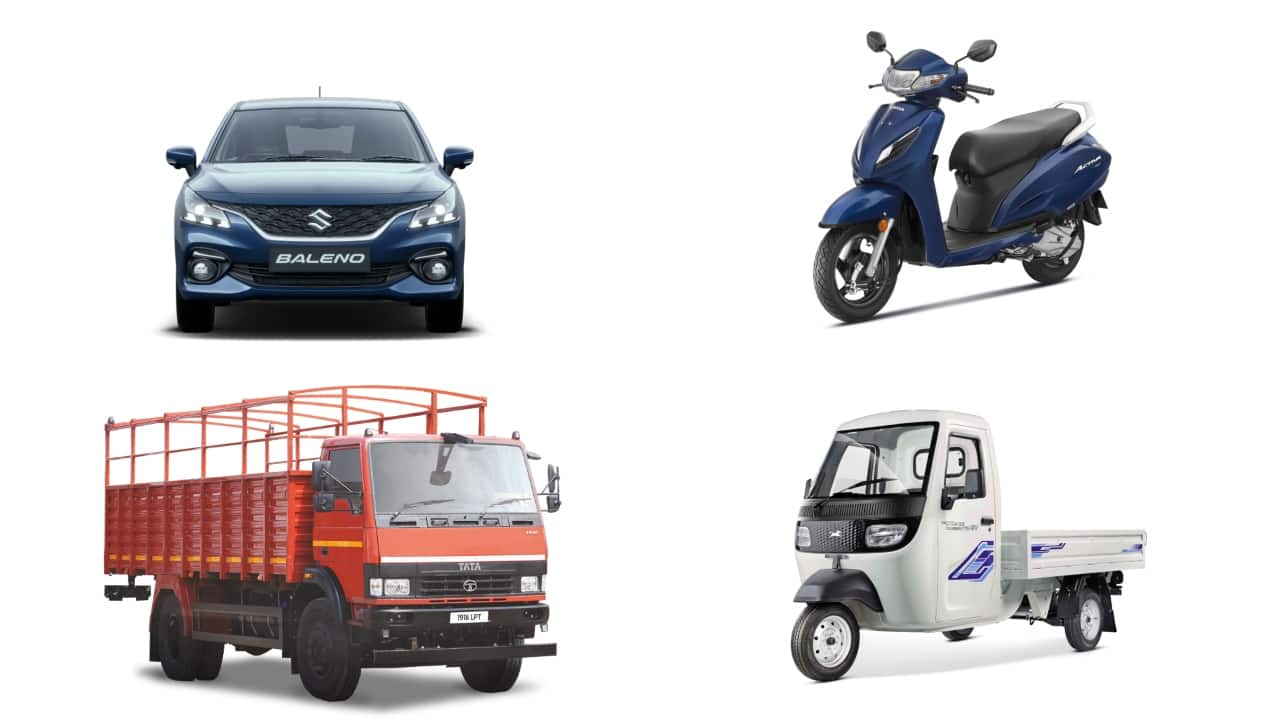
Auto sales in India rose 20% in the first half of FY27, reaching 1,58,00,017 units. SIAM President Shenu Agarwal said, "The Indian automotive industry delivered a strong performance in the first half of FY27." Growth was supported by festive demand and new launches, though rates might moderate later this year.
The automobile sales in India rose 20% year-on-year (y-o-y) in the first half of FY27, with industry body Society of Indian Automobile Manufacturers (SIAM) expecting growth to continue in the second half, supported by festive demand, new launches, infrastructure spending and replacement of older vehicles. The domestic sales across passenger vehicles (PVs), commercial vehicles (CVs), three-wheelers, two-wheelers and quadricycles increased 19.8% y-o-y to 1,58,00,017 units in April-September 2026, compared with 1,31,91,741 units in the corresponding period last year. However, growth rates could moderate in the October-March period due to a higher base following GST 2.0 last year. SIAM also flagged inflation, possible increases in interest rates and geopolitical developments as factors to watch. Passenger vehicles lead H1 growth PV sales increased 28.3% to 26,37,067 units in H1 FY27 from 20,55,122 units a year earlier. Utility vehicles continued to account for the bulk of volumes, with sales rising 31.4% y-o-y to 17,83,535 units. Passenger car sales grew 23.1% y-o-y to 7,66,200 units, while vans rose 15% y-o-y to 87,332 units. While the two-wheeler sales increased 17.6% y-o-y to 1,20,86,812 units, scooters grew faster than motorcycles. Scooter sales rose 29.4% y-o-y to 48,65,192 units, against a 10.4% y-o-y increase in motorcycles to 69,28,700 units. In the CV segment, the sales jumped 23.8% y-o-y to 5,74,255 units, while three-wheeler sales increased 26.3% y-o-y to 5,01,879 units. SIAM President Shenu Agarwal attributed the industry's performance to improved affordability following GST 2.0, resilient rural and urban demand, healthy freight movement, infrastructure-led economic activity and a gradual replacement cycle across vehicle segments. "The Indian automotive industry delivered a strong performance in the first half of FY27, following a robust second quarter and a strong September 2026," he added. Record Q2 volumes support first-half performance All four major vehicle segments recorded their highest-ever second-quarter sales in July-September 2026, according to SIAM. PV sales increased 30.7% y-o-y to 13,60,687 units during Q2 FY27. Utility vehicle sales grew 34.2% y-o-y to 9,19,068 units, accounting for about 68% of PV volumes. The two-wheeler sales rose 15.2% y-o-y to 64,32,842 units, while CVs increased 28.7% y-o-y to 3,09,063 units. The three-wheeler sales grew 23.6% y-o-y to 2,85,342 units. In September 2026, the PV sales increased 21.8% y-o-y to 4,54,574 units, two-wheelers rose 13.5% y-o-y to 24,63,103 units, and three-wheelers grew 16% y-o-y to 98,162 units. Positive H2 outlook, but growth may moderate SIAM expects new PV launches to sustain consumer interest in the second half. Festive demand is expected to support two-wheelers in the near term, although growth rates may moderate against the higher post-GST base. Three-wheeler demand is expected to benefit from cargo applications and last-mile mobility requirements. Infrastructure spending, fleet replacement and demand generated by the PARIVARTAN scheme are expected to support CVs. "Continued investments in infrastructure, sustained economic growth, and rising adoption of cleaner and more efficient mobility solutions are expected to support industry growth through the second half of FY7," Agarwal said.