
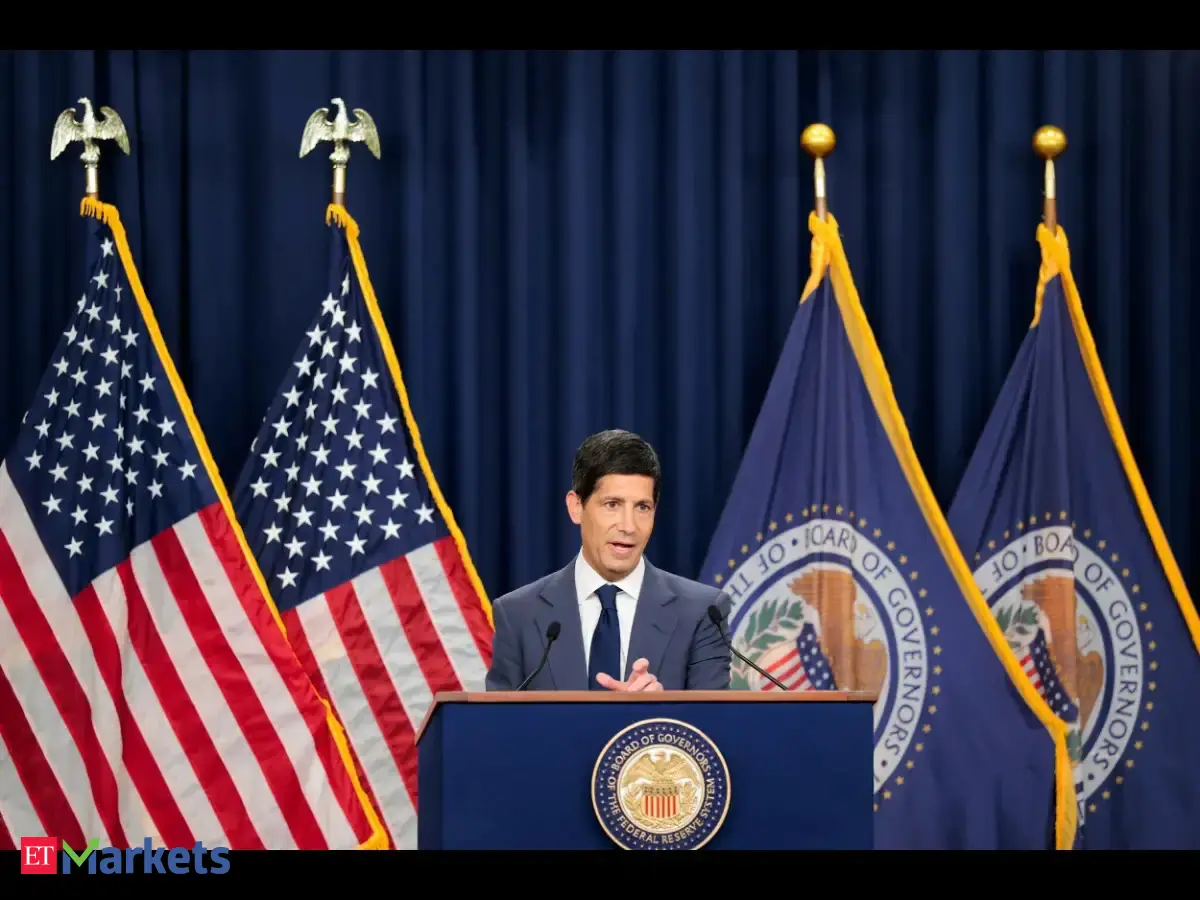
Federal Reserve Chairman Kevin Warsh faces a tough challenge as the AI boom sparks inflation worries. Officials debate if the technology drives growth or economic trouble. Warsh said he is "cautiously optimistic" about super intelligence. The Fed plans a rate increase at their December 8-9 meeting to manage demand.
Federal Reserve Chairman Kevin Warsh has called artificial intelligence a "hinge" of history critical to US leadership, but the technology has also become key to Fed policy as officials debate whether the AI boom is a transformational moment, a source of inflation, or the harbinger of an economic meltdown.
For Warsh, who calls himself "cautiously optimistic" about what he refers to as "super intelligence," as President Donald Trump does, it may be an all-of-the-above dilemma that challenges the US central bank and his leadership of it.
S&P 500 Top Gainers
NVIDIA165.05(31.48%)
Dell Technologies334.91(20.46%)
Micron Technology707.70(19.04%)
Hewlett Packard48.02(17.38%)
S&P 500 Top Losers
CrowdStrike Holdings208.97(-8.92%)
Coterra Energy32.56(-8.62%)
International Paper28.98(-4.55%)
Elevance Health379.55(-3.78%)
"This is a serious test for Warsh," Evercore ISI Vice Chairman Krishna Guha, a former New York Fed official, wrote after major US equity indexes closed last week in correction territory. They were dragged down by nervousness about AI's ability to pay off and by unease over the scandal around AI chip giant Nvidia and the brief ouster of its CEO.
Recent inflation and growth data "is too hot and too strong ... But with growth dependent on AI investment and AI consumer net-worth effects, the Fed needs any weakening to remain contained," Guha wrote. "Warsh needs to balance the data with markets that suggest the forward look is cooler, and his desire to assert inflation credibility with his desire not to go down in history as the Fed chair who blew up the AI boom."
After a run that saw a political backlash against AI, a market slump, a major initial public offering, a massive corporate scandal, and a seeming rebound from it all with equity markets again surging, Fed officials are expected to follow through with a quarter-percentage-point rate increase at their December 8-9 meeting. While they do not necessarily aim to - or have any guarantee they can - slow the AI boom, many see it pushing growth beyond potential and see the need to restrain some aspects of investment and demand.
Live Events
"If the investment rate slows way down, then yes, I'd be less concerned that there would be overheating in the economy," Chicago Fed President Austan Goolsbee told reporters last week, likening the strain AI puts on capacity to trying to get a "pig through the python."
But the impact of rate hikes on the economy "doesn't have to be sector by sector," he said. "The Fed has only one tool, which is to tighten rates ... I do think data centers are included in that business investment" and might be influenced by rising borrowing costs.
'VERY TROUBLING SIGN'
Some US central bank officials have recently discussed AI.
Fed Governor Lisa Cook noted possible financial risks and the likelihood that AI is already eliminating jobs, and Fed Vice Chair Philip Jefferson said AI investment is currently raising inflation, with any productivity benefits still to come.
Warsh, who before taking over as Fed chief had cautioned central bankers to avoid taking sides on political issues like climate change, has called success in AI a make-or-break issue for the US.
"We are at a hinge point for the US economy, the United States' role in the world," Warsh said last week at an AI conference he commissioned, held at the San Francisco Fed. "I don't think any of us are impartial to how we want that to come out."
Increasingly, however, Warsh's colleagues see a more nuanced debate and are focused on near-term implications.
The volatility has been apparent: Nvidia reversed course and rehired Jensen Huang as its chief executive officer on Monday, and stocks surged back after recent sharp losses.
Politically, the country has become more divided, too, about how to balance AI's benefits and risks, the pace of construction, and concerns that the technology is moving too fast without proper oversight.
"People are afraid. When the average American hears AI, they hear I'll lose my job, my kids will lose their jobs, my children's mental health, national security, some version of that," former US Commerce Secretary Gina Raimondo said on a panel with Warsh at his AI conference.
Raimondo, who currently co-chairs a nonprofit trying to ease the AI transition for workers, noted that many ballot initiatives meant to slow data-center construction were approved by voters during the recent US midterm elections.
"I think that is a very troubling sign," she said. "When people are afraid they say 'stop.' I think that would be very bad for America and for them. So where I think we have to go from here is to figure out how we address people's legitimate concerns."
WARSH 'BROUGHT THIS REVOLT ON HIMSELF'
The Fed's role, as Warsh likes to note, is not to pick winners and losers but to guide the credit conditions in which all firms operate, in ways that affect inflation.
Fed officials' view of AI investment as a source of inflation has put the Fed at direct odds with Trump, who wants the boom to roll on. Treasury Secretary Scott Bessent and other administration officials say rising prices are primarily the fault of still-high global oil prices that will fade as energy costs ease.
Warsh, who has defined his chairmanship partly by avoiding guidance on upcoming policy decisions, has acknowledged that AI "hits demand first," with supply and productivity improvements coming later and possibly helping ease inflation down the road.
But he has not yet made the same leap as others and has avoided commenting on whether he feels the AI boom and inflation are now running hand in hand, and on how the Fed may need to respond.
That question has become a key issue ahead of the next policy meeting, when policymakers are due to update their interest rate projections after a period in which the rhetoric of many of them leaned hawkish even as the election results, stock markets and other dynamics pointed to a possible slowdown.
The problem for markets since the midterm elections "has not been just the prospect of an AI slowdown. It's also been that the Fed has seemingly ignored the risks and uncertainty that the post-election period has brought, and thrown caution to the wind," Macquarie analysts wrote recently. "In a way, Warsh has brought this revolt on himself, by not abandoning his own aversion to expressing forward guidance," even as the debate around what he sees as the signature economic issue of the day has become more complex.
(You can now subscribe to our ETMarkets WhatsApp channel)
(What's moving Sensex and Nifty Track latest market news, stock tips, Budget 2025, Share Market on Budget 2025 and expert advice, on ETMarkets. Also, ETMarkets.com is now on Telegram. For fastest news alerts on financial markets, investment strategies and stocks alerts, subscribe to our Telegram feeds .)
Subscribe to ET Prime and read the Economic Times ePaper Online.and Sensex Today.
Top Trending Stocks: SBI Share Price, Axis Bank Share Price, HDFC Bank Share Price, Infosys Share Price, Wipro Share Price, NTPC Share Price
...moreless
As AI sharpens cyber attacks, should listed companies follow one standard in reporting them?
KYC and KYB: Zydus Lifesciences – From the chemist’s counter to US pharmacies. Part 1 of 3
What would it take for the world to stop needing the Strait of Hormuz?
Hidden export winners: The unlikely products finding real buyers abroad
India’s USD25 bn copper drive moves from building smelters to securing mines
Why IndiGo could land a sharp rebound in profit despite a sluggish aviation market