
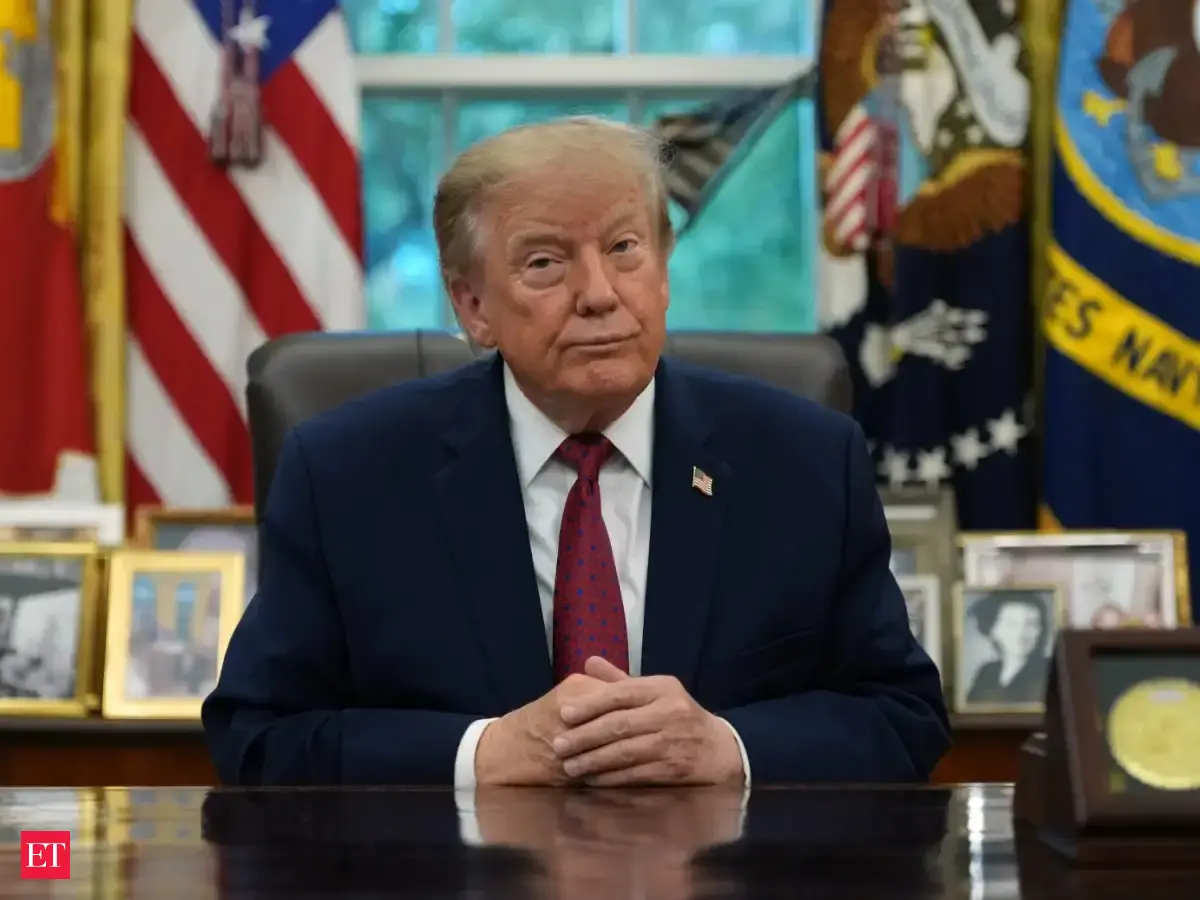
Voters flipped control of both houses of Congress, yet global distrust of the United States remains high. London founder Joe Reeve said, "What everybody's learned is that America's system does allow for these wild swings." Many international observers now wait to see if the nation will actually change its direction.
Synopsis
Joe Reeve, a London startup founder, expressed global concern over the uncertainty following the midterm elections. Many international observers doubt whether the election results will lead to significant policy changes. Political leaders and business owners are cautious about America's potential direction under continued Trump influence. The emotional aftermath of the elections enhances feelings of distrust in American governance worldwide.
London: For Joe Reeve, the midterm afterglow faded fast.
The London startup founder was among the wave around the Trump-weary world awakening to the stunning news that Americans had sharply rejected President Donald Trump's fist-in-the-eye stewardship of the United States that had started a war with Iran, forged no peace in Ukraine or the Mideast and made gas and food so expensive.
Voters, Reeve saw online, had flipped control of both houses of Congress, handing the power to check the president to his rival Democrats. American democracy, 250 years on, had survived the Trump era.
But a deep and profound distrust of the United States had survived the vote, too. And from national leaders to aspiring American immigrants, no one seemed confident that change was afoot.
Live Events
"What everybody's learned," Reeve, 29, the husband of a Ukrainian, said a day later in an interview, "is that America's system does allow for these wild swings. We all know, now, that America has an ability to rotate on a dime and spit in our faces."
Interviews by The Associated Press around the world since the vote revealed a sense that "one election alone does not restore anything," as Kim So-jung, 49, an office worker in Yongin, South Korea, put it. "We have to see what they actually do, and see that they are doing something different to gain at least a little trust back."
And now? 'What happens next matters a lot more'
That 77 million Americans voted to elect Trump to a second term, along with the administration's combative conduct on his tariff war, Israel's conduct in Gaza, immigration and Iran, had already shaken trust in America around the world.
By the time Americans awakened Wednesday, global leaders and regular people from Europe to Australia had moved beyond the "wow" to a reckoning with the reality that Trump still retains enormous powers.
"Quite frankly, Trump has largely governed without Congress for the past two years. Why should that change now?" German Chancellor Friedrich Merz said a few hours after voters flipped control of the House and Senate.
Trump's apparent detachment from the results and his focus on building projects in the days before and after the drubbing did little to calm speculation about how he governs. He could dissociate completely, some observers said. Or he could lean into foreign policy and become even less predictable.
"For the country's allies, the question isn't whether America is back," Ian Bremmer, president and founder of the Eurasian Group, wrote in Think China. "It's back to what - and for how long?"
The stunning midterm elections were not enough to reverse policies that have strained economies and finances and put dreams of making it in America on hold for many across the globe.
Trump's tariff war has roiled markets and economies. He canceled humanitarian aid for millions and upended the world's postwar order. Under Trump, American immigration policy turned violent and deadly - and makes the U.S. look to many like a place better avoided.
There was no sign of Trump letting up. On Friday, he promoted longtime aide Stephen Miller, a key architect of his hard-line immigration policy, to replace Susie Wiles as White House chief of staff.
"I don't think all is forgiven," ReadtheLine.ca Editor Jen Gerson said during an online discussion Thursday. "The President's hold on power over two terms is - and ought to remain - a warning sign to Canada and to all of America's allies."
America's political and economic uncertainty can affect businesses like Synetica, an Indonesian tech company, one of its business development managers said.
"For me, regaining trust means seeing America consistently respect democratic institutions, the rule of law and its international partners," Aditya Surya, 40, of Yogyakarta, Indonesia, told the AP. "The election is a good start, but what happens next matters a lot more."
For many, reversing tariffs is a key test of restoring trust in America
Many eyes are trained on whether the Democrats can reverse Trump's costly tariff regime as the incoming majority has promised in its 100 days agenda - and whether Trump accepts or vetoes any such changes.
Hamish McIntyre, an Australian beef producer, suspects not. With a Southern Hemisphere spring harvest underway in parts of Australia, farmers are grappling with diesel prices inflated by the Iran war, contributing to what the government forecasts will be a 39% drop in large farm profits.
"The midterm result is unlikely, in itself, to fundamentally change the direction of U.S. tariff policy," said McIntyre, president of the National Farmers' Federation agricultural advocacy group. The election, he added, does not "prevent the administration from continuing to pursue its broader trade agenda."
Ivan Slatkine, president of the Federation of Romandie Enterprises in French-speaking Switzerland, said he's heartened that the election showed America's institutions remain robust. That's worth some confidence, he added.
But.
"Let us not be naive," Slatkine said. "The 'America First' concept is not going to be abandoned anytime soon, and I doubt the new majority will reverse all the decisions made by the president."
Hong Kong businessman Danny Lau gained some hope from the elections. More than 30% of the orders received by his aluminum-coating factory in the southern Chinese city of Dongguan come from American clients. But his business was paying a tariff of nearly 81%.
"Trump started the tariff war," Lau said. "If he loses his influence, would that help at all on the tariff front? At the very least, hopefully he won't raise them any further."
Michael Lu, CEO of gift-box producer Brothersbox in southern China, said he believed political tensions remain elevated, particularly after Washington's earlier trade war against China. But no matter who won the midterms, he didn't expect drastic changes in Washington's overall stance against China. The U.S. accounts for roughly 20% of Lu's company's business.
The political shift in the U.S. doesn't change the fact that "continuing to strengthen the alliance and economic relations with the U.S. is essential for Japan," said Yoshinobu Tsutsui, chairman of Keidanren, the Japan Business Federation, a lobby group that represents 1,500 companies. He said he expects Trump to come out even stronger, not weaker, with the Democrats in control of Congress.
For some, the American dream is still on hold
Ambika, an Indian citizen who asked to be identified only by her last name, works in IT in America and has long yearned to make America her permanent home. But Trump's immigration crackdown and latest green card restrictions have given her pause.
"Recent visa policy changes have left me worried," she said this week while visiting family in India. "I don't know if ... the midterm results would lead to any policy change that could benefit those of us who want to move to the U.S."
There's no more accurate look at how America is changing than U.S. elections. And these midterms produced the biggest shift in political power since the post-Watergate election of 1974.
But what now?
"Time and again, we are presented with these chances for change, only for greed to snatch defeat from the jaws of victory," U.K.-based commentator Martin McSweeney wrote on his "Truth Matters" Substack at 5 a.m. the day after the election. "Will this time be different? That's up to the American people, and that makes me very nervous given past experience."
(You can now subscribe to our Economic Times WhatsApp channel)
Explore More Stories
Sass Jordan cause of death: How did ‘Racine’ singer die after cancelling shows over ‘serious medical condition’?
Canadian rock singer Sass Jordan, voice behind ‘Make You a Believer’ and ‘Tell Somebody,’ dies at 63
Helicopter crash on Montreal’s South Shore leaves 4 dead; Transport Minister expresses condolences as probe begins
Nova Scotia teacher charged with sexually assaulting student at school as police identify more victims
Nova Scotia Crime: Teacher faces multiple serious charges, prohibited from public places after alleged assaults at Riverton school
Psychology explains why people who dislike being interrupted may be protecting more than just their train of thought
Powerball jackpot climbs to $313 million for September 21 drawing - Here's what Monday night's winner could take home
Quote of the Day by Malala Yousafzai: ‘One child, one teacher, one book, one pen can…’ - How one person can spark global change with the simplest tools
Quote of the Day by Thomas Mann: ‘Whoever loves the more is at a disadvantage and must suffer’ - Nobel-winning novelist on why the person who care more may have more to lose
Quote of the Day by Anton Chekhov: ‘Every happy man should have someone with a little hammer at his door to knock and remind him that there are unhappy people, and…’
Gary Myers death: NASCAR legend dies at 76; sons mourn ‘hero’ who shaped four generations of racing
Quote of the day by Rita Wilson: ‘Be fearless in trying new things, whether they are physical, mental…’ – Sleepless in Seattle actress on turning fear into growth
Manager keeps booking 4:45 PM Friday meetings despite team logging off at 5, employee calls it a ‘Friday ambush’ and asks if it’s a power move