
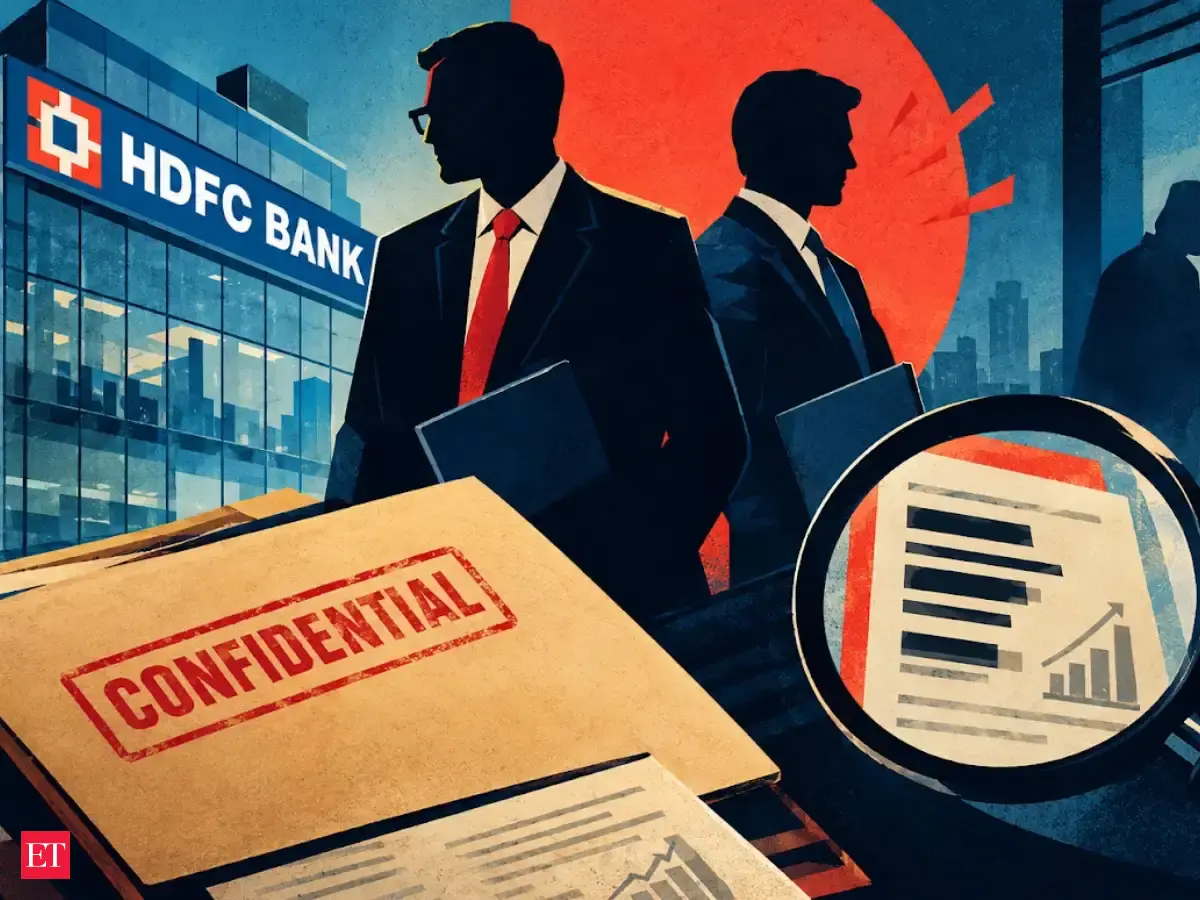
HDFC Bank is probing two senior executives for allegedly leaking confidential business strategies. This investigation follows a turbulent year for India’s largest private lender, marked by leadership exits and governance concerns. Incoming chief executive Anup Bagchi faces these challenges when he takes charge on October 27 to restore investor confidence.
Synopsis
HDFC Bank has faced a turbulent year marked by governance concerns, its former chairman’s abrupt exit, scrutiny of Dubai operations, post-merger profitability challenges and CEO Sashidhar Jagdishan’s departure. A fresh probe into alleged leaks of confidential information adds to the challenges awaiting incoming chief executive Anup Bagchi as the bank seeks to restore investor confidence.
HDFC Bank’s internal investigation has opened another front in a year of mounting questions over its governance, leadership and internal controls.
India’s largest private lender by market valuation is probing two senior executives after an internal inquiry found evidence that they had disclosed confidential business strategies and potentially market-sensitive information to outsiders. The development was first reported by Bloomberg on Wednesday.
The investigation is still underway, with the bank examining whether the information was misused. HDFC Bank acknowledged the review but declined to comment on its findings or the executives involved, saying appropriate action would follow once it was complete.
Investigators were scrutinising email communications involving senior management, including suspected leaks concerning the bank’s Dubai operations, payments linked to the Maharashtra State Road Development Corporation (MSRDC), executive disagreements and differences between former chairman Atanu Chakraborty and outgoing managing director and chief executive Sashidhar Jagdishan, people familiar with the developments told ET Bureau on Thursday.
Live Events
The timing is significant.
Anup Bagchi, the former ICICI Group executive appointed to lead HDFC Bank, is due to take charge on October 27. He inherits a lender where internal disagreements have repeatedly surfaced in public, putting its reputation for institutional stability under scrutiny.
The chairman who left without answers
The year’s most consequential governance shock arrived in March, when Atanu Chakraborty resigned as part-time chairman and independent director. In his resignation letter, he said certain practices he had observed over the preceding two years were “not in congruence with my personal values and ethics”.
He offered no specific explanation. That vacuum became a crisis of its own.
Investors questioned the bank’s assurances that there was nothing materially wrong. During a call with analysts and fund managers, BlackRock’s Prashant Periwal asked: “What exactly was it?” The bank’s shares fell more than 5% that day, wiping out over $7 billion in market value, according to Bloomberg.
The board said Chakraborty had not identified specific regulatory or operational concerns. Reserve Bank of India also defended the lender, saying its periodic assessment had found no material concerns on record regarding its conduct or governance.
Subsequent reviews offered the bank some relief, but did not erase the market’s questions. An independent legal review found no evidence substantiating Chakraborty’s governance concerns, ET reported on August 29.
Separately, an internal examination of the bank’s MSRDC deposit arrangements concluded that the conduct amounted to “business overreach”, rather than mala fide action or personal enrichment. Jagdishan and two other senior executives received warning letters and penalties of Rs 1 lakh each.
Dubai’s costly regulatory overhang
The chairman’s exit also revived scrutiny of HDFC Bank’s overseas operations. On March 21, ET reported that the lender had terminated three senior executives following an internal review into alleged mis-selling of Credit Suisse Additional Tier-1 (AT1) bonds through its Dubai operations.
The bank acknowledged gaps in client onboarding at its Dubai International Financial Centre branch and said it had taken remedial action. The episode followed restrictions imposed by Dubai’s financial regulator in September 2025, barring the branch from onboarding new clients and undertaking specified financial-services activities.
The allegations did not end with AT1 bonds. In August, more than 75 investors who had bought Carlisle’s Luxembourg Life Fund through HDFC Bank’s Dubai operations prepared to approach Indian and overseas authorities, alleging losses exceeding $13.5 million in principal investments. They claimed the insurance-linked product had been marketed as a capital-protection investment, while leverage magnified their exposure during the Covid-19 market crash. Some also alleged years-long denial of redemption.
These are investor allegations, not established findings of wrongdoing. But together, the episodes kept the bank’s overseas sales practices under an uncomfortable spotlight.
A merger still waiting to deliver
Away from the governance disputes, investors have had another reason to be impatient: the integration of HDFC Ltd, completed in 2023, has yet to deliver all the benefits they expected.
The merger expanded the bank’s balance sheet but also brought long-tenor home loans and increased funding requirements. Net interest margin stood at 3.26% in the June quarter, below the 4% level recorded before the merger.
The bank has had to rebalance its loan and deposit portfolios while contending with competition for low-cost deposits and pressure on profitability.
A CEO exit, and a reset
Sashidhar Jagdishan, who became managing director and CEO in October 2020 after Aditya Puri’s more than two-decade tenure, announced in August that he would not seek reappointment and would retire on October 26.
A Bloomberg report, published on September 2, linked the leadership tensions to differences over the bank’s direction. According to the report, incoming chairman Rajiv Kumar wanted faster loan growth, greater investment in technology, action on legacy issues and changes among senior executives. Jagdishan resisted some proposals. The bank disputed key elements of that account, calling them “totally inaccurate and misleading”.
The succession uncertainty ended on October 1, when HDFC Bank announced that RBI had approved Anup Bagchi’s appointment as CEO and MD for a three-year term. Speaking ahead of taking charge, Bagchi said much of the difficult work following the merger was behind the bank, although the transformation remained underway. He said he would first understand the balance sheet, profitability and institution before deciding on the way forward.
But the leadership transition comes as the bank faces another question over internal accountability. The latest probe into two senior executives centres on evidence that confidential business strategies and potentially market-sensitive information were disclosed to outsiders. Investigators are still examining whether the information was misused, leaving the findings and any subsequent action pending.
For Bagchi, the challenge may very well extend beyond merger integration and growth.
HDFC Bank's stocks have fallen 31.41% over the preceding year, shedding Rs 316.90 per share.
Its shares (intraday) were trading at Rs 691.90 per scrip, down 2.13% as of 12:54 PM on the BSE Thursday.
(You can now subscribe to our Economic Times WhatsApp channel)
(Catch all the Business News, Breaking News and Latest News Updates on The Economic Times.)
Subscribe to The Economic Times Prime and read the ET ePaper online.
...moreless
(You can now subscribe to our Economic Times WhatsApp channel)
(Catch all the Business News, Breaking News and Latest News Updates on The Economic Times.)
Subscribe to The Economic Times Prime and read the ET ePaper online.