
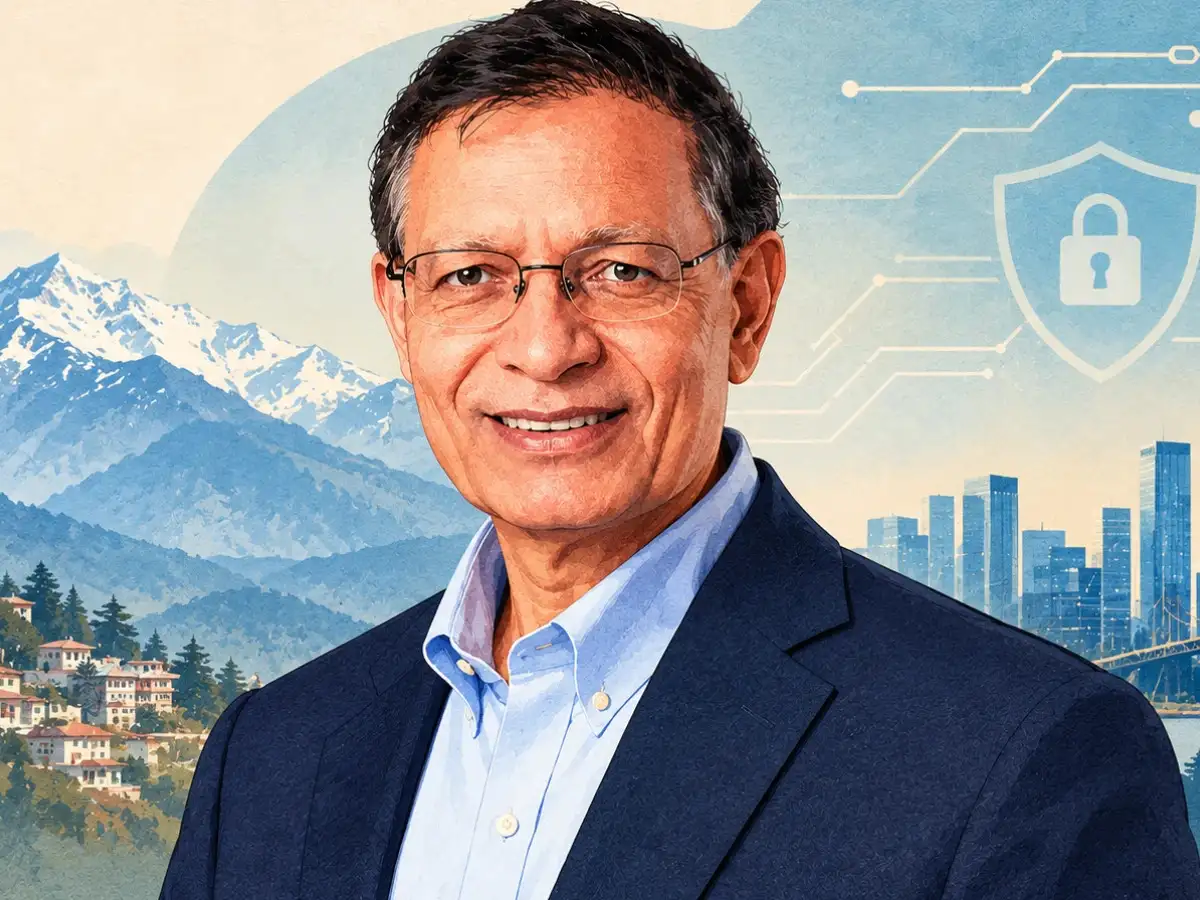
Jay Chaudhry, who grew up in a Himachal Pradesh village, built Zscaler around the principle of Zero Trust security. His family owns over a third of the company shares, making them the biggest beneficiaries of its proposed $44 billion acquisition by CrowdStrike. “In the AI era, Zero Trust security is non-negotiable.”
Synopsis
Jay Chaudhry, who grew up in a Himachal Pradesh village without electricity or running water, built Zscaler around the principle of Zero Trust security. Nearly two decades after founding the cybersecurity company, he and his family, who own more than a third of its shares, stand to be the biggest beneficiaries of its proposed $44 billion acquisition by CrowdStrike.
Listen to this article in summarized format
A boy from a Himachal village where electricity and running water were once luxuries has built a $44-billion business on a rather unusual principle: trust nobody. Nearly five decades later, Jay Chaudhry is set to reap the rewards of that belief as his cybersecurity company Zscaler becomes part of a major deal with CrowdStrike.
The billionaire founder of Zscaler Inc. and his family own more than a third of the cybersecurity company’s shares, making them the biggest beneficiaries of its proposed $44 billion acquisition by CrowdStrike Holdings Inc., according to regulatory filings.
For Chaudhry, who founded Zscaler nearly two decades ago, the deal marks another milestone in a career built around anticipating how technology would change the way businesses operate. His company made an early bet on moving internet security from traditional corporate networks to the cloud, a shift that gained pace as remote working expanded and cyber threats grew.
The Santa Clara, California-based company specialises in securing remote connections to protected computer networks. Its services have become increasingly important as businesses and government agencies face a growing number of threats, including AI-assisted hacking.
As of Friday, Chaudhry had a net worth of $12 billion, making him the 122nd-richest person in the US, according to the Bloomberg Billionaires Index.
Trust no one
The principle behind Zscaler's business is called Zero Trust security. Rather than automatically trusting users or devices inside a network, the model requires every connection to be verified.
That approach is becoming more relevant as companies adopt artificial intelligence and face new security risks from AI-powered tools and agents.
“In the AI era, Zero Trust security has become non-negotiable, and AI agents are rapidly becoming the new weakest link. This agreement will accelerate our ability to bring Zero Trust. We look forward to enabling our employees, customers, and shareholders to be a part of the significant upside that this transaction brings,” Chaudhry said.
The combination will create one of the world's largest pure-play cybersecurity providers. It also comes as corporate customers look to reduce the number of security vendors they work with and prefer companies that can offer multiple services under one roof.
From the mountains
Chaudhry's journey to Silicon Valley began in a farming family in Himachal Pradesh. The village where he grew up did not get electricity and running water until he was in his teens, he recalled in a 2021 speech at his alma mater, the Indian Institute of Technology (BHU) in Varanasi.
After moving to the US on a scholarship, he earned three master's degrees, including an MBA from the University of Cincinnati. He started his career as a software engineer, building healthcare products, before joining IBM Corp. and moving into sales — a field he later described as his true passion.
The internet boom of the 1990s gave him the idea to become an entrepreneur. Chaudhry has said that Netscape Communications' 1995 initial public offering made him think about starting his own business.
At the time, cyber threats were changing. Computer viruses that once spread through floppy disks were increasingly travelling across the internet, creating a need for new ways to protect businesses.
Chaudhry and his wife, Jyoti, quit their jobs and invested their life savings of about $500,000 in SecureIT, an internet security company that deployed and managed firewalls. VeriSign acquired the business for $69 million in 1998.
The sale was only the beginning. Chaudhry went on to establish and sell three more technology companies before setting up Zscaler in 2007. The idea, he said, drew inspiration from Salesforce Inc. and its model of delivering software services over the internet.
Moving beyond the firewall
When Zscaler started, companies largely relied on virtual private network (VPN) software to let employees connect remotely to their office networks. These systems created encrypted tunnels between computers but often required dedicated hardware within corporate networks.
Chaudhry believed that more of these connections would eventually move to the cloud. He backed that view with $50 million of his own money to establish Zscaler.
It was a bet that took time to pay off. After listing in 2018, the company's shares traded at around $50 for much of the period before the pandemic. As businesses shifted to remote work, the stock surged more than sevenfold, reaching a record $376.11 in November 2021.
The pandemic brought two changes that worked in Zscaler's favour. First, businesses and government agencies suddenly had to secure a much larger number of remote connections, exposing the limitations of legacy VPN systems. Second, cyberattacks targeting VPNs, which had been relatively uncommon, began rising in the years leading up to the pandemic and accelerated during lockdowns.
Together, these shifts strengthened demand for the kind of cloud-based security that Zscaler had been building.
The proposed acquisition now brings together two cybersecurity entrepreneurs — Chaudhry and CrowdStrike chief executive George Kurtz — at a time when the industry is seeing greater consolidation and a growing share of business flow towards a handful of large providers.