
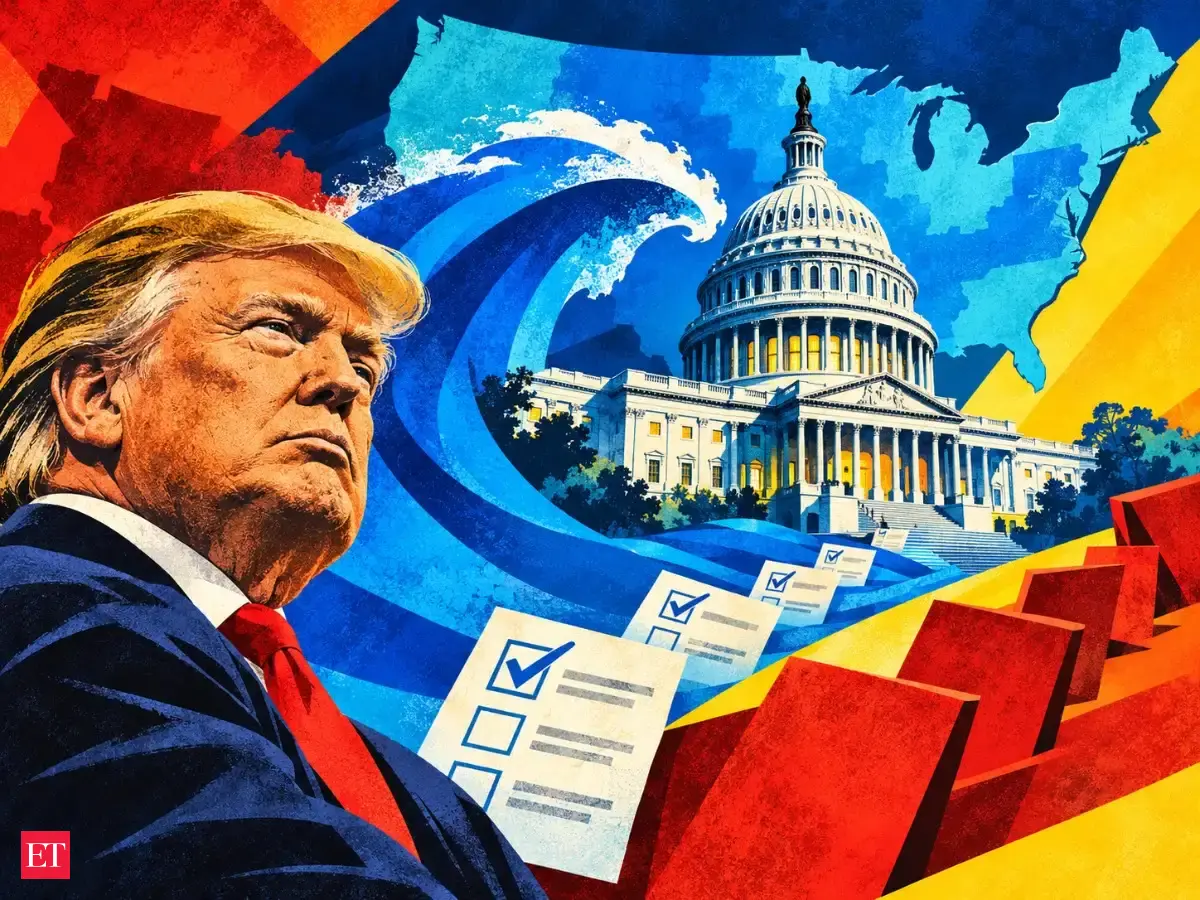
Democratic control of Congress from January 2027 could constrain President Donald Trump's legislative agenda, Fitch's BMI said. While Trump keeps executive powers over trade, a potential debt-limit fight might raise market volatility. BMI noted, "The more likely outcome is greater congressional pushback rather than a return to the pre-Trump trade regime."
Synopsis
Democratic control of Congress from January 2027 could constrain President Donald Trump's legislative agenda, increase scrutiny of his tariff policies and complicate fiscal decisions, Fitch's BMI said. While Trump retains executive powers over trade and immigration, prolonged funding negotiations and a potential debt-limit confrontation could raise financial market volatility.
A historic Democratic victory in the US midterm elections could constrain President Donald Trump’s tariff agenda, complicate his legislative priorities and increase the risk of a contentious debt-limit confrontation in 2027, even as the administration retains considerable freedom to pursue trade and foreign policy through executive powers, Fitch Solutions’ BMI said.
In a report titled Spotlight United States: Democratic Victory Constrains Trump Agenda, Raises Fiscal Risks, BMI said Democratic control of both chambers of Congress from January 2027 would increase institutional constraints on Trump by limiting legislation, intensifying scrutiny of his administration and making senior government appointments more difficult.
However, the shift in congressional control is unlikely to fundamentally reverse the Republican president’s policy direction. Trump retains veto powers and broad executive authority, allowing him to continue pursuing key priorities, including tariffs, immigration enforcement and foreign policy, without necessarily requiring fresh legislation.
For trade, the outcome is likely to translate into greater congressional resistance to unpopular tariffs rather than an outright reversal of the duties imposed by the Trump administration. Democrats would need a deal to roll back existing measures, while Trump can continue using executive instruments to impose tariffs, including Sections 232 and 301 of US trade law.
Live Events
BMI said the election outcome would reduce policy instability by limiting the scope for major legislative changes and another large fiscal expansion. However, the prospect of prolonged negotiations over government funding and the debt ceiling could introduce fresh volatility into financial markets, particularly in 2027.
Democrats could challenge tariffs, but Trump retains executive powers
Democratic control of Congress is likely to increase scrutiny of Trump's trade policies, particularly measures that have attracted domestic opposition, including tariffs affecting Canada. However, bipartisan support for a tougher trade stance towards China, particularly on semiconductors, advanced technology and critical minerals, will limit the scope for a broader reversal.
"The more likely outcome is greater congressional pushback rather than a return to the pre-Trump trade regime," BMI said.
The president is also likely to retain considerable room to pursue his foreign policy priorities, including the US-Iran conflict, relations with China and engagement with countries in the Americas. Congressional oversight could make abrupt policy changes more difficult, but funding decisions, investigations and confirmation hearings would be the principal tools available to Democrats to influence the administration.
On Iran, BMI maintained its baseline expectation of a preliminary agreement in the first quarter of 2027, while warning that further escalation remains a significant near-term risk.
The agency assigned a 40% probability to an agreement in Q1 2027. For the fourth quarter of 2026, it placed the probability of further escalation at 30%, compared with 25% for a deal.
Trump could feel less constrained by electoral considerations following the midterm results. However, Republican losses could also make his administration more sensitive to the domestic political costs of prolonging an unpopular conflict.
Even if an agreement is reached, BMI expects it to break the immediate stalemate rather than resolve longstanding tensions between Washington and Tehran. A rapid deal could also be perceived as a response to domestic pressure or as an Iranian victory.
Ukraine presents a clearer possibility of a shift in policy. A Democratic-controlled Congress is expected to be more supportive of Kyiv, with additional funding potentially attracting enough Republican backing to override a presidential veto. However, any resistance by the administration to distributing funds mandated by Congress could trigger a significant institutional confrontation.
Debt-limit standoff, AI investments among key risks
On the domestic front, Democratic control is likely to constrain Trump's ability to push through major fiscal legislation, while leaving much of his immigration and deregulation agenda intact.
BMI said Republicans have already secured multi-year funding for immigration enforcement, limiting the ability of Democrats to reverse the administration's deportation policy through congressional action alone. They could, however, block fresh legislation, intensify investigations and use future funding negotiations to restrict specific priorities.
Artificial intelligence and data-centre development are likely to emerge as major areas of friction. Concerns over electricity prices, water consumption and the local impact of large data-centre projects could prompt Democratic lawmakers and state administrations to demand tighter scrutiny.
Around 53% of the projected growth in hyperscaler data-centre capacity from 2028 is located in states where governorships changed hands, BMI said. The resulting policy pushback is likely to slow investment rather than halt it altogether. Moratoriums could delay projects, while fewer tax exemptions and requirements for companies to arrange their own power supply could increase development costs.
Financial services and cryptocurrency deregulation, meanwhile, are likely to continue, albeit under closer congressional scrutiny.
The immediate challenge for Washington will be avoiding another government shutdown. Federal funding expires on December 11, and BMI expects lawmakers to favour another short-term continuing resolution rather than a comprehensive funding agreement.
Republicans are likely to resist substantial new spending following their electoral defeat, while Democrats have little incentive to negotiate a long-term settlement before assuming control of Congress in January.
An early increase in the debt ceiling also appears unlikely. Fiscal conservatives could oppose a measure that would enable further borrowing while removing an important negotiating tool ahead of the 2027 fiscal battles.
The risk of a prolonged debt-limit confrontation could weigh on investor sentiment, particularly if bond yields remain elevated. Although financial conditions have remained resilient, a deeper equity market correction could erode household wealth and confidence.