
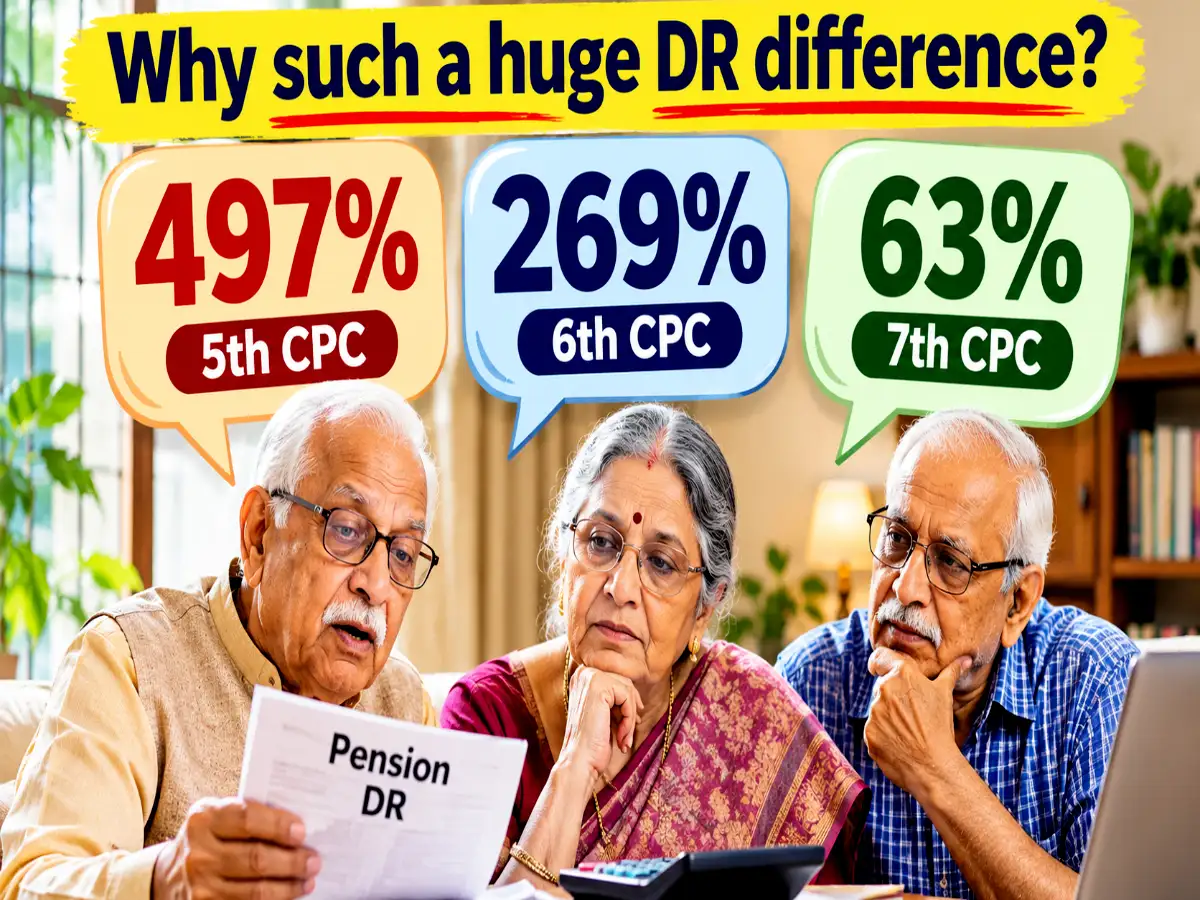
The Ministry of Personnel announced an enhanced dearness relief of 497% for 5th Pay Commission pensioners from July 1, 2026. This follows earlier announcements of 63% and 269% rates for 7th and 6th Pay Commission pensioners. These different rates exist because they use various pay structures and historical base levels.
DR calculator: Pensioners who receive their pensions under the 5th Pay Commission will see their dearness relief increased significantly. The Ministry of Personnel announced that this enhancement will take effect from July 1, 2026. This decision also affects surviving CPF beneficiaries entitled to basic ex-gratia payments as of June 2013. Different dearness relief rates exist for various pay commissions based on different inflation indices and reference levels.
The Ministry of Personnel, Public Grievances & Pensions, in an official memorandum (OM) dated November 17, 2026, announced that pensioners who get their pension under the 5th Pay Commission pay scales will get an enhanced dearness relief (DR) of 497% with effect from July 1, 2026.
"The surviving CPF beneficiaries who have retired from service between the period 18.11.1960 and 31.12.1985, and are entitled to basic ex-gratia@Rs 3,000, Rs 1,000, Rs 750 and Rs 650 for Group A, B, C & D respectively, w.e.f. June 4, 2013, vide OM No. 1/10/2012- P&PW(E) dated June 27, 2013, shall be entitled for enhanced dearness relief from 483% of the basic ex-gratia to 497% of the basic ex-gratia, w.e.f., July 1, 2026," reads the OM.
Prior to this announcement, the Finance Ministry had earlier announced 63% and 269% DR rates for pensioners getting their payouts under the 7th and 6th Pay Commissions, respectively.
While all three DR rates are referred to central government pensioners, who might have retired from the same designation in the same department, why are they 63%, 269% and 497% for pensioners receiving payouts under different pay commissions?
Why are DR rates different for pensioners getting payouts under different pay commissions?
The answer lies in the fact that these DR rates are calculated at different pay structures and historical base levels. However, they represent the same inflation index for their calculation. The DR rates of the 5th and 6th Pay Commissions look much higher because the older pay scales have not been converted into the 7th CPC pay matrix.
To know the difference, first see how the figures of 63%, 269% and 497% are arrived at.
How is the DR calculated for 5th, 6th and 7th Pay Commissions?
The DR is calculated on the basis of the 12-month average inflation of the All India Consumer Price-Industrial Workers (AICPI-IW).
The difference is while the 5th Pay Commission takes 1982 as the CPI base year, the 6th and 7th CPC take 2001 as the CPI base year.
However, for the 7th Pay Commission DA calculation, the 2016-base AICPI-IW series is linked to the 2001-base series by multiplying it by 2.88.
The factor of 2.88 is derived from Labour Bureau data, where the CPI-IW value for August 2020 was 338 under the 2001 base and 117.4 under the 2016 base.
The other factor for DA calculation is the reference index, which is 306.33, 115.76 and 261.42 for the 5th, 6th and 7th Pay Commissions, respectively.
Pay Commission Reference Index How it was established 5th CPC 306.33 12-month average CPI-IW in 1982 series, ending December 1995 6th CPC 115.76 January 2006 average of 536 in 1982 series, converted using 4.63 7th CPC 261.42 12-month average CPI-IW in 2001 series, ending December 2015 Now see how inflation index is factored in to calculate DR under the 5th, 6th and 7th Pay Commission
DR calculations for 5th Pay Commission
The 5th Pay Commission uses the AICPI-IW series with 1982 as the base year. It takes the reference index of 306.33 and 12-month average inflation into account.
But an important distinction is that we first need to link this inflation to the 2016 base average, the 2001 base equivalent and then to the 1982 base equivalent.
The 12-month average of AICPI-IW for DR calculation is 148.65 (from July 2025-June 2026).
For this 12-month average inflation, the base year is 2016-
Base average Number 2016-base average 148.65 2001-base equivalent: 148.65 × 2.88 428.112 1982-base equivalent: 428.112 × 4.63 1,982.16
However, ever since the government merged 50% DR into dearness pay from April 1, 2004, the DR for the 5th Pay Commission is calculated as-
DR (5th CPC)= [{12-month average of AICPI-IW (base year 1982)- 306.33}/306.33x100]-50
The 12-month average of AICPI-IW after converting into the 1982 base year is 1,982.16.
Putting this value into the formula, the DR value will be 497%.
DR calculations for 5th, 6th and 7th Pay Commissions
Particulars 5th CPC 6th CPC 7th CPC CPI base year 1982 2001 2001 Reference index 306.33 115.76 261.42 Implied 12-month average CPI after adjusting to the base year 1,981.97 427.15 426.11 DR rate 497% 269% 63% Special adjustment 50% Dearness Pay merger deducted No merger New pay/pension structure from 2016
DR calculations for 6th Pay Commission
The formula for the DR calculation will have three different things here. The average inflation will be converted as per the 2001 base equivalent by multiplying by 2.88. The reference index will be 115.76.
Hence DR will be = (428.112-115.76/115.75) x 100= 269% (after dropping decimal portion)
DR calculations for 7th Pay Commission
DA% = [{12-month average of AICPI-IW (base year 2001)- 261.42}/261.42x100]
Here also the average inflation will be multiplied by 2.88, but the reference index will be 261.42, so the DR will be= (428.112-261.42/261.42) x 100= 63%.