
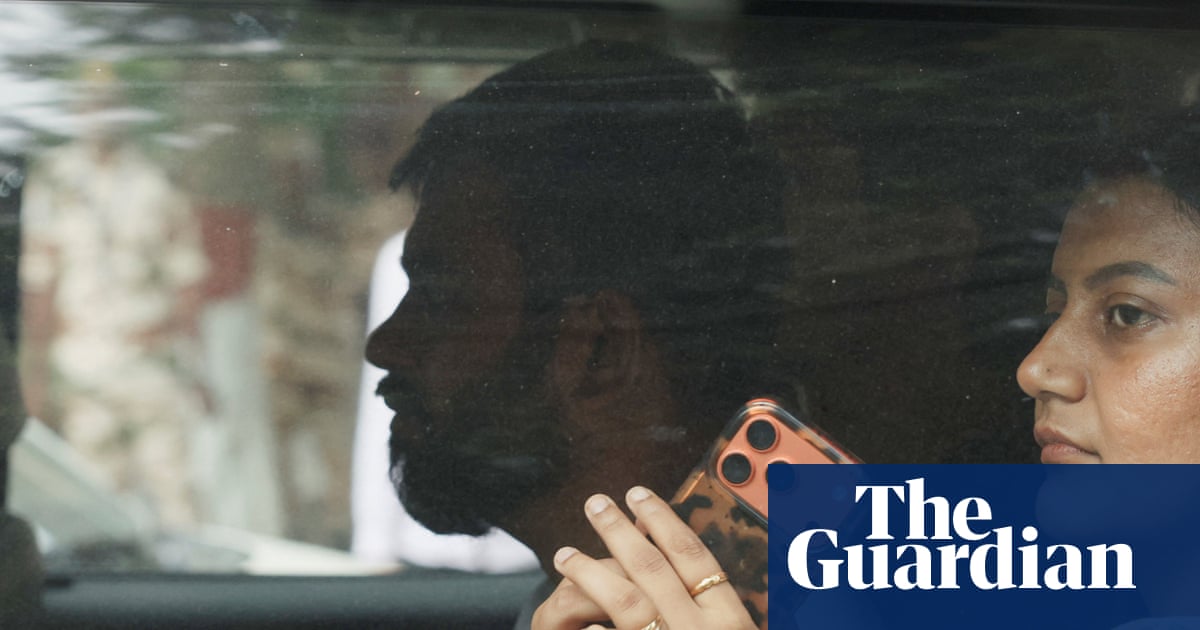
A court ordered the release of Cockroach Janta party founder Abhijeet Dipke on Sunday as Delhi braced for a second day of youth protests. Authorities detained thousands on Saturday to stop the movement against voter list revisions. The UN urged authorities to ensure that the right to peaceful assembly is respected.
Delhi braced for a second day of youth protests demanding the resignation of India’s election chief on Sunday, as a court ordered the release of the “cockroach” movement founder, Abhijeet Dipke, and two other senior leaders.
Dipke, the founder of the Cockroach Janta party (CJP), and the other leaders were detained when their plane landed in Delhi on Saturday, as the movement planned to gather thousands of people at Jantar Mantar in central Delhi.
Indian authorities on Saturday deployed a sweeping crackdown across Delhi and detained thousands of protesters as the youth “cockroach” movement sought to intensify a nationwide campaign against a contentious voter list revision that has fuelled anger at the prime minister, Narendra Modi’s Hindu nationalist government and election authorities.
Reuters reported police detained more than 2,000 people to thwart Saturday’s protest. Thousands of police and paramilitary personnel continued to be deployed across the city on Sunday although metro stations reopened and mobile internet services were back up.
Most detained on the first day of protests were released on Saturday night, police said.
Opposition parties and critics of Modi’s government criticised what they said was the high-handed use of force against the protesters.
The UN human rights office expressed concerns over mass detentions before and during the protests.
UN human rights spokesperson Thameen Al-Kheetan said: “We call on the authorities to ensure that the right to peaceful assembly is fully respected and fulfilled.” He urged authorities to engage in “meaningful dialogue” to address the “broadly held” concerns expressed.
India’s foreign ministry said the UN’s approach was “selective” and its statement constituted “an unwarranted interference in the internal affairs of India”.
The protests are calling for the resignation of the chief election commissioner, Gyanesh Kumar, over a revision of voter lists that critics say disproportionately benefits Modi’s ruling Bharatiya Janata party (BJP), which has been in power for more than 12 years.
Sporadic protests have been going on across India since the Indian Express newspaper in late September reported Kumar’s two deputies raised several concerns internally about voter list revisions, registration procedures and digital systems.
The commission says differing views are normal in internal deliberations, and has denied favouring any party.
Modi’s BJP has accused groups opposed to it of trying to undermine the country’s democracy by wrongly questioning legitimate electoral processes.
Election Commission data cited by the party shows about 130 million names, more than the population of Japan, have been deleted from electoral rolls during the verification exercise, including 63 million people who had relocated and 30 million who could not be traced.
The BJP and the commission deny allegations of manipulation, although opposition parties say Muslim voters and other minorities, who are unlikely to support the Hindu nationalist ruling party, are disproportionately affected by the deletions.
The “cockroach” movement, which began as an online satire, rapidly evolved into a pressure group, with street protests against exam paper leaks culminating in the resignation of Modi’s education minister.
The CJP has called its protests against Kumar “Season 2” on its social media handles, and said it would not stop until India’s election system was reformed.