
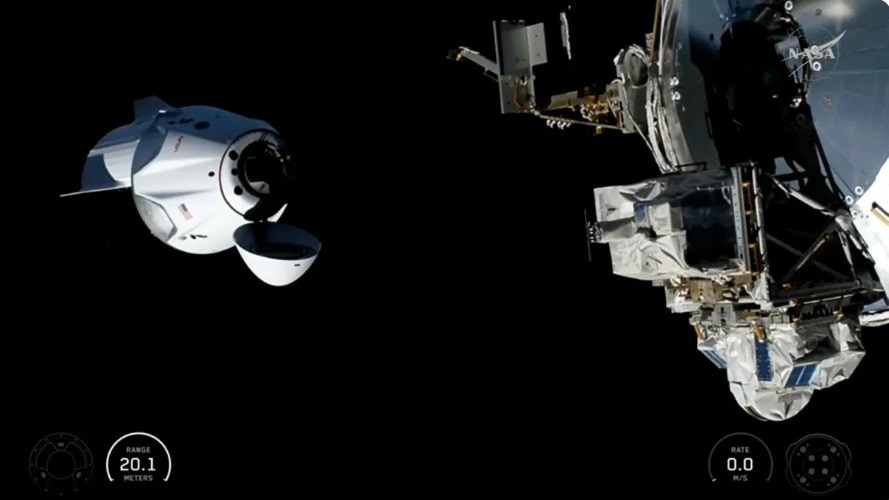
SpaceX’s Crew-13 mission reached the International Space Station on October 2 in a record 7 hours and 55 minutes. Julianna Scheiman said, "The orbital mechanics, the physics of it all, worked out for it to be the shortest launch-to-docking time we've had to date." Four astronauts will now conduct research.
SpaceX's Crew-13 mission for NASA reached the International Space Station (ISS) on October 2, setting a new record for the fastest an American spacecraft has travelled from launch to docking with the orbiting laboratory.
The Crew Dragon spacecraft docked with the ISS at 4:35 a.m. IST, just 7 hours and 55 minutes after lifting off from Florida's Space Coast.
NASA officials said the mission broke the previous US record of 12 hours and 33 minutes, set by SpaceX's robotic Dragon cargo spacecraft during the CRS-31 resupply mission in November 2024. The fastest journey by astronauts aboard a US spacecraft had been Crew-11's 14-hour-43-minute trip in August 2025.
Julianna Scheiman, director of NASA science and Dragon programs at SpaceX, said the unusually quick journey was largely due to the ISS being in an "opportune spot in space" at the time of launch.
"The orbital mechanics, the physics of it all, worked out for it to be the shortest launch-to-docking time we've had to date," Scheiman said, adding that the mission's timing was close to the fastest possible.
However, Crew-13 did not break the overall record for reaching the ISS. That mark belongs to a Russian Soyuz spacecraft, which carried three astronauts to the station in just 3 hours and 3 minutes in May 2020.
The difference is largely due to the flight paths selected by mission controllers. Russia has traditionally used more aggressive "fast-track" trajectories to reach the ISS, rather than the spacecraft itself being inherently faster.
Crew-13 carried four astronauts to the space station -- NASA's Jessica Watkins and Luke Delaney, Joshua Kutryk of the Canadian Space Agency and Sergey Teteryatnikov of Roscosmos.
The four astronauts are expected to spend about six months aboard the ISS, where they will conduct scientific research and support station operations.
They will replace the four members of SpaceX's Crew-12 mission, which launched in February. Crew-12 astronauts Jessica Meir, Jack Hathaway, European Space Agency astronaut Sophie Adenot and Roscosmos cosmonaut Andrey Fedyaev could return to Earth as early as October 5, NASA officials said.