
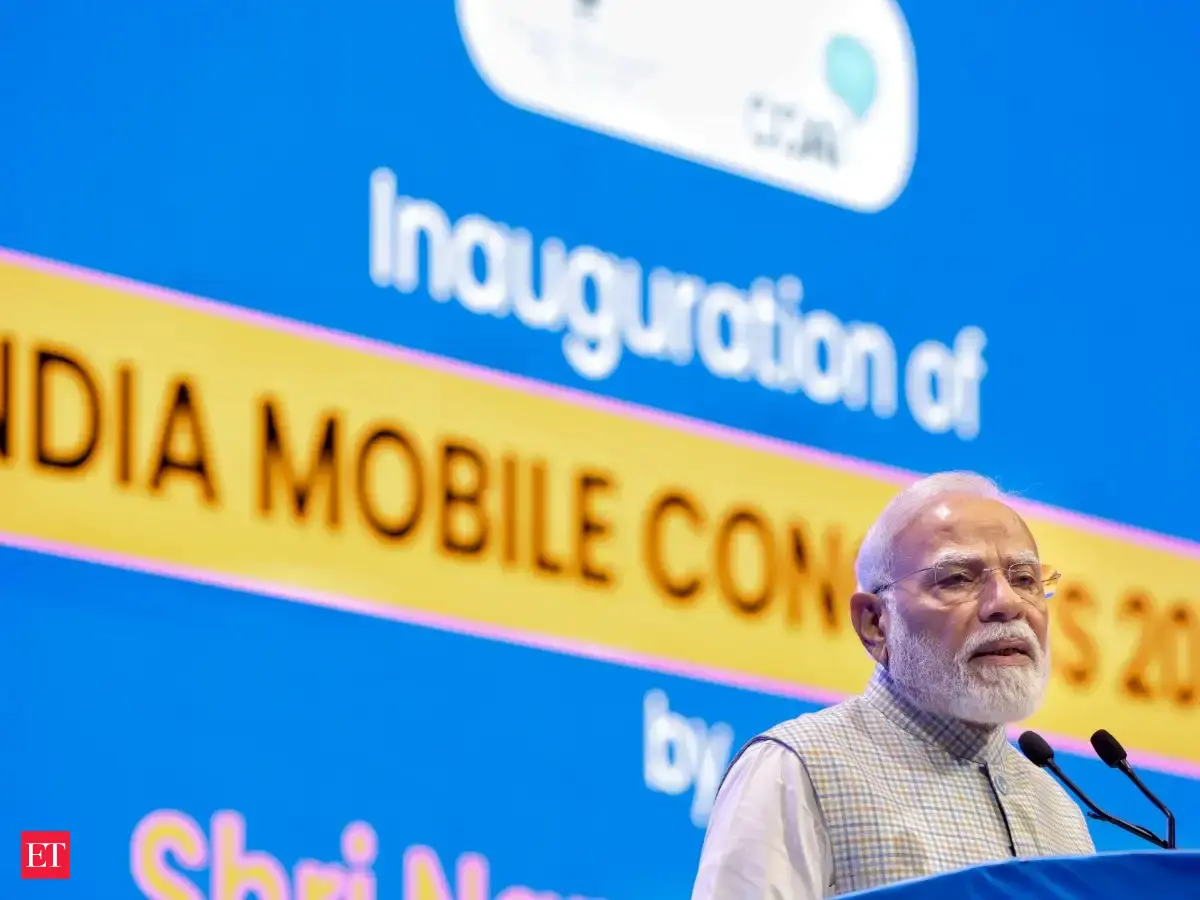
Prime Minister Narendra Modi urged global telecom leaders to build a system to stop cyber fraud before it reaches users. Speaking at the India Mobile Congress, he said, "Technology achieves scale only when it earns trust." India now aims to lead in product design, technology, and intellectual property ownership globally.
Prime Minister Narendra Modi emphasized the need for a global effort against cross-border cybercrime during the India Mobile Congress. He also outlined India's ambitions in telecom by advancing product design, technology, and intellectual property ownership. India has made significant progress in 5G connectivity and mobile internet speeds. The government aims to connect millions of students through digital learning platforms.
New Delhi: Global telecom operators, governments, technology companies and financial institutions must jointly tackle the growing deluge of cross-border cybercrime and build global mechanisms to intercept cyber fraud before it reaches users, Prime Minister Narendra Modi said.
"I urge the GSMA (Global System for Mobile Communications Association) and global telecom operators to establish a global mechanism that can stop such frauds before they reach people," he said.
Cybercriminals could operate from one country, enlist help in another and target victims in a third, and hence, the threat required a coordinated global framework. India was ready to share lessons from its experience, he added.
"Technology achieves scale only when it earns trust," he said. For ordinary users, that meant knowing who was calling, distinguishing genuine messages from fake ones, making payments safely and trusting that information submitted online would remain protected.
The appeal came as Modi outlined India's next telecom ambitions - moving beyond consumption and manufacturing towards ownership of product design, technology and intellectual property.
"In recent years, India has journeyed from being a consumer to becoming a creator," he said. "Now India is moving toward the goal where product design, technology, and IP will all belong to India."
The Prime Minister said the government was providing incentives and pursuing reforms to support that transition. The Telecommunications Act had established a modern regulatory framework and the government was working to rationalise structural burdens like AGR (adjusted gross revenue) and bank guarantees. The Gati Shakti Sanchar portal had accelerated right-of-way approvals through digital processing.
He also said commercial semiconductor production was underway at five locations in India. The next phase of the India Semiconductor Mission would focus on the entire supply chain.
On connectivity, Modi said 5G had reached every district, with more than 5 lakh base stations operating across the country. Mobile internet speeds had increased tenfold compared with 2022, when he launched 5G services from the India Mobile Congress platform.
Modi argued that India's telecom transformation went beyond spectrum, towers and network coverage. Over the past 10-12 years, mobile phones have become a crucial instrument of governance and the centrepiece of the Digital India programme.
Telecom reforms, infrastructure expansion and domestic manufacturing of mobile phones and other telecom equipment had helped make devices and data more accessible and bridge the digital divide.
On education, Modi said the Diksha platform had recorded more than 500 crore learning sessions and nearly 6,000 crore learning minutes during the pandemic period up to July 2022. The government was now seeking to connect nearly 25 crore students through its digital and online learning platforms, he said.
The expansion of towers in remote areas, optical fibre networks and affordable data had also created new markets in technology, entertainment and education, alongside a new generation of creators, Modi said.
More than 50 crore people in India were estimated to be connected to the gaming ecosystem in some form, he said. Young people, including those in tier-2 and tier-3 cities, were participating in esports, producing gaming content and building businesses.
Faster connectivity and cheaper data had brought video-sharing platforms, social media and regional streaming services to villages and towns, helping overcome language barriers, Modi said. India's content creation industry had grown to thousands of crores of rupees and was providing income to lakhs of people, he added.