
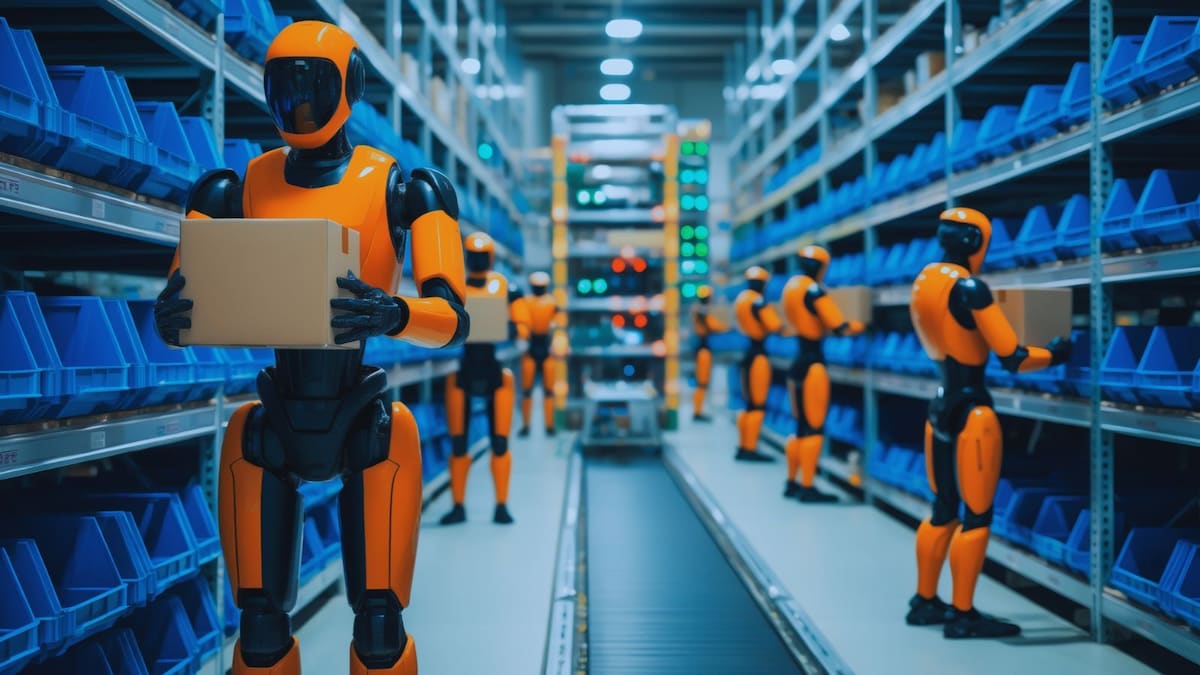
Humanoid robots are moving from labs into defence research, though major hurdles remain before they can operate in combat. Foundation Robotics is developing a robot called Phantom for battlefield tasks. CEO Sankaet Pathak said, "Foundation's goal is to produce at least 40,000 units a year by the end of 2027."
Humanoid robots are moving from labs and factories into defence research, but major hurdles remain around autonomy, power, durability and cost before they can operate effectively in combat.
By CNBCTV18.com
(Photo Credit : Canva )
Artificial intelligence (AI) is no longer limited to chatbots that answer questions, write emails or create images. The next big step could be robots that can see, understand and act in the real world, known as physical AI.
Humanoid robots are one example. These robots have two arms, two legs and hands like humans. While many companies are building them for factories and other jobs with limited human control, some are exploring how the same technology could eventually be used on battlefields.
What is physical AI?
Physical AI can act in the real world. For example, imagine telling a robot: "Pick up that box and take it to the other room." A normal AI chatbot can understand the sentence and tell you what to do. A physical AI system would do it like humans, such as picking up the box, walking around obstacles and putting it in the right place.
AI systems operating in the real world are a little tough because if a robot misunderstands its surroundings, it could crash into something, damage equipment or hurt someone.
Current humanoids still struggle with basic tasks such as walking over uneven surfaces, opening doors, handling small objects and recovering after a fall.
How could physical AI be used on the battlefield?
US-based Foundation Robotics, for example, is developing a humanoid robot called Phantom for both civilian and defence applications.
The company's first-generation Phantom can walk and manipulate objects, but it is nowhere near being a battlefield-ready soldier. The machine weighs about 80 kg, does not currently have a battery, is not dust- or waterproof and cannot get itself back up after falling.
The company is developing a second-generation model that it says will have a battery capable of around six hours of operation, better protection from the elements and the ability to recover from a fall.
Foundation has said it is working towards making the robot capable of tasks such as collecting supplies, inspecting dangerous areas, recovering equipment and helping with casualty recovery.
"Foundation's goal is to produce at least 40,000 units a year by the end of 2027 with costs in the long term less than $20,000 each," Sankaet Pathak, co-founder and CEO of two-year-old start-up Foundation Robotics, told the BBC.
Could humanoid robots actually fight wars?
Experts quoted in the BBC report say today's humanoids are still far from being capable battlefield machines. "If there was a war in Taiwan today, the likelihood that China is going to militarise these humanoids and fight effectively is fanciful, said Dean Fankhauser at Robozaps, a humanoid robotics advisory firm.
Robert Griffin, who works on humanoid robotics at the Florida Institute for Human and Machine Cognition, points to situations that appear simple to humans but are extremely difficult for autonomous machines.
Another problem is power. Walking and constantly moving robotic joints consume a lot of energy. Even six hours of operation would be considered a lot of an achievement. Companies are now training these systems using videos, simulations, games and data collected directly from robots.
How much does a humanoid robot cost?
According to Morgan Stanley research cited by JPMorgan, the estimated material cost of a typical humanoid robot using a China-based supply chain was around $46,000, compared with about $131,000 for a US-based supply chain.
How fast is the robotics market growing?
JPMorgan Private Bank, citing estimates from several research firms, said the global robotics market could potentially grow from around $100 billion in annual sales in 2025 to $2.5 trillion by 2035. Humanoid robot sales are projected in one estimate to rise from around $2 billion in 2025 to roughly $300 billion by 2035.