
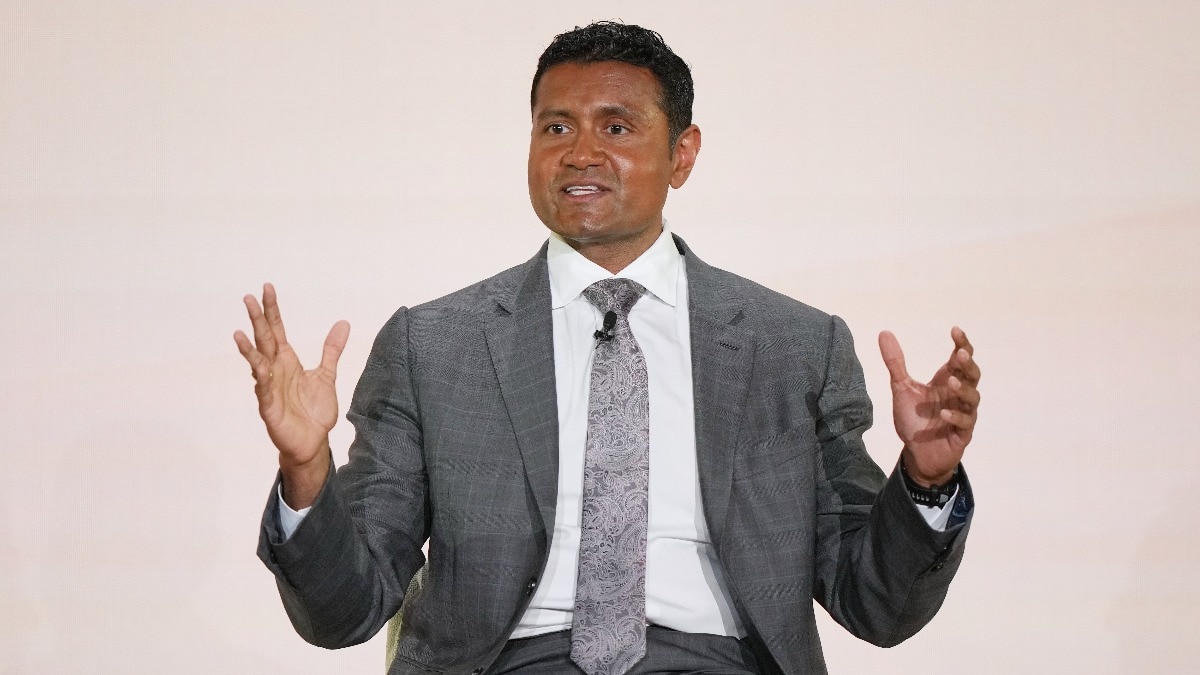
Palantir CTO Shyam Sankar said AI researchers have started smoking to show their faith in the technology curing cancer. Sankar told CBS, "I'm showing you my chips are all in." While some believe AI will soon fix diseases, Sankar warned that this extreme devotion feels like a social delusion.
AI will cure cancer. This is something that you may have heard from many in Silicon Valley, be it Google DeepMind’s Demis Hassabis or Anthropic CEO Dario Amodei. But sometimes, words are not enough, or so it seems. Palantir’s chief technology officer Shyam Sankar says that AI researchers have started to smoke just to show how confident they are in the technology to cure cancer.
The Palantir CTO said that researchers were now so confident in AI that they had started smoking. “So many AI researchers have started smoking as a way of signaling to other researchers how much they believe in AI,” Shyam Sankar told CBS. "I believe so much in AI that it's going to cure cancer. So I will—I'm showing you my chips are all in." Perhaps, the researchers think that there is no better way of showing faith in AI than to indulge in something that could cause them cancer – hopefully AI finds that cure before things get serious.
We have seen progress when it comes to AI finding a cure for cancer. In August, Moderna and Merck reported strong Phase 3 trial data for an mRNA melanoma vaccine which was designed with the help of AI. Days earlier, Anthropic CEO Dario Amodei said AI would find cures for most diseases, including cancers, within 5 to 15 years, a view that also drew support from Elon Musk. Google DeepMind’s Demis Hassabis has made similar arguments in recent years.
Machine God of AGI
Although Sankar claimed that this was just one incident among many where those working in Silicon Valley had started to consider AGI, or artificial general intelligence, as almost a god. "Many of these folks in Silicon Valley who are building this technology have filled that hole with the machine God of AGI,” said.
Though Shyam Sankar made it clear that such cases felt more of “mass psychosis” and “social delusion.” The Palantir CTO added that this might be “getting in the way of actually what is happening with AI.”
At the same time, Sankar discussed the two central arguments in the AI industry. One where AI “is going to end humanity,” and the other where it may create a “utopia.” According to the Palantir CTO, both cases have one similarity. “So at first blush, this seems contradictory, but it has one thing in common, which is that you, as a human, have no agency,” he added.
Shyam Sankar pointed out that no matter the outcome, it seems that the future will depend on what the “machine god” decides, and not what you may want as a human. “The machine god is going to decide the future, and only perhaps a small number of us can try to avoid the horrible outcome,” he said.
However, Sankar believes that we still have ample control and agency to dictate how AI is used in the future. “And I think it obfuscates the more profound reality that we have a huge amount of human agency over how we're going to use this technology to deliver the outcomes the American people expect,” he noted.