
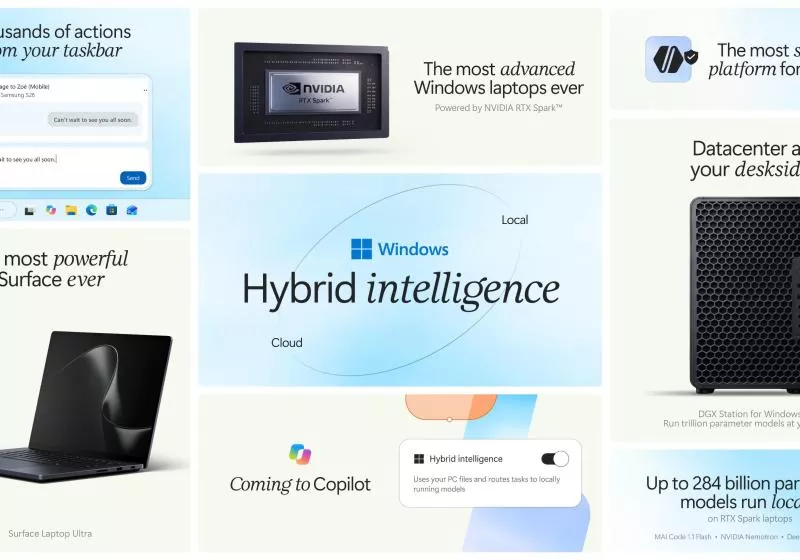
Nvidia and Microsoft launched the Surface Laptop Ultra, marking the start of the agentic PC era. CEO Jensen Huang said the new device, powered by the RTX Spark chip, reinvents the PC. This laptop uses AI to handle complex tasks locally, offering a powerful hybrid approach for users and businesses.
Serving tech enthusiasts for over 25 years.
TechSpot means tech analysis and advice you can trust.
Ripple effect: When the likes of Microsoft CEO Satya Nadella and Nvidia CEO Jensen Huang are chatting onstage together, you're bound to get big-picture vision statements and bold claims. In the case of PCs, a field in which both have worked and exerted tremendous influence for decades, that's particularly true.
At yesterday's big Microsoft-Nvidia launch event, Huang stated, with Nadella's strong endorsement, that the new Surface Laptop Ultra, along with all the new Windows-based PCs running Nvidia's RTX Spark chip, heralds the reinvention of the PC, marking the dawn of the agentic PC era.
Only time will tell whether that proves to be true, but in the moment, the story was undoubtedly intriguing and maybe even a bit convincing. What the two companies laid out was a rethinking and repositioning of PC capabilities, thanks to a combination of important changes to Windows, powerful advancements in Nvidia's latest chips, and the dramatic rise of AI foundation models and agentic software tools.
Together, these elements are now aligning in a way that enables processing power and productivity capabilities that were available only through cloud-based frontier models just one year ago to fit into a form factor you can carry with you or a tiny box on your desk.
That, in turn, is driving a whole new conversation about the potential for impressive amounts of token-generating work to be performed directly on the device, without having to pay for those tokens (except, of course, when considered as a fraction of the device's purchase price).
Even more importantly, this combination dramatically increases the potential for creating hybrid AI solutions that can leverage both on-device processing and cloud resources. There's no question that we'll always need to use the most advanced cloud-based frontier models for certain tasks, but it also seems abundantly clear that we don't need to use them for everything.
Splitting the work across those environments, as well as enterprises' own on-premises AI factories, makes the most sense for a multitude of reasons, including economics, security, privacy, and just plain logic (see "How Tokenomics Might Save AI PCs" for more). That's why hybrid AI is such a compelling solution and why it was arguably the overall focus of the event.
However, the star of the show was the new Surface Laptop Ultra, priced at $2,599 for the base configuration with 24 GB of RAM, 512 GB of storage, 18 CPU cores, and 5,120 GPU cores, but reaching up to $5,899 for the top-end configuration with 128 GB of RAM, 1 TB of storage, 20 CPU cores, and 6,144 GPU cores (interestingly, the company is offering up to $1,000 cash back if you trade in an eligible MacBook Pro.)
The Surface Laptop Ultra features a super-bright, 1,000-nit, 15-inch mini-LED touchscreen display, capable of reaching 2,000 nits in HDR, along with a clever new magnetic USB-C connector for its power adapter. Impressively, Microsoft's spec sheets claim up to 15 hours of battery life for video playback and up to 12 hours of "active web usage."
The new PCs will be able to run local AI models with over 120 billion parameters, depending on the amount of system memory installed. In addition, Microsoft unveiled pricing for its previously announced developer-focused Surface RTX Spark Dev Box, which features 128 GB of RAM, 2 TB of storage, 20 CPU cores, and 6,144 GPU cores for $5,999.
In addition to Microsoft's own systems, the two companies showed off forthcoming RTX Spark-based notebooks from Asus, Dell, HP, Lenovo, and MSI, as well as small desktop systems from Dell and Asus.
The notebooks are expected to start shipping around October 16, as will the Surface Laptop Ultra, while the compact desktops and developer boxes will follow later this year. Unlike the previous DGX Spark systems, which use Nvidia's GB10 chip and run Linux, the new small desktops, Surface Dev Box, and laptops run Windows 11 on Nvidia's N1X family of chips.
While details are still forthcoming, the GB10 and N1X family are apparently architecturally similar, with configurations offering up to 1 petaflop of FP4 AI performance. In addition, both Dell and HP showed off forthcoming high-end workstations capable of running Windows that will incorporate Nvidia's GB300 Grace Blackwell Ultra Desktop Superchip.
Along with AI capabilities, Microsoft also touted the gaming capabilities of its new Nvidia-powered laptop. The company announced support for Gears of War and many other popular gaming titles at launch, with Call of Duty support coming in 2027.
What's particularly interesting about this development is that it highlights an easily overlooked impact of Nvidia's entry into the Windows PC market with the N1X family. Like Nvidia's data center CPUs, these chips are based on the Arm CPU architecture, with MediaTek contributing to their design, meaning these are Windows on Arm devices.
Up until now, gaming support for Qualcomm's Snapdragon X family of Arm-based PCs has been challenging, but with Nvidia entering the market, many game developers who may have initially balked at the effort to port their games from x86 now have a good reason to do so. As a result, all Windows on Arm devices, including Qualcomm Snapdragon X-based systems, stand to benefit from these efforts. This is also true for the Windows enhancements that Microsoft debuted at the event, so it's a case of lifting all boats.
The new Windows features will also be coming to x86-based systems, particularly Copilot+ PCs. That's important because, despite all the initial focus on hardware, some of the most impactful announcements from the event were these additions and enhancements to Windows. As Windows and Surface chief Pavan Davuluri explained, the company is working to make Windows the most secure platform for agents, as well as the heart of a hybrid intelligence computing experience.
Given all the recent stories about agents running amok, the security story for Windows is particularly noteworthy because it's designed to build the trust that's going to be necessary for individuals and businesses to run agents. The company's new Microsoft Execution Containers, or MXCs, safeguard people and their data by running agents in isolated environments and controlling which files and networks they can access.
This capability is designed to help ensure that agents can run safely on Windows. Many of the major agentic tools, including OpenAI's Codex, OpenClaw, Nvidia's OpenShell, and others, already support it. Interestingly, for small desk-side AI computing devices, Microsoft is also adding a simplified setup wizard and integrated Windows gateway that make the process of configuring these devices as AI companion computers dramatically easier.
On the hybrid intelligence side, by flipping a single switch in Windows settings, Microsoft is enabling a raft of new features that will make your computer seem smarter. Doing so gives Copilot permission to access your local files and activity, providing the context it needs to do work on your behalf. In addition, it can perform local actions either through manual control or by leveraging the further-enhanced Autopilot agent now built into Windows.
The new Actions in Windows Search feature, which I expect to be the one announcement from this event that virtually every Windows user will benefit from, extends this concept by allowing you to simply type action requests into the Windows search bar and have it execute them for you. From changing Windows settings to organizing files, sending a text message, and more, this is the kind of Windows intelligence many have been waiting for. Finally, the hybrid intelligence switch enables Windows to easily tap into local models you can download and run on your PC, making the often-confusing task of configuring those models much easier.
A critical part of the overall hybrid AI computing concept is routing tasks between on-device and cloud-based models. Microsoft is starting its efforts with developers by bringing GitHub's HydraFusion into Windows. This can automatically select which coding tasks can be handled by on-device models and which need to be sent to the cloud. Hopefully, we'll see more of this intelligent AI model routing spread across additional Windows-based applications and activities in the future.
There's no doubt that PC capabilities have evolved more over the last few years than they have in a very long time. Whether that really means the category has been reinvented is still up for debate, but it's undeniably great to see companies across the PC ecosystem coming together to help our computers become as smart, capable, and useful as we always thought and hoped they could be.
Bob O'Donnell is the founder and chief analyst of TECHnalysis Research, LLC a technology consulting firm that provides strategic consulting and market research services to the technology industry and professional financial community. You can follow him on Twitter @bobodtech