
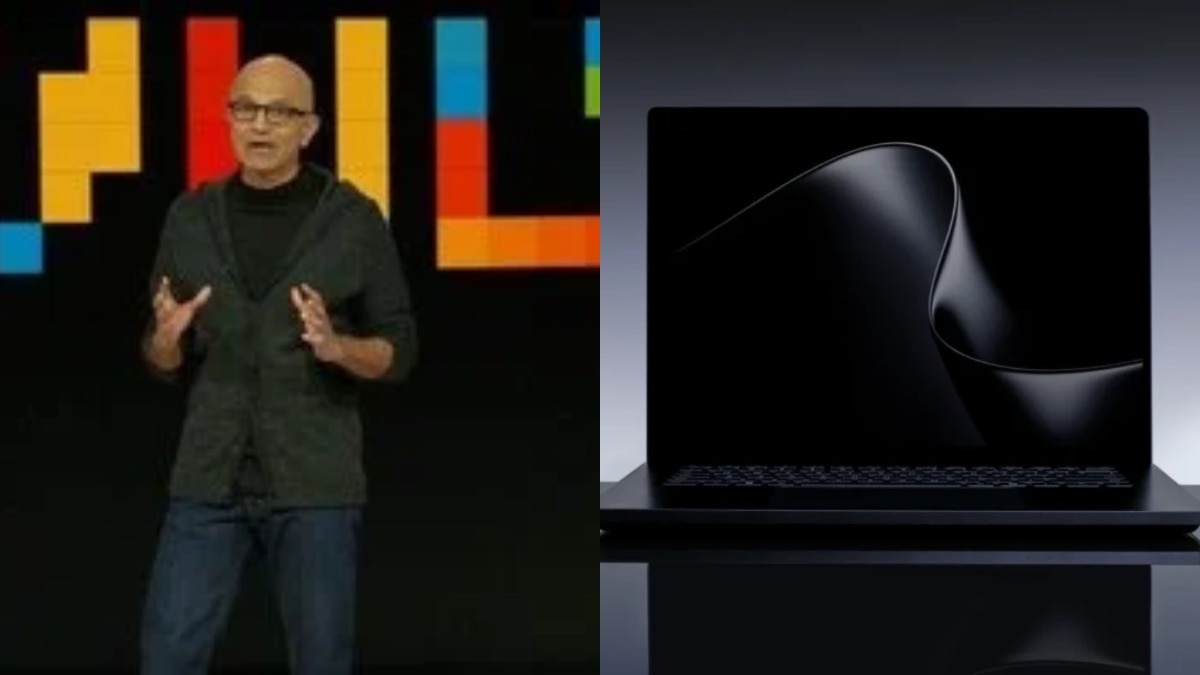
Microsoft launched the Surface Laptop Ultra with 128GB RAM and updated Windows to support AI agents. The company wants Windows to let AI agents “run around the clock, use tools, write code, access files, and act across systems.” New security containers now help keep these powerful AI tools in check.
Microsoft's latest Surface event was not confined to hardware only. The company used the event to show how it wants Windows to work in the age of AI, with computers that can run AI models locally, agents that can take actions for users and new security tools designed to keep those agents under control.
From a powerful new Surface Laptop Ultra to local AI models, smarter Copilot features and a new security system for AI agents, Microsoft had quite a lot to announce. Here is everything the company revealed at the event.
Microsoft wants Windows to become a home for AI agents
Microsoft's biggest announcement was perhaps not a laptop. The company introduced a broader vision called hybrid intelligence, where AI tasks can move between the PC and the cloud depending on what makes the most sense.
In simple terms, some AI work can happen directly on your computer, while more demanding tasks can still be sent to the cloud. This could help reduce cloud costs and also keep sensitive information on the device when needed.
Microsoft says in a blog post that Windows is being built to let AI agents “run around the clock, use tools, write code, access files, and act across systems, often without someone watching every step.”
The company is also bringing MAI Code 1.1 Flash to PCs. The coding model has 137 billion total parameters, with 6.8 billion active parameters, and supports a 256K context window. Microsoft says it uses 3-bit precision to reduce the model size by nearly 80 per cent while maintaining coding quality.
Microsoft Execution Containers aim to keep AI agents in check
With AI agents becoming more capable, Microsoft is also trying to solve a major problem: what happens when an AI agent gets access to something it should not? The company has now made Microsoft Execution Containers (MXC) generally available on Windows 11. The technology lets organisations decide which files and networks an AI agent can access, with those rules enforced while the agent is running.
The idea is similar to giving an AI agent its own controlled space to work in rather than letting it freely roam around a computer.
Microsoft says agents including OpenAI's Codex, GitHub Copilot, OpenClaw, Replit and LM Studio already support MXC. Meta's Muse is also coming to Windows as a native app with MXC integration.
GitHub Copilot can now use local AI models
Microsoft is also changing how GitHub Copilot works on Windows. With HydraFusion, Copilot can decide where a task should run and route it to the appropriate model. Now, that can include models running directly on the PC. The feature is expected to arrive in experimental preview later in October for the GitHub Copilot app, Copilot CLI and Visual Studio Code.
With the user's permission, Copilot will be able to understand relevant information stored on the PC, including files and recent activity. It will also be able to take actions such as organising files, checking device diagnostics, troubleshooting problems and carrying out workflows directly on the computer.
The company says these hybrid intelligence features are expected to start rolling out to Copilot+ PCs in the coming months.
Microsoft announces a new generation of AI-powered PCs
All this AI needs some serious hardware, and Microsoft announced a new range of Windows PCs powered by Nvidia's RTX Spark platform. The lineup includes new machines from Asus, Dell, HP, Lenovo, MSI and Microsoft Surface. These computers are designed to handle demanding local AI workloads such as running models, image generation and video generation.
Microsoft says the new RTX Spark PCs can deliver up to 2.1 times faster time to first token, 4.3 times faster AI image generation and 6.2 times faster AI video generation compared with a MacBook Pro 16-inch with Apple's M5 Pro, based on Microsoft's testing.
Surface Laptop Ultra is Microsoft's new AI powerhouse
The biggest hardware announcement was the Surface Laptop Ultra, which Microsoft calls its most powerful Surface Laptop yet. The machine is built around Nvidia RTX Spark and can be configured with up to 128GB of unified memory. Microsoft says it can run AI models with more than 120 billion parameters locally.
The Surface Laptop Ultra has a 15-inch touchscreen and a new thermal design aimed at keeping performance going during demanding workloads. It is available for pre-order and will start shipping on October 16.
The price, however, is not exactly small. The Surface Laptop Ultra starts at $2,599 (approximately Rs 2,50,648) and goes up to $5,899 (roughly Rs 5,70,678) for the higher-end configuration with 20-core processing, 128GB memory and 1TB storage.
Surface RTX Spark Dev Box
Alongside the laptop, Microsoft introduced the Surface RTX Spark Dev Box. As the name suggests, this is aimed more at developers and AI engineers than regular laptop users. It is designed to provide powerful local AI computing for people who want to experiment with models, test them and build AI applications without constantly relying on the cloud. It will start shipping in the US in November.
Microsoft is also bringing AI supercomputers to Windows
If the Surface Laptop Ultrasounds seems powerful, Microsoft has something much bigger for organisations that need serious AI computing. The company announced DGX Station for Windows, powered by Nvidia's GB300 Grace Blackwell Ultra Desktop Superchip. These desktop-sized systems are designed to run frontier AI models locally, including models with more than a trillion parameters.
Microsoft says these machines can also act as a shared "token factory", allowing teams to run 32 or more AI agents simultaneously. The idea is to reduce cloud spending while keeping sensitive data inside an organisation.
Windows Search is getting a lot more useful
Microsoft is also making a smaller but potentially very useful change to Windows. The company is adding actions directly to Windows Search. Instead of simply searching for settings or files, users will be able to type commands such as "switch to dark mode", "turn on Do Not Disturb", "dim my screen" or "minimise all my windows".
Users will also be able to send messages through Search, such as asking Windows to text someone that they will arrive soon. These features are beginning to roll out to Windows Insiders in the experimental channel.
Windows AI boost for gaming
The company highlighted the gaming capabilities of its new RTX Spark-powered PCs, including support for technologies such as DirectX ray tracing, variable rate shading and DirectStorage.
It also announced that Call of Duty will come to RTX Spark in 2027. Microsoft says the platform will continue expanding gaming support on Arm-based Windows PCs, with more major titles coming to the platform.