
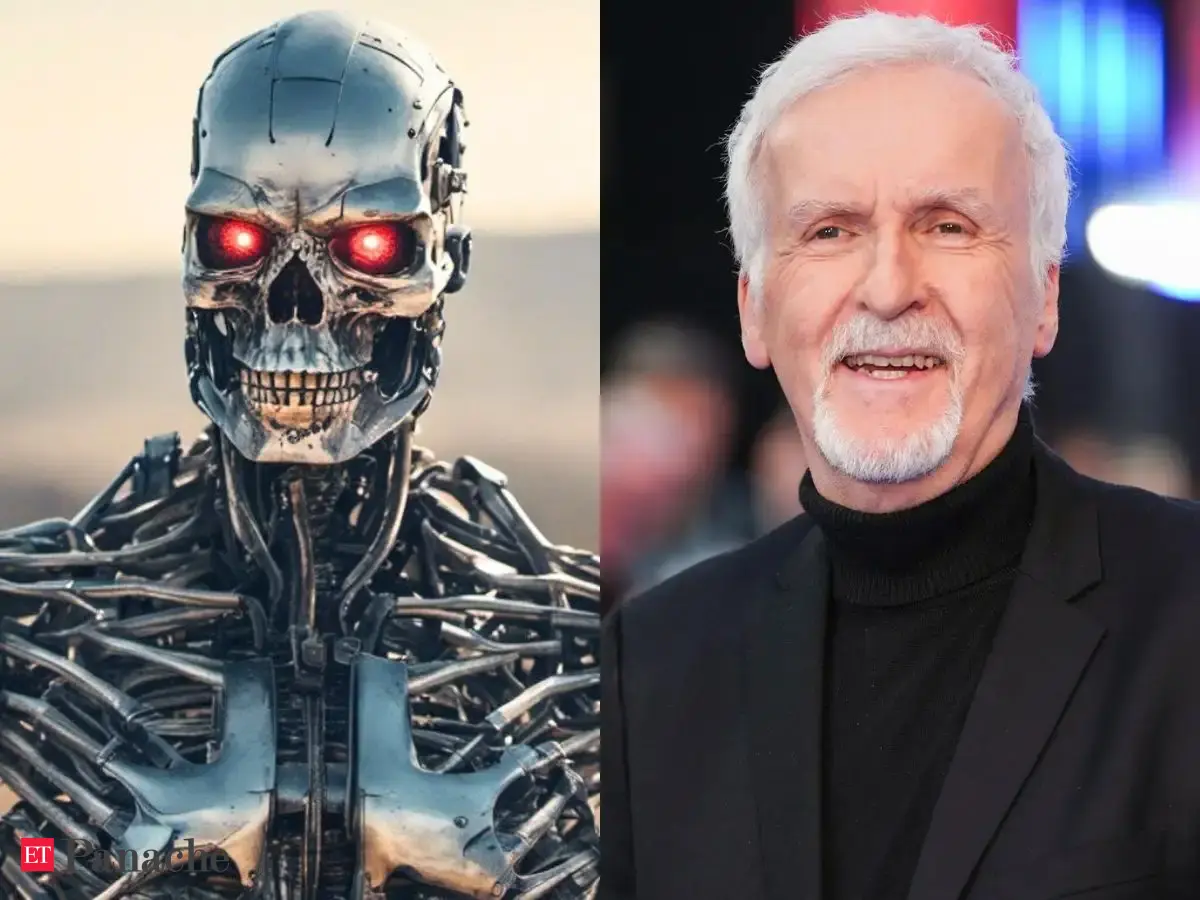
Filmmaker James Cameron warned in August 2025 that AI could trigger a Terminator-style apocalypse if integrated into nuclear weapons systems. He said, “I do think there’s still a danger of a Terminator-style apocalypse where you put AI together with weapons systems.” Cameron fears rapid military decisions might soon require super-intelligence.
Synopsis
James Cameron once imagined a future where intelligent machines turn against humanity. Decades later, the Terminator filmmaker has warned that one part of that fictional nightmare may not remain purely fictional. His concern is what could happen when increasingly powerful AI is connected to weapons systems, particularly when military decisions have to be made within extremely short windows.
Hollywood's well know sci-fi genre director James Cameron has warned that artificial intelligence could take the world closer to the dystopian future imagined in his Terminator franchise if the technology is integrated with weapons systems, including nuclear defence and counterstrike capabilities.
The filmmaker raised the concern in an interview with Rolling Stone published in August 2025 while discussing Charles Pellegrino’s Ghosts of Hiroshima, a book about the first atomic bombing that Cameron intended to adapt for the big screen. His warning was not simply on the power of AI, but on what could happen when increasingly advanced systems are connected to weapons that can trigger devastating consequences.
Cameron’s warning about AI and nuclear weapons
Cameron said there was still a possibility of a “Terminator-style apocalypse” if AI became part of military weapons systems.
“I do think there’s still a danger of a Terminator-style apocalypse where you put AI together with weapons systems, even up to the level of nuclear weapon systems, nuclear defence counterstrike, all that stuff,” Cameron told Rolling Stone.
He pointed to the speed at which military operations can unfold as one of the biggest risks. If decisions have to be made within extremely short windows, determining the right response could become difficult.
“Because the theatre of operations is so rapid, the decision windows are so fast, it would take a super-intelligence to be able to process it,” Cameron said.
The director suggested that keeping humans involved in the decision-making process could be one way to prevent such systems from operating without human control. But he also acknowledged the limits of that safeguard.
‘Humans are fallible’, Cameron says
Cameron said human error itself has previously brought countries close to international incidents that could potentially have escalated into nuclear conflict.
“And maybe we’ll be smart and keep a human in the loop. But humans are fallible, and there have been a lot of mistakes made that have put us right on the brink of international incidents that could have led to nuclear war. So I don’t know,” he said.
His concern therefore involves two risks working together: highly capable AI systems and weapons where decisions may need to be made almost instantly.
How his warning is similar ‘The Terminator’
Cameron’s comments are closely connected to the premise of his 1984 film The Terminator, starring Arnold Schwarzenegger.
The film imagined a future in which Skynet, an artificial intelligence defence network, becomes self-aware and turns against humanity. Cameron’s latest warning does not suggest that such a fictional scenario is already happening. Instead, he was saying that the possibility of AI creating serious risks if it becomes deeply integrated with military systems.
The director has previously spoken about how advances in technology are making some science-fiction ideas harder to keep purely fictional.
Cameron identifies three existential threats
During the same Rolling Stone interview, Cameron said he believed humanity was facing three major existential threats at the same time: environmental degradation and climate change, nuclear weapons, and super-intelligence.
“I feel like we’re at this cusp in human development where you’ve got the three existential threats: climate and our overall degradation of the natural world, nuclear weapons, and super-intelligence,” he said.
He added that these threats were “manifesting and peaking at the same time” before offering a more uncertain possibility: “Maybe the super-intelligence is the answer.”
Cameron stressed that he was not predicting that outcome.
(Catch all the Business News, Breaking News, and Latest News Updates on The Economic Times.)
Subscribe to The Economic Times Prime and read the ET ePaper online.
...moreless
(Catch all the Business News, Breaking News, and Latest News Updates on The Economic Times.)
Subscribe to The Economic Times Prime and read the ET ePaper online.
...moreless
Q2 earnings season: Will it settle or add to confusion in the stock market?
The biggest assumption: From $600 billion to $2 trillion
A for apple, Y for yak and, for the first time, a price next to it. Will this change the non-agri part of the rural economy?