
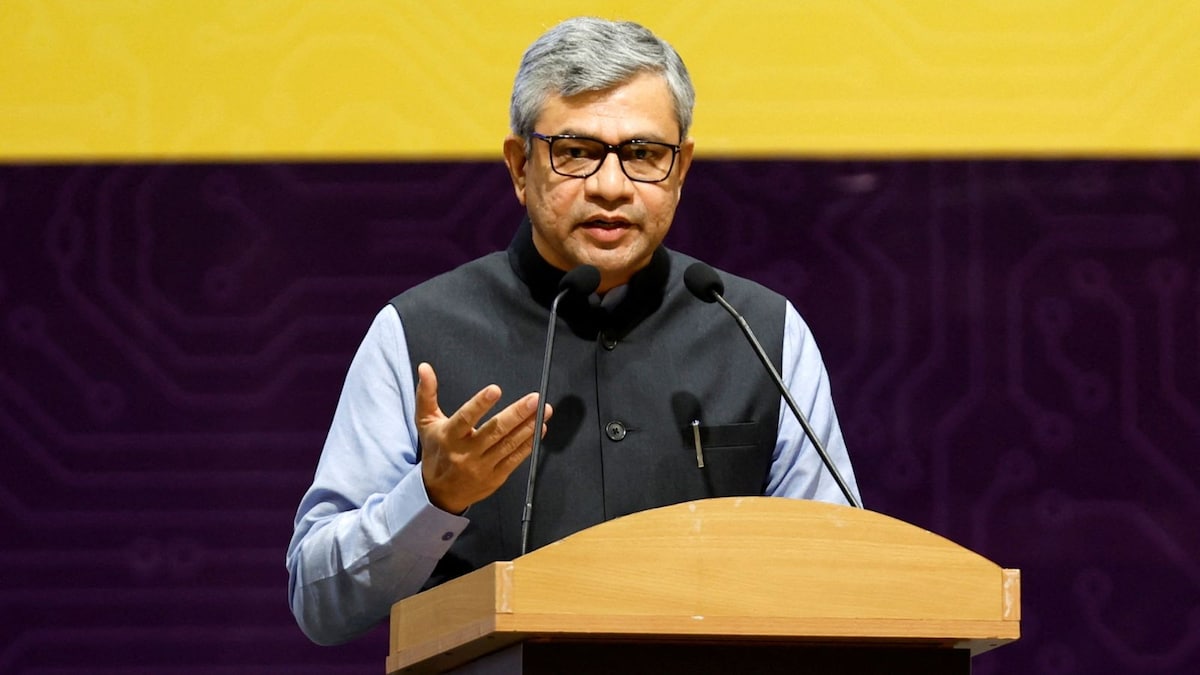
India will release a consultation paper on artificial intelligence regulation within a month, Ashwini Vaishnaw said. The framework will focus on safety, skilling, and social harms like deepfakes. Vaishnaw said, “The bulk of the regulation and responsibility will have to be taken by industry,” while pushing for new techno-legal solutions.
The government will release a consultation paper on artificial intelligence regulation within a month, Ashwini Vaishnaw said, outlining a framework focused on safety, skilling and social harms. The World Bank’s AI report also flagged the need for developing economies to adapt the technology to local needs.
By Aishwarya Airy
India is expected to publish a consultation paper on artificial intelligence (AI) regulation within a month, Union Minister for Electronics and Information Technology Ashwini Vaishnaw said, adding that the document will form the basis for the country’s AI regulation.
“In a month’s time we should be able to publish the consultation paper. That paper will form the base for the regulation to come,” Vaishnaw said at the launch of the World Bank’s World Development Report: The Promise of AI.
Vaishnaw said the proposed framework will focus on AI safety, a human-first approach, skilling and ensuring that no person is left behind. It will also address harms to society, particularly those arising from deepfakes.
“Deepfake quality [is] improving. People believe them. It sets a wrong narrative, luring people into doing wrong things,” he said.
The consultation paper will also consider psychological harms associated with AI use, Vaishnaw said.
AI regulation will need more than a law
Vaishnaw said AI and related technologies cannot be regulated through legislation alone and that India will need to develop “techno-legal” solutions.
“The bulk of the regulation and responsibility will have to be taken by industry,” he said.
He also said AI policy would need to account for the uneven distribution of its benefits.
“We will have people who feel left out and some who feel they’re getting huge benefit. That social situation needs to be considered when making policy,” Vaishnaw said.
He said the scaling up of AI would also present challenges around how young people learn and adopt the technology, as well as opportunities for micro, small and medium enterprises (MSMEs).
“This journey has just begun. It will be an exciting but turbulent journey,” he said.
Vaishnaw said India’s approach to AI had already produced gains, with the country among those that have adopted the technology for practical uses.
“Real benefits come from using the technology to generate productivity gains, cost gains, revenue gains and making a difference in people’s lives,” he said.
AI gains are already showing up across India
Vaishnaw cited several examples of AI being used in agriculture, healthcare and dairy.
In Baramati, a combination of satellite data, Internet of Things (IoT) sensors, weather data and farm-level information has helped increase sugarcane yields by 40%, while reducing labour costs by 20-40% and water and fertiliser use by 30%, he said.
Farmers are also using mobile phones to ask AI systems questions in their own languages and receive suggestions related to farming.
In Gujarat, the Agri Stack platform is being used by more than 5 lakh farmers. Vaishnaw also cited an AI-based tuberculosis detection system developed by a startup, which he said had increased the reliability of TB detection by about 35%.
The Sarlaben app in Gujarat is using AI to provide services to around 3 crore cattle and 36 lakh milk producers in the Amul network through mobile phones, he said.
Another startup has used open-weight models and fine-tuned them for specific requirements, allowing it to access capabilities associated with frontier models.
“These examples show the direction in which the benefits of new technology will come,” Vaishnaw said.
He said India could use such examples to take its experience with AI to other developing countries and the wider Global South.
“This is an opportunity to take our voice to the Global South,” he said.
World Bank flags need for locally adapted AI
The World Development Report said the impact of AI is likely to differ between developing and advanced economies. Developing economies may not have the resources to advance the AI frontier and therefore need to focus on adapting existing technologies to local requirements.
Report Director Gaurav Nayyar said AI was highly context-specific and that simply importing AI systems developed elsewhere may not be sufficient.
The report recommends that developing economies make cost-conscious choices as AI enablers, users and regulators.
AI could help developing economies build capabilities in complex, analytical and cognitive tasks, where skilled workers are in shorter supply. The report said AI could allow some countries to achieve in a decade what might otherwise take a century.
Public service delivery is another area where AI could generate gains. While attention has focused on large language models and generative AI for frontline services, government surveys show that many administrations are already using AI for back-office functions.
Most current government applications rely on traditional predictive AI and machine learning, rather than generative AI, the report said.
The report also said AI could help small businesses improve their capabilities. Many businesses in developing economies already use basic digital tools, which could allow AI to be embedded into existing systems and adopted more quickly.
The risk of widespread AI-driven job displacement is less immediate in developing economies because a larger share of workers are engaged in manual rather than cognitive work. Less than 10% of jobs in developing economies are susceptible to automation by AI, according to the report.
Vaishnaw said the government would need to consider both the benefits and risks as adoption expands.
“Our approach has paid us dividend,” he said. “India [is] among countries that have adopted and used AI for real benefits.”
He compared AI to a prism that can create multiple applications from a common technology base.
“This is a prism which will convert one white light into many colours,” Vaishnaw said.
He also called on the World Bank to use its global reach to understand how countries were approaching AI and develop policy recommendations based on those experiences.