
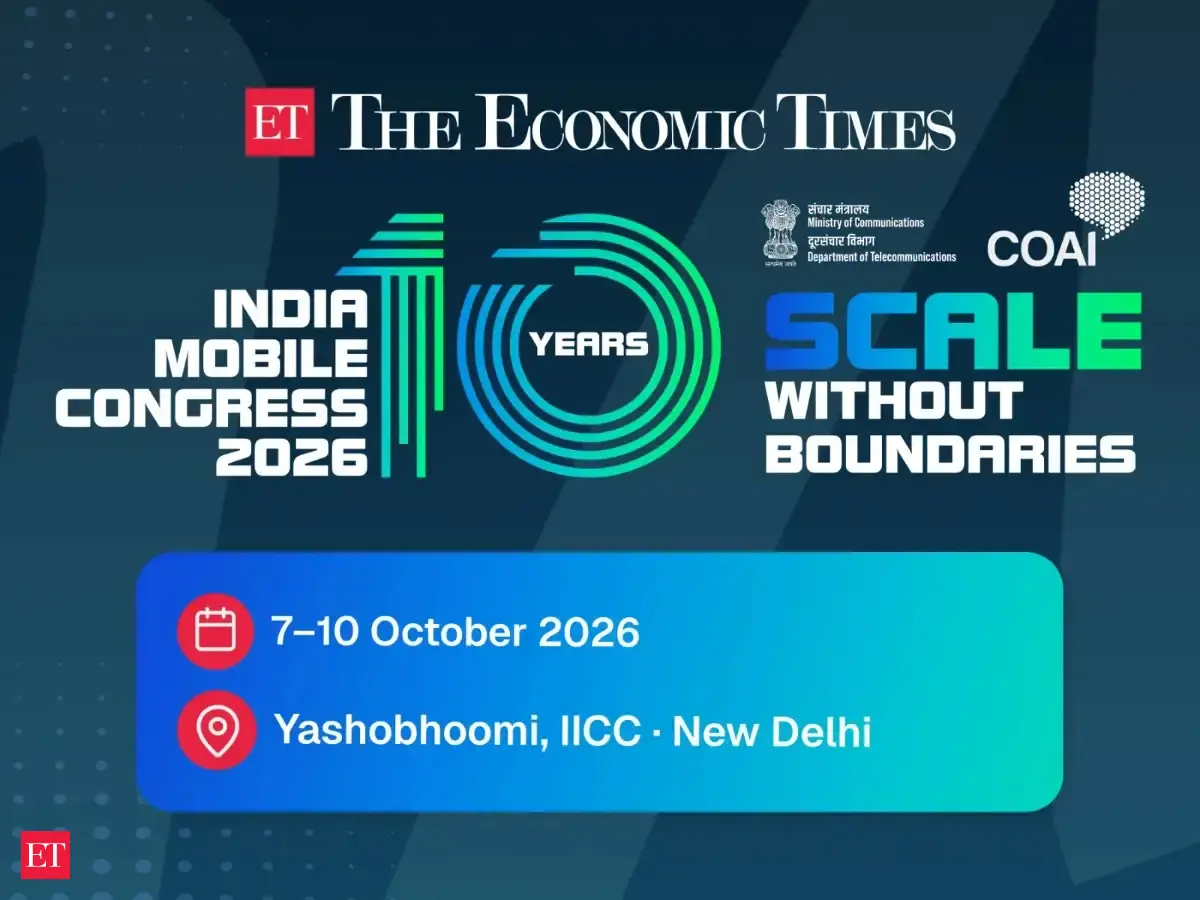
India Mobile Congress 2026 is set for October 7 to 10 at Yashobhoomi, New Delhi. This tenth edition, run by the Department of Telecommunications and COAI, carries the theme "Scale Without Boundaries." Organisers expect over 150,000 visitors as the event highlights major shifts in 6G, satellite communication, and national semiconductor missions.
India Mobile Congress 2026 is on from October 7 to 10 at Yashobhoomi, New Delhi. The Department of Telecommunications runs it with COAI. This is the tenth edition. "Scale Without Boundaries" is the theme, and the organisers are working with a footfall estimate north of 150,000 over the four days.
Listen to this article in summarized format
Listen
×
Subscribe to
Unlock AI Briefing and Premium Content
New Year Offer 24 Hours Left
Subscribe Now
Already a member? Sign In
What's Included
* Exclusive Stories
* Daily ePaper Access
* Smart Market Tools
* Curated Investment Ideas
* Ad-lite Experience
* Subscription
Ask most people which network their phone is on and you will get a shrug, or maybe the name of a plan they picked three years ago. Network coverage stopped being interesting to the public roughly around the time it stopped failing. Inside the industry, almost nothing is settled, however.
India Mobile Congress 2026 is scheduled for October 7 to 10 at Yashobhoomi in New Delhi, to answer the unsettling questions within the industry. The Department of Telecommunications runs it alongside COAI (Cellular Operators Association of India), the body that speaks for the operators.
Ten editions now
The first edition in 2017 fit into a considerably smaller hall, back when 4G was still being laid down across the country, and the word "satellite" was not brought into the conversation very often. That one drew roughly 32,000 visitors, 152 speakers and 100 exhibitors. This year's is being built for about 150,000 people.
Almost a decade later, things have drastically changed. 5G was switched on at IMC in October 2022, when the Prime Minister launched commercial services from the event floor, and the rollout that followed was among the quickest anywhere in the world.
The conversation has since moved on. The Bharat 6G Alliance has been running since 2023, and the government has said it wants India to hold a tenth of the world's 6G patents. Satellite communication went from a side topic to a licensing and spectrum contest involving Starlink, OneWeb and Jio. Semiconductors, barely mentioned in 2017, now have a dedicated national mission and a set of approved fabrication units. The Telecommunications Act of 2023 replaced a law that had been on the books since 1885.
The theme for this year is "Scale Without Boundaries". Branding, obviously. The programme sitting under it is a good deal more concrete than the phrase lets on. The organisers have split it into four pillars, each with a Sanskrit name: Srishti, Samvardhan, Sashakt and Suraksha.
Srishti covers the early-stage material. 6G, quantum communications, semiconductors, AI chipsets, edge and cloud, and networks that run with little human supervision.
This is the pillar where the sessions get technical. The International 6G Symposium sits under it, along with a Quantum Summit and CTO-level roundtables on network architecture. Vendors do most of the talking here. Operators tend to listen and take notes.
Samvardhan deals with what happens after the technology exists, which is mostly a money question. 5G monetisation, network APIs, satellite and direct-to-device, telecom manufacturing, and the economics of AI infrastructure.
Sashakt is the access and sustainability track. Green telecom, e-waste, energy costs, digital skilling.
Suraksha is about trust, and it has become the busiest of the four. Cybersecurity, data privacy, AI governance, spectrum, network resilience, and the unglamorous problem of spam and fraud that every operator in the country deals with daily.
The conference programme sits on top of these pillars. There is a "Global Telecom Leadership" segment with participation from more than 20 international operators, an International 6G Symposium, a Satcom Summit, a Cybersecurity Summit, a Quantum Summit and a Smart Mobility Summit. Viksit Tech 47 and the Startup Worldcup run alongside, with closed-door leadership roundtables scheduled throughout the week.
The numbers the organisers are working with are large. Over 150,000 expected attendees. More than 100 countries to be represented. Over 2,000 technology use cases will be on display. Around 600 startups, 300-plus investors and accelerators, and roughly 700 investor meetings are expected to take place on the floor.
The exhibition itself takes up 60,000 square metres, which is a fair chunk of Yashobhoomi. Ericsson is the principal partner this year. TCS, Nokia and Qualcomm are on the top tier alongside it, with Airtel, Jio and Vodafone Idea as foundation partners. BSNL, C-DOT, Tejas Networks, GSMA and the Bharat 6G Alliance are also involved, as is the Ministry of Electronics and Information Technology.
Past editions have had Communications Minister Jyotiraditya Scindia on stage, along with Minister of State Dr Chandra Sekhar Pemmasani and Telecom Secretary Amit Agrawal. Reliance Jio's Akash Ambani, Bharti Airtel's Sunil Bharti Mittal and Vodafone Idea's Kumar Mangalam Birla have all spoken at previous editions. The 2026 speaker list is still being filled in.
For most visitors, the week works in two halves. The conference halls are where the policy and strategy talk happens, and the exhibition floor is where companies showcase what they have built. Private meeting rooms can also be booked at the venue, which tells you something about what a lot of attendees are really there for.
Registrations are open on the IMC website separately for delegates, visitors, students and the media. The venue is about forty minutes from central Delhi by road, and closer to the airport.