
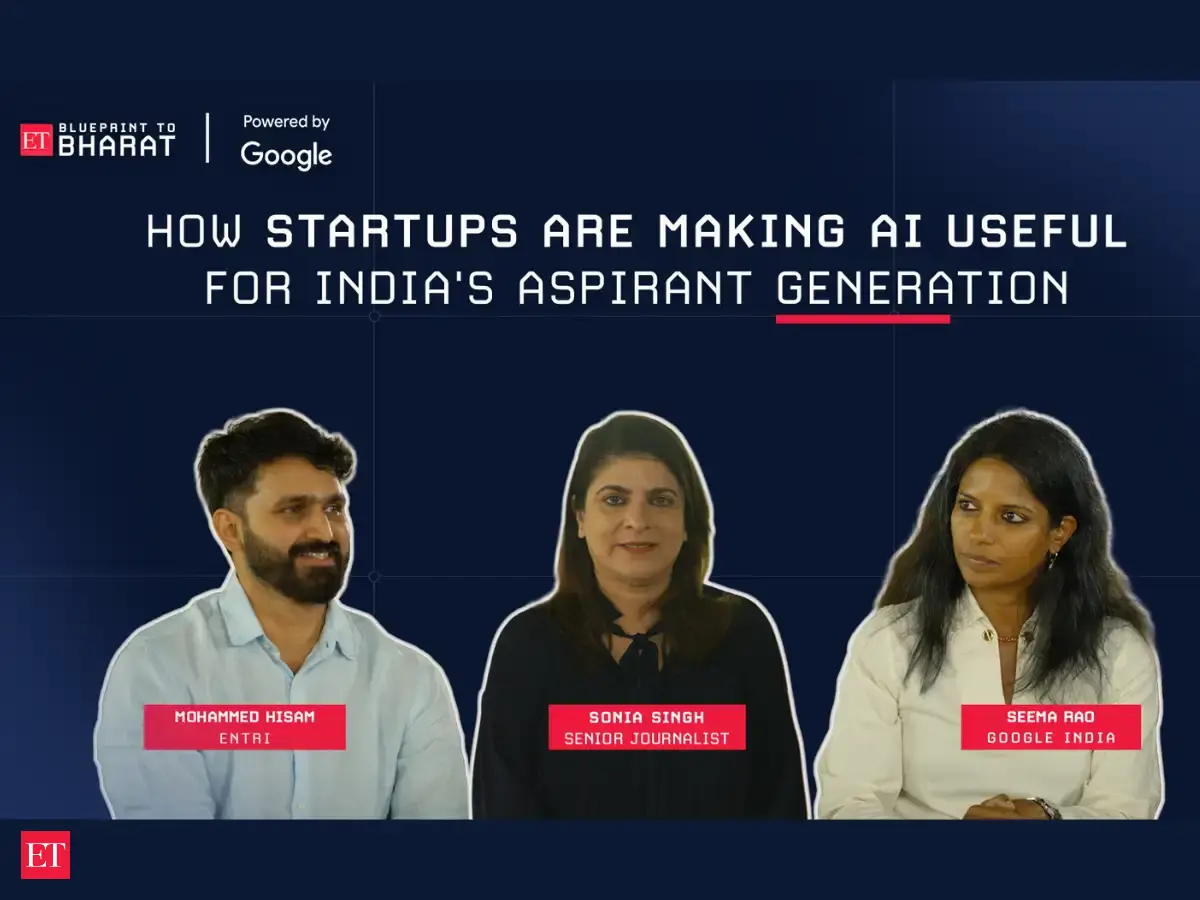
Artificial intelligence is helping millions of Indians prepare for competitive exams and job interviews. Startups like Entri use Gemini models to provide coaching and mentorship in local languages. Sonia Singh said, “Today we are asking what happens when high level preparation becomes uniquely personal, affordable, and easily available.”
Synopsis
Artificial intelligence is now being used in learning, competitive interview preparation, and training millions of Indians irrespective of their socioeconomic background. Entri is taking coaching, employability-specific programs, and mentorship to the fingertips of aspirant Indians. Read on!
Listen to this article in summarized format
Loading...
×
For many Indians, education and competitive exams are the only way to take their social and economic status a notch higher. Despite the opportunities for the taking, however, it is not easy.
The aspirant generation of India, counted in millions, prepares for competitive exams, job interviews, professional certifications, and moving up the organizational ladder year after year. Are they talented? A big yes. Are they motivated enough? Again, a yes! What impedes their journey then? What is keeping them from realising their dream?
It could be the lack of guidance, mentorship, access to quality coaching, lack of avenues to upskill their skills, and language barriers that are hindering their progress.
The important question is, at a time when artificial intelligence (AI) has answers to almost anything and everything, can this problem stacked up against millions of Indians be solved utilising AI?
This is precisely the question Sonia Singh, from The Economic Times, asked in this episode of the series -titled “Blueprint to Bharat” powered by Google- with Mohammed Hisam, Co-founder of Entri, and Seema Rao, Managing Director, Corporate Development, Google India.
Live Events
“Today we are asking what happens when high level preparation becomes uniquely personal, affordable, and easily available on any phone, regardless of the language you speak,” Singh asked as she opened up the conversation for the two guests.
What happens when AI builds for this need at scale, solving complex problems in your language, even providing you with an AI interview coach, she asked. Hisam has the answers, for it is this problem he has set out to solve with Entri, after observing recurrently students in South India grappling to cross the language barrier.
How Startups Make AI Useful for India's Aspirant Generation | Google x ENTRI | Blueprint to Bharat
From local-language learning and AI-powered interview coaching to personalized teaching assistants, ENTRI is using Gemini models to help learners build skills, get job-ready, and find better career opportunities. The conversation also looks at the larger opportunity for Indian startups: how solving deeply local problems can create products built for population scale, and ultimately for markets beyond India. Mohammed Hisam, Co-founder of ENTRI, and Seema Rao, Managing Director, Corporate Development at Google India, join Sonia Singh of The Economic Times for the fourth episode of Blueprint to Bharat. Watch the full episode. #Google #GoogleIndia #Entri #AI #GeminiModels #VernacularAI #EconomicTimes
AI and Education
“Imagine a 22- or 23-year-old woman from Kerala or Tamil Nadu just out of college with a degree but not very confident in English, right? They're not proficient in English. And for them to get a job, they have to upskill, right? Entri is built for them,” Hisam said.
Entri came into being in 2017, and in less than a decade, the company is now providing learning programs in vernacular languages including Malayalam, Tamil, Kannada, and more.
“We are helping our users upscale, go zero to one on a particular skill and get a job,” Hisam said. He estimates that more than 400 million Indians, aged between 18 and 35 years, are not proficient in English, and this handicap impairs their learning.
Entri does not expect them to learn English; rather, it helps them upskill in their own language and increase employability chances. “We are improving their employability chances by imparting learning in their own language. And we are super focused,” Hisam said.
Entri has been a part of the Google for Startups accelerator program, and Rao expresses pride in knowing the outcomes that the alumni see post the program. Besides, she says, Entri was solving a deep-rooted problem with real-world implications.
“Education is almost foundational to the growth of an economy, a society, a nation. And a country as diverse and complex as India, the question of resolving the impediments in the sector has always been a fundamental one,” Rao said.
Entri, the entry of AI into education
Rao appreciates the fact that Entri has made everything suddenly very clear, with best-in-class models that are accessible to every learner, no matter where they are, right at their fingertips.
“For us at Google, it is exciting to see the AI technology we have built getting reflected in day-to-day problems and opportunities. Learning is a great way of using the power of AI for solving such problems at population scale,” she said.
Speaking further about Entri, Rao said that the company was not only creating an AI feature, but it is embedding Gemini models deep into their product, given the complexity of solving vernacular problems.
“Our Gemini models are built to be vernacular, multimodal, and multilingual from the ground up,” she said, adding, “When you combine the power of the models with real-world applications, magic can happen.”
Backed by such capabilities, Entri has moved beyond any conventional online learning platform. This platform, unlike many EdTech platforms, measures success through employment outcomes, and not finishing a lesson or getting a certificate.
Hisam says the users of Entri do not care about anything other than cracking a job interview or upscaling so that their salaries improve. “Our users are either unemployed right now or in a low-paying job. Their priority is to cut out; they do not care about finishing a lesson,” he said.
Knowing your core deliverable is a huge plus for any startup, and this knowledge has led Entri to develop tools, powered by AI, that are directly focused on employability. For example, the AI interview coach of the company allows people to practice with unlimited mock interviews, while they prepare for the real one.
Another very interesting feature Entri has come up with is the AI Teaching Assistants, a real AI-human collaboration making learning easier. This AI assistant can answer questions in vernacular languages during recorded videos as well as live teaching sessions by human mentors-which Hisam believes has the potential to fundamentally alter the economics of education delivery.
“Imagine one teacher teaching one million students while unlimited AI co-teachers answer every learner’s questions in real time,” he said.
Learning outcomes, Hisam says, are another metric of Entri’s success. The platform has helped a visually impaired user get Rank 1.
“And that is not about it. We have got autorikshaw drivers getting jobs. We have women who have not been able to go outside their homes after marriage, doing a Montessori Teaching Training Certification on Entri and getting a job. All these are success stories,” Hisam maintained.
The partnership between Entri and Google also showcases a wider approach by the tech giant in supporting India’s startup ecosystem. “Our goal is to be the innovation partner of choice throughout a startup’s journey,” Rao said.
A matter of trust:
The two speakers agreed that the trust factor will ultimately determine long-term AI adoption in India’s education sector, as it is being embedded rapidly.
Rao believes that trust cannot and should not be added later in the system. “In education, users must inherently trust the product,” Rao said, with Hisam echoing her concerns.
Hisam said that factual accuracy was critical for learners preparing for competitive exams, asserting that one of Entri’s biggest priorities was to ensure AI does not hallucinate on factual questions.
“We used verified data to train it. Incorrect information can directly affect a learner’s future,” he said.
Rao concluded by saying that Google has safety and security at the very foundation of any of its products from day one. “It is not an end-of-life or a late-stage check-the-box activity. It is not to be done when the product is more complex and when you have more users; it's meant to be done at the very beginning.”
(This article is generated and published by ET Spotlight team. You can get in touch with them on etspotlight@timesinternet.in)
The world is witnessing a bond rout. Why should it matter to you?
Q2 earnings season: Will it settle or add to confusion in the stock market?
How Sebi busted Growpital’s ‘assured’ returns, LLPs and money trail
The biggest assumption: From $600 billion to $2 trillion
A for apple, Y for yak and, for the first time, a price next to it. Will this change the non-agri part of the rural economy?