
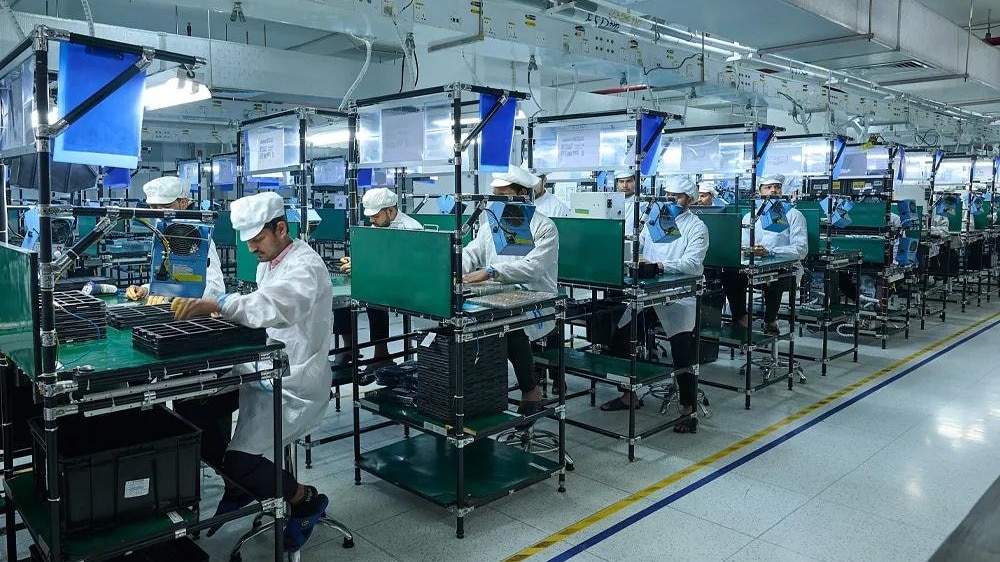
Bhagwati Products Limited is changing how India builds electronics. The firm started its Rudrapur facility in 2012, long before the Make in India initiative. Vikas Jain said, "The stereotype that Indians were mostly known for being consumers is changing slowly and surely." Now, they ship millions of units every month.
The year is 2026. Inside a Surface Mount Technology (SMT) assembly facility, high-speed feeder arms are placing microscopic silicon chips, resistors, and capacitors onto blank printed circuit boards (PCB) with razor-sharp precision. Across automated conveyor tracks in the Final Assembly, Testing, and Packaging (FATP) bays, workers in anti-static gear assemble, flash, run diagnostics, and box finished smartphones in a matter of seconds.
Things were not always this forward-looking. For the longest time, India was the quintessential consumer. Never the creator. At least not the one that built consumer electronics at scale anyway. Global firms designed the architecture in Silicon Valley, fabricated chips in Taiwan, and assembled their devices in China. India merely consumed them, absorbing heavy import duties along the way.
Today, that stereotype is breaking on factory floors across the country including this one located in Rudrapur, about 250 kms south of Dehradun (the capital of Uttarakhand).
This facility was set up in 2012 by Bhagwati Products Limited (BPL), two years before the Prime Minister of India, Narendra Modi, would officially announce the "Make in India" initiative. The team behind this Rudrapur facility came together in the early 2000s under the brand name Micromax Informatics. Their association goes back even further than that, long before hashtags were a trend on social media. As the government marks #12YearsOfMakeInIndia, Bhagwati's quiet evolution into one of the country's most formidable electronics manufacturing services (EMS) players, is one for the ages.
"The stereotype that Indians were mostly known for being consumers is changing slowly and surely," says Vikas Jain, co-founder of Micromax and Bhagwati Products Limited. "We have reached a stage where we are not taken lightly. Overseas governments are trying to put embargoes in terms of export of certain machines to India, which gives a very clear signal of the rise of India. It's going to be a long-term play, but another decade of sustained initiative will see us among the top two manufacturing countries in the world."
There is a sense of optimism. But of course, this optimism is not new, what with Jain and Co. being one of the OG makers in India. From assembling basic handsets in the early 2010s, Bhagwati's manufacturing ecosystem now ships over three million units monthly from its flagship Greater Noida facility alone. It is rapidly expanding toward an enterprise capacity of five million units per month, covering smartphones, smart TVs, air conditioners, wearables, and enterprise IT hardware.
From Y2K code to telecom hardware
Micromax started as a bootstrapped idea operating out of North Delhi. Founded by four engineering friends -- Vikas Jain, Rahul Sharma, Sumeet Arora, and Rajesh Aggarwal -- the company was built entirely on personal savings. Coming from middle-class families with fathers in government service, every co-founder received an identical equity stake, a structure they have preserved across every entity they have founded.
"Fundamentally, we wanted everybody to have equal stakes in the company so that everyone was equally aligned and inclined toward growth," Jain says. "Being first-generation entrepreneurs, our philosophy was simple, we don't take money out of the company. We relied on substantial retained earnings. That fiscal discipline was the sole reason we stayed together and navigated every downturn. Every time we faced a disruption, we were able to come back because our retained earnings were intact."
Their first act was all software writing code during the Y2K wave. From there, the founders migrated into embedded systems, signing on as partners to Wind River on real-time operating systems (RTOS).
In 2005, an unexpected partnership with Nokia marked their entry point into telecom hardware. Nokia had made an early machine-to-machine (M2M) wireless module -- a predecessor to modern IoT architecture -- designed for wireless data and voice transmission. Micromax would spot the use-case.
At the time, tele-density in India hovered at single-digit percentages. Telecom operators charged exorbitant tariffs: as much as Rs 34 per minute for an outgoing call and Rs 17 per minute just to receive an incoming call. Landlines were a luxury reserved for the affluent. The Public Call Office (PCO) was the go-to communication channel for the common folk.
Using Nokia's M2M module, the Micromax engineering team designed a proprietary hardware unit called the Fixed Wireless Terminal (FWT). The device captured ambient cellular signals and routed them directly into standard PSTN telephone sets, allowing you to deploy a functional GSM-powered PCO anywhere an operator's wireless signal reached, bypassing the need for physical copper wire.
The hardware they built got a reality check when Bharti Airtel offered the founders a trial along one of the most challenging corridors in Asia: the 12-kilometre mountain trek between Katra and Vaishno Devi in Jammu and Kashmir.
Traditional wired lines failed in the rocky terrain, and cellular signals were erratic. To compensate, Sumeet Arora engineered a custom high-decibel antenna. Booth operators mounted it to their tin roofs, wired it to the Micromax terminal, and powered the entire rig using 24-volt truck batteries. The setup survived 20-hour daily duty cycles, yielding operators up to Rs 2,000 a day.
The Vaishno Devi pilot succeeded, opening the door to enterprise telecom deployments. Over the next three years, Micromax became the primary hardware provider for Airtel's national PCO rollout, a division that at its peak generated roughly Rs 3,000 crore in annual service revenue for the telecom operator.
But by 2008, crashing tariffs and the proliferation of cheap mobile handsets triggered the fall of the PCO. Simultaneously, Airtel shifted from a capital expenditure model to an operational one, forcing Micromax to build a nationwide distribution network in 30 days to survive.
India had not yet unified its indirect taxation under the Goods and Services Tax (GST). Operating across states required maintaining registered corporate premises, local inventory, and state-specific Value Added Tax (VAT) registrations across nearly two dozen tax jurisdictions.
"At that time, my entire corporate team consisted of about 25 people," Jain recalls. "We had one person in finance, one in administration, one in human resources, and everyone else was an engineer alongside the four founders running daily operations. When Airtel shifted the model, we asked their management how many months we had to build out national distribution. They told us: 'No months. You have thirty days.'"
Faced with a 30-day deadline or the risk of forfeiting their account to Beetel, the four founders partnered with domestic logistics player Om Logistics to negotiate shared lease agreements across 25 freight warehouses nationwide. Within four weeks, they secured localised VAT clearances, deployed regional inventory, and transitioned into a national distribution operation. But the fixed-line era was coming to an end. It left the founders with an existential question: what to build next?
Moving closer to the soil
The answer would come out from a service call in Berhampore, a semi-rural town in West Bengal. Investigating a malfunctioning terminal, the founders discovered an operator running a profitable communication hub in a complete dead zone with rolling blackouts. Every morning, his son pedaled a truck battery eight kilometres to a grid-connected village just to charge it.
Back then, mobile devices were categorised into 3 rigid tiers: Ultra-Low-Cost Handsets (ULCH) with monochrome screens and limited functionality, basic mid-tier candy-bar phones, and prohibitively expensive executive products like the Nokia Communicator. Crucially, there was no single device for a market where consumers travelled eight kilometres on a bicycle just to charge a battery.
Prompted by MediaTek, Micromax decided to leverage its existing 25-state logistics network to enter the mobile market directly, launching its first consumer handset -- the Micromax X1i -- in September 2008. Here too, Arora's tech genius apparently came into play. He re-engineered MediaTek's base schematics to improve signal retention in low-reception areas and wrote custom firmware to cut idle power draw, giving the X1i 30 days of standby battery life.
"Because we didn't have a manufacturing plant yet, we partnered with an EMS facility in Shenzhen through MediaTek," says Jain. "The plant required a minimum run of 5,000 units. We scraped together our available liquid cash to clear the order, assuming those 5,000 units would supply our distribution network for a month to forty-five days. We launched the phone, and all 5,000 units sold out completely in three days."
Vikas Jain and Rahul Sharma flew back to Shenzhen the following weekend, attempting to secure immediate line capacity. The factory was fully booked, offering an assembly slot three weeks out. The founders doubled their next order to 10,000 units, which sold out just as quickly. By January 2009 -- barely four months after launch -- Micromax was selling over 100,000 handsets a month.
By 2014, the company was shipping 3.5 million mobile phones monthly, capturing the number two market share rank in India and briefly trailing only Samsung, while standing as the tenth-largest mobile brand globally.
The shift to sovereign manufacturing
In 2012, importing Completely Built Units (CBUs) from China was cheaper and faster than domestic assembly. The founders established Bhagwati Products Limited anticipating future global trade friction.
"We realised that shipping over a million and a half devices a month out of China was unsustainable over the long term," says Jain. "We anticipated that global trade headwinds would eventually emerge, or that the government would recognise the need to industrialise domestic electronics. When we established Bhagwati Products Limited and opened our first manufacturing plant in Rudrapur in 2012, there was zero duty differential on CBUs. It was actually more expensive to manufacture a device in India than to import it fully assembled from China. But as a de-risking strategy, we went ahead and started domestic manufacturing."
In 2014, Bhagwati acquired a 25-acre plant in Bhiwadi, Rajasthan, investing heavily in automated SMT lines to mount microcomponents domestically rather than snapping together imported boards. This infrastructure proved vital when supply chains collapsed during the COVID-19 pandemic.
"COVID was the ultimate stress test," Jain notes. "Revenues dropped while fixed overheads remained. But our founding principle held. We took a firm stance against laying off our workforce. Our employees stood by us, voluntarily accepting pay cuts so we could preserve every job. And because we had consistently preserved our retained earnings over the preceding decades rather than taking out capital, our balance sheet held firm."
The government responded with policy upheaval introducing the Production-Linked Incentive (PLI 1.0) scheme for Large-Scale Electronics Manufacturing. Enacted as a five-year initiative running through March 2026, the program offered direct financial incentives on incremental sales of goods manufactured locally.
"Early critics ridiculed PLI as a superficial scheme that wouldn't change core economics," says Anil Joshi, Managing Partner at Unicorn India Ventures. "But combining targeted financial incentives with India's massive captive domestic market created a compelling rationale. It prompted firms to retool lines and commit meaningful capital expenditure."
Domestic smartphone production surged to cover nearly 99 percent of local demand. For Bhagwati, PLI 1.0 provided the capital momentum to expand aggressively.
"The central government understood what the industry was up against and laid out a clear roadmap," Jain says. "PLI 1.0 was about establishing baseline capacities and manufacturing capabilities. China held a multi-decade lead in component supply chains, and the government stepped forward to help offset that initial disability."
In mid-2024, Bhagwati acquired Vivo's primary manufacturing plant in Greater Noida. To acquire technical design knowledge and elevate operational standards, the founders formed a joint venture with Huaqin Technology, an established Chinese original design manufacturer (ODM) with whom the founders had worked since 2008.
Because the cross-border investment involved a foreign technical partner, the joint venture required formal clearance under India's Press Note 3 regulations, instituted to ensure thorough security screening of foreign capital from neighboring countries. Following government review, the venture secured formal approval in September 2024. The equity structure was formalised with the Indian founders retaining a 51 percent controlling interest.
"Through our relationship with Vincent Qiu, the founder of Huaqin, we identified an opportunity to transfer technical design expertise to India," Jain explains. "We acquired the Vivo facility, while Vivo committed a portion of their EMS contract volume to support our ramp-up. When we took over the plant in mid-2024, it ran four SMT lines and seven FATP lines. In July 2024, our first month of production, we shipped 48,000 units."
Today, Bhagwati's Greater Noida facility covers 1.6 million square feet of built-up floor area. Inside, the production lines run at full capacity: 21 automated SMT lines and 35 FATP assembly bays run continuously, producing more than three million devices each month.
The plant manufactures a diverse hardware portfolio including smartphones, legacy feature phones, large 4K televisions, inverter air conditioners, digital set-top boxes, smart wearables, and hearables. Under an exclusive manufacturing arrangement with Omni Devices, Bhagwati also manufactures 100 percent of Omni's remote-control units (RCUs) for the Indian market.
"Every resource in that facility is running at full capacity," says Jain. "We can no longer expand within those four walls. To handle future demand, we are building an additional 400,000-square-foot facility nearby in Greater Noida's Kasna industrial belt, which will go live before the close of 2026. That will help scale our monthly run rate from 3.5 million to roughly five million units over the next 12 to 18 months."
The company's expansion plans, however, look beyond consumer electronics assembly. Bhagwati is positioning itself to enter complex enterprise computing through laptops, high-performance data servers, and enterprise AI hardware.
"Hardware provides the foundation for the global AI wave," says Jain. "There is an extensive software stack, but it requires a high-performance hardware backbone to run. India is well positioned to assemble and engineer IT servers, hyperscaler infrastructure, and AI hardware domestically. Our joint venture partner runs an established enterprise IT hardware division in China, and we are working to adapt that engineering expertise to build server design and assembly lines in India over the next two years."
The next frontier
In April 2026, the government initiated the next phase of its manufacturing roadmap: the Scheme for Promotion of Manufacturing of Electronic Components and Semiconductors (SPECS/ECMS) and the new National Phone Manufacturing Scheme (NPMS), succeeding the original PLI framework.
NPMS shifts the policy focus from basic device assembly to deep component localisation and domestic intellectual property creation.
"The government's message is clear," Jain explains. "The first five years helped build factory capacity and scale. Now, policy is pushing for deeper component integration. Through the component policy launched earlier this year, the government is incentivising EMS providers to source key parts from domestic component factories. There are targeted incentives across six key component categories: 0.5 percent on device enclosures, 0.3 percent each on display panels and camera modules, along with dedicated tiers for localised battery cells and Indian-manufactured charging cables and connectors."
The policy also introduces export incentives to encourage global competitiveness. "Under the framework, maintaining status-quo domestic volumes yields limited incentives," says Jain. "To qualify for top-tier support of 2.7 to 5.0 percent, companies must demonstrate exceptional performance -- either by significantly growing domestic market share with an annual revenue markup above 15 percent to outpace component inflation, or by using India as a primary export base for international markets."
Jain says this could be an opportunity to position India alongside established global electronics export hubs.
"The broader conversation often frames this as India versus China. But an immediate, practical opportunity lies in competing with established secondary manufacturing centres like Vietnam, Thailand, and Indonesia. Those countries do not manufacture simply for domestic consumers; the vast majority of their production is destined for global export. The current policy framework provides us the leverage to show international clients that India can serve as a dependable, cost-competitive manufacturing and export alternative."
This push for deep localisation is no longer just an economic strategy but it is also a national security mandate. Abhishek Tripathi, Co-founder of Deep Algorithms, notes that hardware manufacturing and digital security are inextricably linked.
"Make in India cannot be viewed simply as assembling a physical chassis or soldering a printed circuit board," Tripathi says. "A device can be put together in a domestic factory, but if its firmware, core operating libraries, and data storage pathways depend on unaccountable foreign supply chains, it presents an operational vulnerability. COVID-19 was a major turning point. It highlighted how quickly global supply chains can fracture and prompted a re-evaluation of technology, shifting from seeing it merely as an everyday productivity tool to recognising it as critical national infrastructure."
Initiatives like the Digital Personal Data Protection (DPDP) Act, alongside government computing infrastructure initiatives managed by CDAC and the IndiaAI mission, are helping build a foundation for locally managed digital infrastructure.
"Before 'Make in India' took hold, the country lacked an integrated cybersecurity and specialised hardware ecosystem," says Tripathi. "Today, domestic cybersecurity startups are securing systems like UPI, which process payments for over 1.4 billion people every day. Domestic data centre operators like CtrlS and ESDS are expanding sovereign server operations. Building algorithmic capability in India is critical as computing shifts from remote server farms directly onto everyday mobile devices."
The road to complete localisation -- and self-reliance -- is long. Global contract manufacturers operating in India still primarily run Electronics Manufacturing Services (EMS), assembling components based on client blueprints, rather than operating as Original Design Manufacturers (ODMs) that engineer products from the ground up. This intellectual property shift will take time and investment.
"Make in India was originally designed to encourage domestic production for our home market," Joshi notes. "The next phase -- designing products from scratch -- is what builds durable industrial self-reliance. When an international brand builds a phone in India today, it is primarily manufacturing hardware. By contrast, deep-tech and space startups like Skyroot or Agnikul are designing proprietary intellectual property from the ground up to serve both India and global clients. That structural evolution requires five to ten years of focused R&D investment."
Joshi points to targeted government design incentives as an important push. "The policy focus is broadening beyond pure volume manufacturing," Joshi explains. "Programs like the Design Linked Incentive (DLI) for semiconductors, the National Quantum Mission, and the defense ministry's iDEX initiative are helping bridge the gap between initial product development and customer adoption. Developing a complex product is only half the battle; having a confirmed customer base willing to procure it gives startups the runway they need to commercialise indigenous designs."
That -- design in India -- is Bhagwati's next frontier as well.
"Our goal is to build on our core EMS operations and expand into genuine ODM design and engineering," says Jain. "Through our joint venture with Huaqin, we are integrating experienced design and engineering leads directly into our Greater Noida teams. We want to train young Indian engineers under veterans who have designed consumer hardware for decades, accelerating our learning curve. If we execute, we can offer end-to-end ODM product design for Indian and global brands alike."
The timing of this ODM initiative aligns with new incentives under the NPMS framework, which provides a dedicated 3 percent production incentive for manufacturers that develop and own their product design IP within India.
"If the Indian government is willing to support indigenous research, development, and IP ownership, that represents a valuable opportunity for our industry," Jain adds.
Will this opportunity translate into Micromax's return to the consumer smartphone market?
"The government has made clear that it is ready to back ambitious domestic initiatives," Jain says. "We are evaluating the landscape, tracking policy criteria, and studying the operational prerequisites. It is a work in progress -- neither a definitive yes nor a definitive no (to launching a Micromax phone). But entering the market cannot be treated as a short-term tactical move simply to capitalise on an incentive scheme. If Micromax returns to the consumer fold, it must be built on a sustainable, forward-looking foundation designed for long-term category presence."
Whether Micromax makes its way back to the retail shelves, the legacy of its founding journey is already visible in the industrial revolution taking place across the country.
Twenty-six years after four middle-class engineering graduates pooled their parents' modest savings during the Y2K transition, their venture has helped prove that Indian manufacturing can compete at international scale. With the right policies in place, now and in the coming future, India rising is more than just a thought -- it is inevitable.