
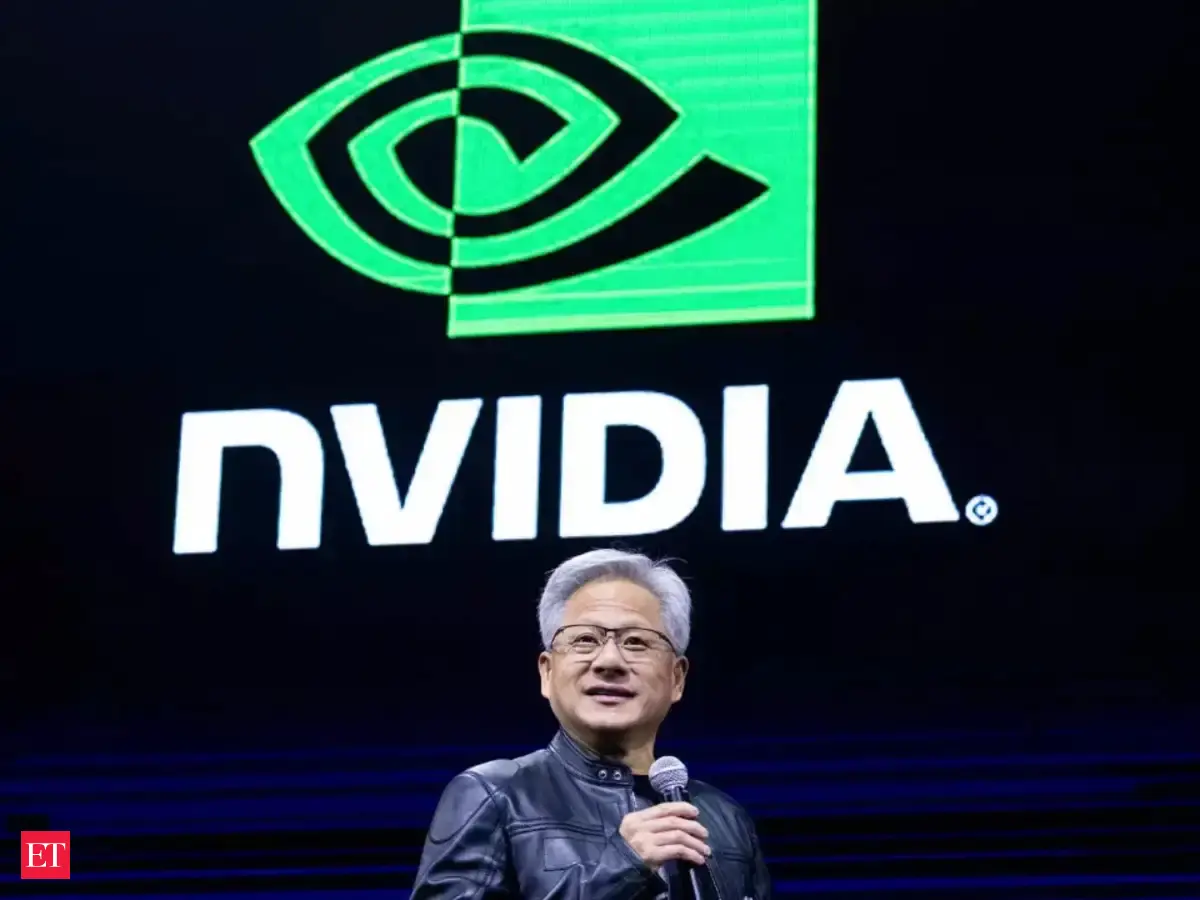
Jensen Huang cleaned bathrooms at a Kentucky boarding school at age 9. He later worked at Denny’s, where he got the idea for Nvidia. In 2006, he started CUDA as the company’s valuation fell. Many years later, his work showed that GPUs are now central to the global AI boom.
Synopsis
Jensen Huang's journey started at a boarding school in Kentucky, where he worked as a janitor. After his parents joined him, they faced financial struggles, which shaped Huang's future. He later worked at Denny's, where he conceived the idea for Nvidia. Despite initial challenges, Nvidia introduced CUDA, which became crucial for AI development.
Listen to this article in summarized format
Loading...
×
Long before Jensen Huang became known as the cofounder and CEO of Nvidia, his first job in the United States involved cleaning bathrooms at a Kentucky boarding school.
Huang was 9 years old when his parents sent him and his brother from Thailand to the United States in the mid-1970s. According to Fortune, the family had been living in Bangkok during one of Thailand's periodic coups, and Huang's parents decided to send the boys to America.
An uncle in Tacoma, Washington, helped find a school for the brothers. They eventually attended Oneida Baptist Institute in Clay County, Kentucky.
Jensen Huang became a janitor at age 9
Students at Oneida Baptist Institute were expected to have jobs, according to Fortune.
Huang's brother worked in the school's tobacco fields, while Huang was assigned to clean bathrooms. He was responsible for bathrooms used by about 100 teenage boys.
Live Events
You Might Also Like:
In 1935, Grace Groner, a secretary, invested $180 in her employer Abbott; 75 years later, it had grown to about $7 million
Fortune described the environment at the school, including dormitories without closet doors or locks. Huang also recalled that students smoked and sometimes settled disputes with knives.
Huang later told Joe Rogan that, despite those circumstances, he had mostly good memories of his time there.
Huang’s parents eventually joined him in America
Huang and his brother spent two years at the Kentucky school before their parents arrived in the United States.
Fortune reported that his parents arrived with suitcases and little money. His mother worked as a maid, while his father, who had been trained as an engineer, searched newspaper classifieds for employment.
You Might Also Like:
Trump Account $1,000 eligibility explained: Your child may qualify for an account but not the federal deposit - here’s why
His father eventually found work at a consulting engineering firm, where he designed factories and refineries.
Huang also recalled an early family experience involving a particleboard coffee table in their rented furnished apartment. He and his brother accidentally broke it, and he remembered his mother's reaction because replacing it would have been difficult for the family.
Jensen Huang worked at Denny’s before Nvidia
Before Nvidia, Huang also worked at Denny's.
According to Fortune, he started there as a dishwasher before becoming a busboy.
You Might Also Like:
Josh Brolin bought his Atlanta mansion for $3.25 million in 2020; 6 years later, he sold the 7,700-square-foot home for $4 million after a price cut
It was at a Denny's booth that Huang met two friends and discussed the idea that eventually became Nvidia. The idea was to create a chip capable of powering 3D graphics on a personal computer.
Nvidia later launched CUDA in 2006
One of Nvidia's major technology developments came years later with CUDA.
Fortune reported that when Nvidia introduced CUDA in 2006, the cost of its chip roughly doubled while revenue did not move. During that period, the company's valuation fell from about $12 billion to between $2 billion and $3 billion.
Huang recalled that the response to CUDA's launch was “complete silence.” He said nobody wanted it, asked for it or understood it.
CUDA eventually became a software layer that allowed Nvidia's graphics chips to function as general-purpose computing engines. According to Fortune, that capability allowed the chips to power large neural networks.
The technology later became closely connected to the development of modern AI. Fortune reported that nearly every major AI model runs on hardware that depends on CUDA.
Huang connected Nvidia’s story to his early experiences
Huang has connected the risks taken by Nvidia with the risks his parents took when they sent him and his brother to the United States.
Fortune reported that Huang described America as a place where people can be given a chance if they are willing to take one.
His early years in Kentucky, his first jobs and his experiences before Nvidia all form part of the background to his later career.
From working as a 9-year-old janitor in Kentucky to cofounding Nvidia, Huang's path eventually led to a company whose GPUs and CUDA technology became closely connected to the development of modern artificial intelligence.
Gold paradox: Why India, a refining giant, is not a big bullion exporter
A refinery is not a laptop: Why America's diesel problem can't be switched off
How Irdai’s big reset can change insurance landscape, customer choice
Everyone asks who will fund AI. Few ask who pays if it burns
Can Fly91’s flightpath for India’s smallest airline defy the doomy past?
Smugglonomics: Geckos, dry dates, human hair – what makes something worth smuggling?