
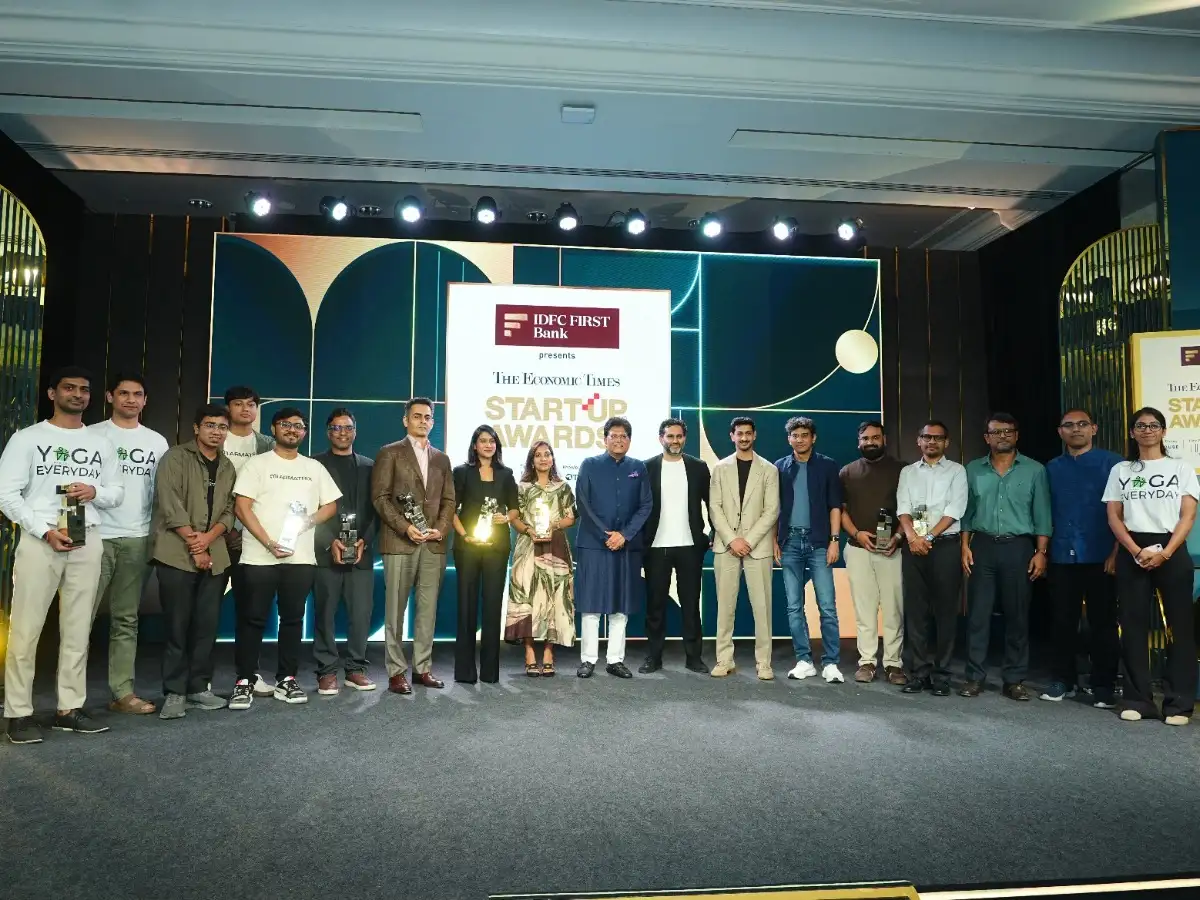
The 12th edition of The Economic Times Startup Awards celebrated India’s evolving entrepreneurial landscape. While the nation now hosts 250,000 registered startups, commerce minister Piyush Goyal noted the journey is only beginning. "We have only just begun," he said, highlighting the massive untapped potential waiting in the deeptech sector.
The 12th edition of The Economic Times Startup Awards (ETSA) captured this transition, reflecting an ecosystem that has moved beyond the race for scale to pursue technological depth, durable businesses and international markets.
More than a decade after India's startup ecosystem took its first steps, its entrepreneurial journey is entering a new phase, with a growing crop of founders tackling complex problems in deeptech and hardtech, and homegrown companies tapping the public markets as well as pursuing global ambitions.
The 12th edition of The Economic Times Startup Awards (ETSA) captured this transition, reflecting an ecosystem that has moved beyond the race for scale to pursue technological depth, durable businesses and international markets.
That breadth was evident in this year's Startup of the Year nominees, which included AI startup Sarvam, ecommerce marketplace Meesho, satellite launch vehicle maker Skyroot, wealthtech platform Groww, urban mobility service Rapido and logistics company Porter.
An 11-member jury, chaired by Wipro executive chairman Rishad Premji, named Groww the winner, recognising its ability to sustain rapid growth while turning profitable at scale.
Speaking to a gathering of more than 300 of the most influential names in India's startup and technology industry, commerce and industry minister Piyush Goyal, the guest of honour at the awards, pointed to the gap between the scale of the country's startup ecosystem and its untapped potential.
Even with about 250,000 registered startups, he said, the journey was only beginning, particularly in deeptech, where the number of significant startups remains small. "We have only just begun," said the minister. "In fact, in the deeptech space, there are only a few thousand startups of significance. We have a long way to go."
His remarks reflect a broader shift in an ecosystem, where the aspiration is increasingly to build companies that can compete internationally, rather than simply serve India's growing consumer base.
The early years of the startup boom were dominated by ecommerce, consumer internet and digital services, but founders are taking on problems in sectors that demand deeper technological capabilities, longer investment horizons and greater spending on research and development.
Many prominent voices from the industry concurred.
Kalyan Krishnamurthy, chief executive of Flipkart group, termed India's startup ecosystem one of the most dynamic stories of this time. "It keeps growing in ambition, in scale and in the problems it takes on," he said. "Founders, investors, operators and customers are all building on each other's progress. ETSA does an important job in celebrating that journey and the entrepreneurs driving it."
PhonePe cofounder and chief executive Sameer Nigam said India's startup landscape had widened dramatically over the past decade, with innovation spreading well beyond its early strongholds.
"We started with companies largely focused on consumer technology and ecommerce," he said. "Today, we are seeing startups working in deeptech, agritech, robotics and foundational technologies. The ET Startup Awards reflect that innovation taking place across the country."
Razorpay cofounder and CEO Harshil Mathur, whose company was Startup of the Year at ETSA 2022, said the strength of this year's field showed how far Indian entrepreneurship had come. "Each of them was outstanding, and choosing a winner must have been extremely difficult. It shows how far the ecosystem has come. Ultimately, the ecosystem wins when more companies do well," he said.
Manu Chandra, founder and managing partner at venture capital firm Sauce, won the Midas Touch award for distinguished early-stage consumer investing. Online yoga platform Habuild was named Bootstrap Champ, while climatetech startup Varaha won the Social Enterprise award.
For the first time, the Woman Ahead category had joint winners, with the jury picking Palmonas cofounder and CEO Pallavi Mohadikar and Progcap cofounder and chief executive Pallavi Shrivastava. Deeptech startup Theranautilus won the Top Innovator award, Armatrix was named Best on Campus startup, and Mukund Jha, cofounder of vibe-coding startup Emergent, was the Comeback Kid.
The next chapter
Discussions in Bengaluru on Friday also made it clear that global ambition will define the ecosystem's next phase. "Let's get out of the cosy comfort of the large Indian opportunity or Indian market. Let us think of going global, because those who will not go global will be left behind," Goyal said.
India's lower cost structure is an advantage, but it cannot make up for inferior technology, Dheemanth Nagaraj, cofounder and CEO of AI semiconductor startup Agrani Labs, said during a panel discussion on building the hard stuff.
Moderated by Accel founding partner Prashanth Prakash, the panel also included Kshitij Khandelwal, cofounder and CTO of spacetech startup Pixxel, and Laina Emmanuel, cofounder and chief executive of BrainSight AI.
"At the end of the day, the technology we use is state of the art. There's no other way to penetrate the market," Nagaraj said, arguing that a cheaper but substandard product would not work.
For the ecosystem's next phase of growth, however, access to capital and viable exit routes will be critical. In a fireside chat, Groww cofounder and CEO Lalit Keshre said capital was available for companies that needed it, but valuations remained a key consideration for private market investors.
Meesho cofounder and chief executive Vidit Aatrey said global late-stage investors, many of whom have been focused on AI in recent years, would return to India as they reassess opportunities across markets. "Late-stage funds have been comparing opportunities across the globe... and we all know the last two to three years have been about AI. I believe they will come back to India and it will happen very soon," he said.
Serial entrepreneur K Ganesh said three developments were reinforcing one another -- investors were more willing to back founders for longer, public markets were accepting new-age companies that continued to invest for growth, and entrepreneurs were taking on harder problems in sectors such as semiconductors, space, defence and energy. "Every successful IPO gives investors a reason to fund the next deeptech company," Ganesh said.
The Economic Times Startup Awards were presented by IDFC First Bank, with workspace partner Indiqube, knowledge partner Tracxn and hospitality partner The Leela Palace, Bengaluru.