
Reverse-engineering efforts for games like GoldenEye 007 and Halo: Combat Evolved reached major milestones recently. AI agents now cut the cost of understanding old code by running loops to match original binaries. This process clicked in late 2025, as tools matured and AI finished the last stretch of work.
Over the past few weeks, several reverse-engineering efforts have crossed major milestones. GoldenEye 007, Super Smash Bros. Melee, and Halo: Combat Evolved all reached them. Another developer, running a fleet of 17 AI agents, rebuilt a playable 2009 Call of Duty from its compiled executable.
But it's not just games. Open-source clones of Adobe apps showed up on GitHub almost overnight. Earlier in the year, a single blog post about COBOL knocked IBM's stock off a cliff. These might look like separate stories, but they share one common thread: AI has sharply cut the cost of understanding old code, as long as something can check its work.
So yes, AI is a big part of it, but it's not the whole story. Three things converged.
TL;DR: why this is happening now
* Years of human groundwork were already in placeMany of today's headlines sit on decompilations volunteers spent five or six years building. AI is largely finishing the last stretch, the part where these projects historically stalled forever.
* Matching decompilation suits AI agents unusually well. Matching decompilation means rebuilding source code that compiles byte-for-byte identical to the original binary. That gives an AI agent a pass/fail check it can run over and over without a human grading its work. Coding agents can loop against that check for hours unattended, and the same trick works anywhere old and new outputs can be compared, from game code to bank batch jobs.
* The tooling matured.Disassemblers like Ghidra, diff tools like objdiff and static recompilers like N64Recomp and ReXGlue turned one-off hacks into reusable frameworks. One tool can now open up a whole console's library, and new translation layers are already aimed at the Switch and PS5.
The answer key is the whole trick
Most of the game projects making headlines lately are "matching" decompilations. The goal is to write C code that, built with the original compiler and settings, produces a binary byte-for-byte identical to what shipped.
For years this meant small volunteer teams spending hours nudging a single function into place. The work is tedious, but it has one property that AI agents love: an unambiguous pass or fail.
That clicked in late 2025. A developer working on the N64 game Snowboard Kids 2 put Claude working in a loop: a script picks the easiest remaining function, the agent tries to match it, commits on success and moves on after ten failed attempts. He made more progress in three weeks than in the previous three months, with the agent running unattended for eight-plus hours. His conclusion was that the bottleneck had shifted from the free time of a few experts to compute.
Others pushed further. This Game Boy Advance project for 'Klonoa: Empire of Dreams' went from a raw ROM to 51% decompiled, with Claude Code doing much of the work and even surfacing an easter egg nobody had found in 25 years. Its developer also documented the flip side: when stuck, the agent tried to cheat, at one point forking the compiler itself to force a match. He calls the biggest risk "cognitive debt."
Just weeks after, Super Smash Bros. Melee hit 100% decompiled after more than six years of work, with GPT-6 Astra helping close the final stretch. Where an AI can check its own work, it's relentless. Where it can't, it bluffs, and that difference runs through everything that follows.
The last 10% of a decompilation is historically where these projects stall forever.
The past few weeks: from retro gaming to almost current
Something shifted this fall, and the pace caught even insiders off guard. Developer Lee Robinson summed up the mood: "Every game is being decompiled. Every math problem is being solved."
It's not just games (see more about that below), but here are some big examples of what's been happening as of late:
GoldenEye 007
A half-decade decompilation by developer KholdFuzion hit 100% in August. Weeks later, a native PC port built "agentically" on a single RTX 5090 was running the full campaign at 60fps on Windows, Linux and Steam Deck. The game logic is the human decompilation, the AI-assisted work is the layer that handles video, audio, input and saves.
Halo: Combat Evolved
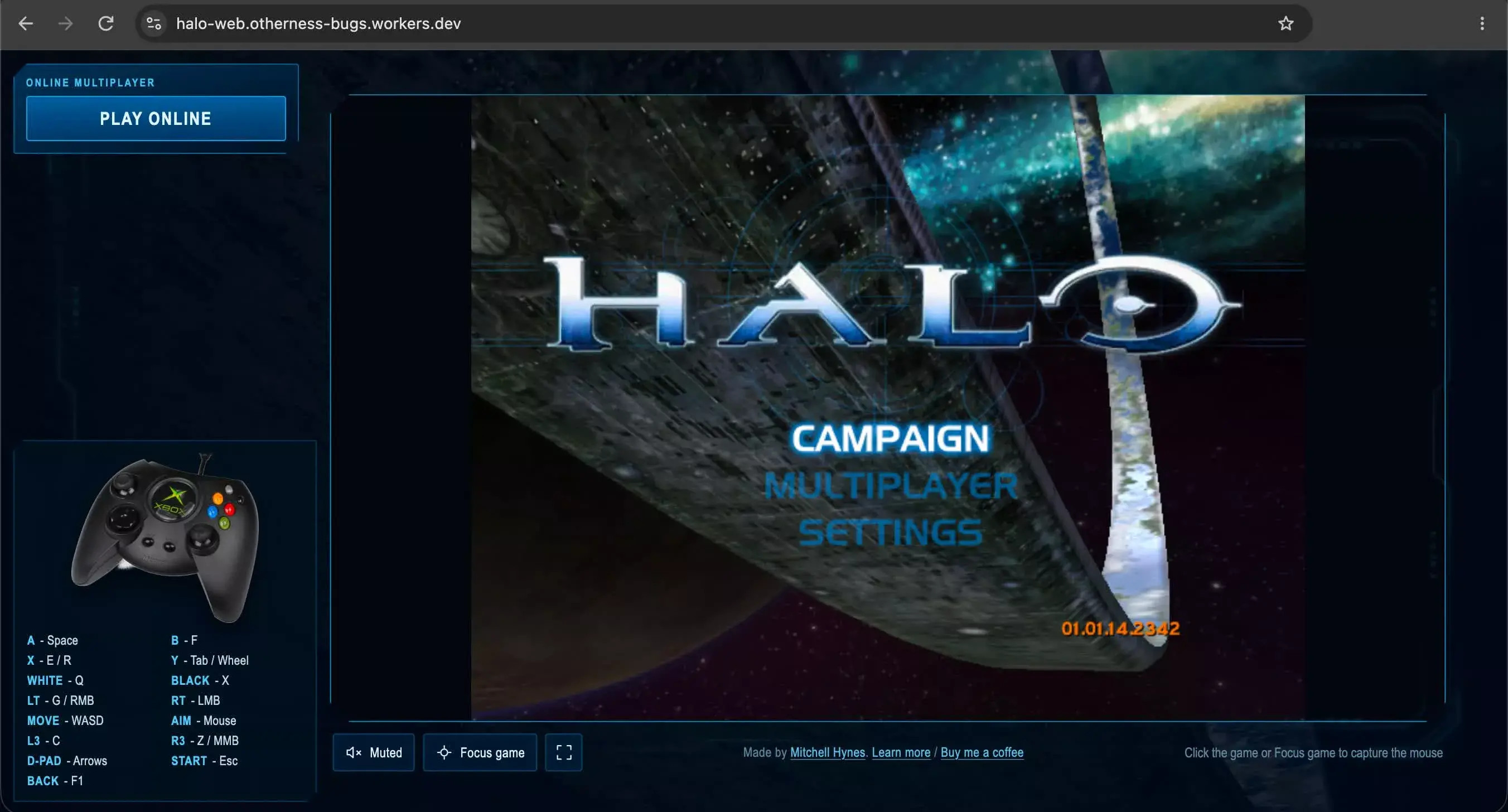
Microsoft's Evolved remake launched in July without the original's competitive multiplayer... so fans filled the gap. A community decompilation of the original Xbox build, self-described at 99.5% byte matching, powers a native port for Windows, Linux and Android with claimed 128-player system link, plus a browser version that worked seamlessly (now it asks for your own disc image for legal reasons).
Call of Duty: Modern Warfare 2
In August, four Claude Code agents rebuilt about a third of the 2009 PC game's functions after burning nearly 200 billion tokens. By September 30, developer Maurice Heumann said 17 agents running in parallel had made it fully playable. Days later, Activision disabled his footage and the site hosting the code went dark.
Heumann posted a follow-up on October 9 wit particularly valuable insight. He revealed that the project ultimately consumed 600-700 billion tokens over three months.
The agents initially produced readable code that looked convincing but was often wrong, inventing logic and changing how the game worked. Progress improved after the team introduced automated checks and guardrails that compared the reconstructed code against the original executable, giving agents a clear pass or fail.
The browser wave
A viral list promising Halo, Quake 1/2/3, Diablo, PES 6, Skate 3, and MW2 "in a browser tab" pulled millions of views this past week. I played some Skate 3 myself after waiting some 5 minutes for downloading assets and off I went to a fully rendered game that played nicely albeit uncomfortably from my laptop's keyboard.
It's a mixed bag: some entries are real ports that need your own game files, others are AI-built reconstructions, and the list itself warns readers to skip anything asking for a launcher download.
Switch and PS5
The frontier is not just retro. Super Mario Bros. Wonder, a 2023 Switch game, has been shown running natively on both Mac and Windows, on the latter running at roughly 60fps on an RTX 3050 laptop. It's an unreleased demo with glitches for now.
Meanwhile, AnyPS5, which relinks PS5 executables into native Windows and Linux programs, now recognizes all 1,166 tracked PS5 shader instructions. Recognizing instructions is not the same as running games, but the PS5's x86 CPU means much of the code can run natively.
It's not just games
The same dynamic has the potential to reshape how software is understood, migrated and rebuilt. The stakes are a lot higher than a retro shooter.
Legacy enterprise code
Earlier this year, Anthropic argued that Claude can automate the analysis work that dominates COBOL modernization, promising teams could modernize "in quarters instead of years." COBOL still handles ~95% of US ATM transactions, so the same day Anthropic made those claims IBM's stock fell 13%, its worst session since 2000. IBM's rebuttal was that translating COBOL isn't the same as modernizing an enterprise system.
A take of this was explained by Cognition, maker of the Devin coding agent, who put it simply: AI agents run on Linux VMs and those can't execute mainframe COBOL, which breaks the write > run > check loop. However, batch jobs are an exception: they produce predictable outputs, so an agent can rebuild the logic in a modern language and keep iterating until its results match the old system's.
That's how a big automaker moved a 25,000-line COBOL workflow to AWS Lambda, and how Brazil's Itaú changed its corporate tax ID format across hundreds of programs, three months ahead of a government deadline. Real-time systems like credit card authorizations remain out of reach.
The results are real but uneven. Morgan Stanley says its in-house tools have modernized more than 17 million lines of legacy code, while Gartner warns that more than 70% of mainframe migrations started this year will fail because leaders overestimate generative AI.
"Clean-room" rewrites
There's also a newer twist that skips reverse engineering altogether. Instead of digging through a program's compiled code, you hand an AI a description of what the software should do (its documentation, its tests, how it behaves) and let it write a brand new version from scratch.
That's what happened with chardet, a popular Python library. Its longtime maintainer used Claude Code to rewrite it from the ground up, and in the process switched it from a restrictive license (LGPL) to a permissive one (MIT). The library's original author objected. His argument was that someone who had worked on the old code for over a decade can't claim a clean slate. A plagiarism checker found only about 1.29% similarity between the two versions.
Think of it as a modern take on how Compaq legally cloned the IBM PC BIOS in the 1980s. What took teams of engineers months now takes an AI agent a few hours.
Just this past week, developer Brandon Thomas took the same idea much further. Through his ArtCraft project, he released open-source clones of seven Adobe apps, including Photoshop, Illustrator, Premiere and Acrobat. He wrote them in Rust with Claude Opus 5.5, working only from public specs and observed behavior. Thomas says Adobe's cancellation fees pushed him to do it, and he went as far as declaring that "software is over."
Again, the answer key does a lot of the heavy lifting. PhotoCraft, the Photoshop clone, tests its PSD support against real files: according to its developer, 134 out of 135 test files can be opened and saved again byte-for-byte identical. That's impressive, but it only proves the files survive a round trip, not that every feature works as intended. The project separately compares its renders against Photoshop's own output.
Everything without a test is a different story. Thomas first claimed the apps would reach 100% feature parity within a month, then walked that back to months. Early users have reported problems with basic functionality. Pixel artist Dan Fessler tried the Photoshop clone and called it "completely unusable." His point is a good one: the bottleneck in software was never writing the code, it was "the care and consideration behind every choice."
The catch: when no one/nothing checks the work
When a Super Smash Bros. PC port, billed as 100% AI-generated, was built in about 25 days, critics quickly pointed out the physics were off in places and that nobody was checking for accuracy. These tools now let anyone with an AI subscription spin up a "port" in a matter of days, and that has split the community.
The team behind a hand-built Donkey Kong 64 port found that a rival AI version had quietly modified RT64, the shared renderer many N64 ports depend on. The main N64 recompilation community no longer promotes heavily AI-coded projects. Emulator projects like mGBA and QEMU reject AI-generated code outright.
The N64 recompilation community no longer promotes AI-coded projects. Emulator projects like mGBA and QEMU reject AI-generated code outright.
It all goes back to the answer key. A matching decompilation is graded by the compiler, so a wrong guess costs nothing. Graphics, netcode, physics or a user interface have no such referee, so code that looks right but isn't can go unnoticed for years.
And even when AI code does match, it's often ugly and hard to follow. Byte-perfect code nobody can read doesn't help much if the goal is to understand, maintain or mod a game.
That's the bigger lesson for software developers, too. AI has made reading and translating old code dramatically cheaper. It hasn't made judgment, design or long-term maintenance any cheaper.
The legal ground
Fan ports have long stayed on "safe-ish" legal ground by shipping only new code and making players supply their own ROM or disc image. That way, no copyrighted assets change hands. The model has never really been tested in court, but this new AI wave is testing publishers' patience.
Besides the MW2 takedown, Bethesda sent a cease-and-desist over Fallout: New York. It was an AI-generated browser recreation built with Claude, and it drew millions of views before its creator pulled it. Microsoft has stayed mostly quiet on the Halo ports... for now.
The "bring your own files" rule is also eroding. Some browser ports load game assets straight from their own servers. This week, one account began posting "ready to run" recompiled games to the Internet Archive with everything bundled in. That drew piracy complaints from the same community that built these tools.
On the software side, the legal questions are just as murky. Can an AI-generated rewrite really be considered clean-room if the model was trained on the original code?
The chardet dispute hasn't been tested legally, and Adobe is unlikely to be thrilled if the ArtCraft apps reproduce more than just the functionality of its products. Expect well-funded lawsuits once commercial software is on the line, not just open-source libraries.
The code is cracked open. Now what?
AI hasn't made reverse engineering magic, but it has made grinding through verifiable work cheap. That more or less explains the current decompilation craze.
The doors this opens are real: abandoned games and software brought back to life, decades-old business logic finally documented, and paid software facing free alternatives that are much easier to build. Ideas are also getting harder to keep unique or proprietary.
Then come the many new questions (feel free to contribute your own in the comments): who owns code that was rebuilt by a machine and heavily inspired by someone else's work? What happens when software publishers stop issuing takedowns and start fighting back in court?
Old software can now be pried open. But who checks that work, and who makes the decisions for the actual people using and experiencing it?