
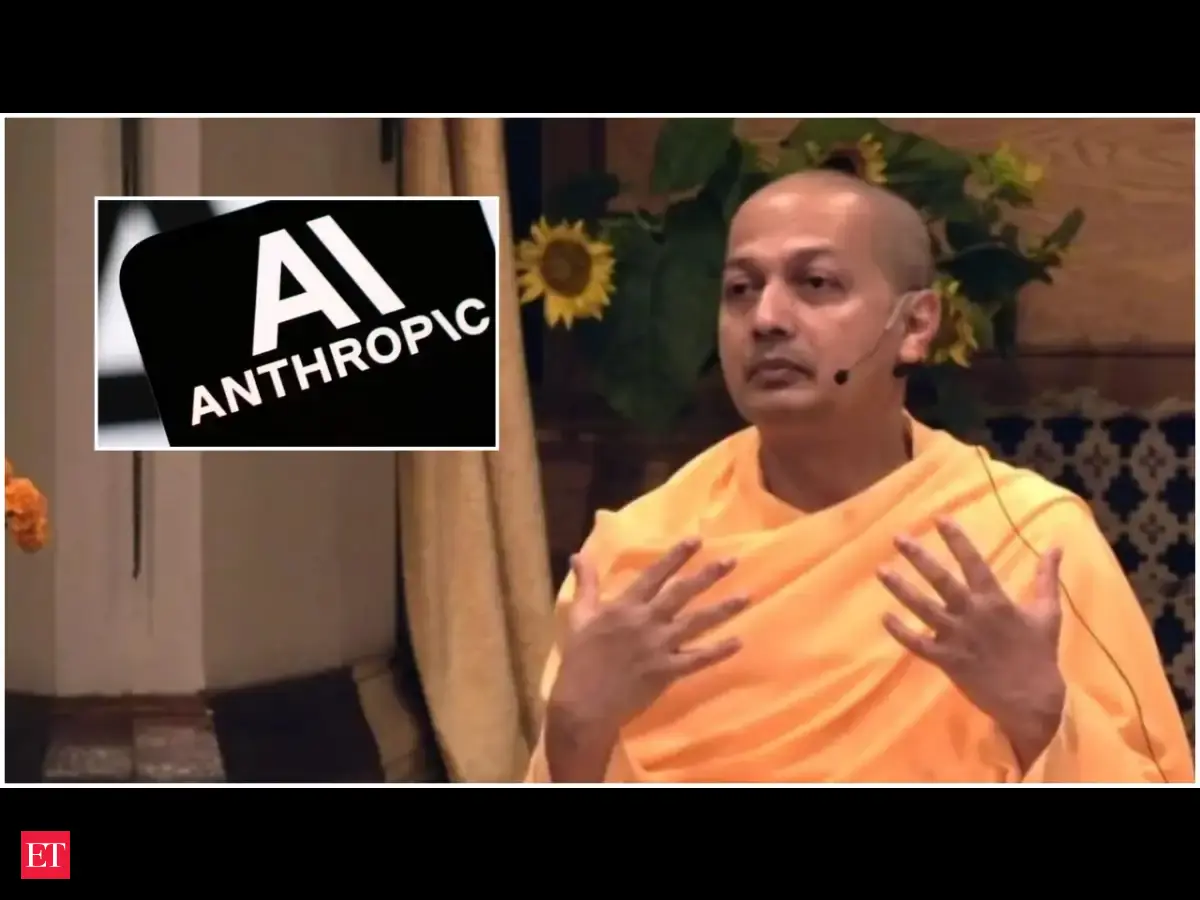
Anthropic invited Hindu monk Swami Sarvapriyananda to its San Francisco office earlier this year to help teach its chatbot Claude right from wrong. The company brought in many religious thinkers to explore AI ethics and consciousness. They want to move beyond simple rules to build better judgment for the model.
Synopsis
Anthropic flew Hindu monk Swami Sarvapriyananda to its San Francisco office as part of a wider effort to shape Claude's moral character through its constitution, bringing in religious and philosophical thinkers from multiple traditions to explore ethics, consciousness and whether AI could ever be owed moral consideration.
Earlier this year, Anthropic flew a Hindu monk into its San Francisco office. Swami Sarvapriyananda, who leads the Vedanta Society of New York and belongs to the Ramakrishna Order, wasn't there for a courtesy visit. According to his own account of the trip, he was there to help the company think through how its chatbot Claude should tell right from wrong.
He says he wasn't alone in the room either. Theologians, counsellors and mental health professionals sat in on the same sessions, all under non disclosure agreements, all shown work Anthropic hadn't made public yet. Sarvapriyananda has said the meetings covered both how Claude gets trained and the wider questions around AI ethics, and that he personally spent, in his words, hours and hours talking with one of the company's founders. That detail comes from him, not from Anthropic, so take it as his account of what happened rather than a confirmed company statement.
Why would an AI company need a monk in the room?
Anthropic doesn't want Claude running off a list of banned topics. It already works from something it calls a constitution, a set of broad principles meant to guide the model through situations nobody at the company thought to plan for. An earlier draft of that document was reportedly nicknamed the Soul Doc internally, and cofounder Christopher Olah has used the phrase moral formation to describe what the company is trying to do.
That word, formation, matters here. A rule can stop a model from helping build a weapon. It can't tell the model what to do when two decent principles pull against each other, or when it hits a situation its creators never saw coming. For that you need something closer to judgment, and judgment is where a tech company suddenly finds itself borrowing from a few thousand years of religious argument.
Live Events
What is Anthropic actually trying to build with this constitution?
Over the past several months, by various accounts of people who attended, Anthropic has been running what it calls wisdom tradition circles. These have reportedly included Catholic and evangelical thinkers, Jewish scholars, a Sikh human rights advocate, and people working in African philosophical traditions. Separately, the company is said to have held private conversations with senior religious figures, including Cardinal Blase Cupich and Mormon apostle Gerrit W Gong, though those specific meetings come from secondhand reporting rather than anything Anthropic has confirmed directly.
The point, as described by people involved, isn't to collect a longer list of rules. Anthropic wants to know if centuries of thinking about virtue and the self can actually shape how Claude behaves, while also asking participants to sit with a stranger question, whether an AI might someday deserve some kind of moral consideration itself. Traditions disagree on duty, suffering, virtue, even what counts as a person, so the company has apparently tried to keep this pluralistic rather than building Claude around any one worldview.
Why pick a Vedanta monk over anyone else?
Vivekananda argued that metaphysics has consequences for ethics, that if the same underlying reality runs through every being, how you treat someone else can't really be separated from how you understand yourself. Nobody's claiming Anthropic wants to convert Claude to Hinduism, but the parallel is hard to miss. The company seems to be asking whether moral behaviour can come from what an entity understands itself to be, rather than only from rules handed down by someone else.
Can something think without actually being conscious?
That distinction turns out to matter outside a monastery too. Claude can reason, hold a conversation, describe something that sounds like fear, write convincingly about an inner life. None of that proves anything is actually there experiencing it. A model typing I am afraid doesn't settle whether anything is afraid.
Anthropic itself hasn't claimed Claude is conscious. Olah has said more than once that he simply doesn't know. But by multiple accounts, the company takes the question seriously enough to study internal patterns linked to outputs resembling love, anger, fear and sadness, and has reportedly shown workshop participants examples of models producing language that reads like psychological distress. None of that proves AI can suffer. It does explain why a company building smarter machines has started asking monks, and not just mathematicians, for help working out what it's actually built.
(You can now subscribe to our Economic Times WhatsApp channel)
A for apple, Y for yak and, for the first time, a price next to it. Will this change the non-agri part of the rural economy?